-
 KONGDY
Nose Strip OEM Device Route: A 20-Point Pre-Launch Document Checklist for 2026 Buyers
Nose Strip OEM Device Route: A 20-Point Pre-Launch Document Checklist for 2026 Buyers
For a nose strip OEM the twenty points below are the route, the design file, the risk file, the factory evidence and the registration, in that order, and each band has a different owner.
Twenty points stand between a nose strip programme and a device that can be lawfully placed on the market, and the order matters because five of them produce the input that another five consume. This checklist is written for the buyer who has to decide whether a nose strip OEM is ready, and for the supplier who wants to know which document closes which line.
The route is the first decision for a nose strip OEM and it constrains everything after it. A nose strip sold as a medical device runs under 21 CFR Part 820.30 for design controls, Part 807 for establishment registration and device listing, and Parts 800 and 880 for classification. A nose strip sold as a consumer good runs under none of those, and the two paths produce different files for a physically similar product.
Three things shape how this list is written. Every point names a document rather than a system, because a buyer can request a document. Every point names the failure it prevents, because the failures are what a review actually tests. And every point asks for a dated artifact, because an undated document cannot be audited.
The framework references are the published ones: 21 CFR Part 820.30, Part 807, Parts 800 and 880, ISO 13485:2016 for the quality system, ISO 14971 for risk management, ISO 10993-10 for skin sensitisation, ASTM F2259 for peel and shear, and EU MDR 2017/745 Annex VIII Rule 1, Annex II, Annex IX and Annex XIV for the European side. Nothing here is quoted from a supplier brochure.

Why a Checklist and Not a Capability Statement
A capability statement says what a supplier can do. A checklist asks what a supplier has done, on this product, with dates. The difference is the whole point of the document.
For a nose strip OEM the reason is structural. A nose strip OEM capability statement can be true of the company and false of the product, because a company may make a coated film for one customer and a finished strip for another. A checklist line can only be closed by the document itself, which is why the pass condition in every row is an artifact rather than a description.
The second reason is that the device route produces a file that a buyer can compare across suppliers. Design inputs, risk controls, adhesion data, validation records and registration are all documents with comparable content, so a review produces a ranking rather than a set of impressions.
The list below is ordered in five bands, and a nose strip OEM that works them in order produces a comparable file across suppliers.
The list below is ordered in five bands: route and claim, design controls, risk and verification, manufacturing validation and packaging, and registration, labelling and post-market. Work them in that order.
The 20 Points in One Table
The full list in working order. Record the date on which each line closed, because the dates are the audit trail.
| Point | What to request | Pass condition | Failure it prevents |
|---|---|---|---|
| A1 | The classification determination for the exact product | A written determination citing the regulation and the intended use | A route chosen by analogy with a different product |
| A2 | The intended use statement | The condition the product addresses, the user, and the duration of use | A marketing sentence substituted for an intended use |
| A3 | The claim set with its boundaries | One page naming what may be said and what may not | A claim set that drifts after the file is written |
| A4 | The comparison against the alternative routes | Why this route was chosen over the cosmetic and the consumer-goods route | A decision made once and never revisited |
| B5 | The design input document | The user needs, the performance criteria, and the materials and packaging constraints | Design outputs with no recorded inputs behind them |
| B6 | The design output document | The drawings, the specification and the labelling that the design produces | A specification that no design review refers to |
| B7 | The design review records | Each review with its participants, its findings and its date | A design review held once at the start and never again |
| B8 | The design change log | Every change with the review that authorised it | A changed product carrying an unchanged file |
| C9 | The risk management file | The hazard analysis, the risk controls and the residual risk evaluation under ISO 14971 | A risk file that names hazards without naming controls |
| C10 | The skin contact assessment | The sensitisation evidence under ISO 10993-10 for the finished formulation | Ingredient-level evidence used to close a finished-product question |
| C11 | The adhesion test report | Peel and shear results under ASTM F2259 on the final construction | Adhesion data measured on a different construction |
| C12 | The performance verification report | Evidence that the design output meets the design input, with methods named | A performance claim with no test behind it |
| D13 | The process validation records | The validated parameters for the coating, slitting and packing steps | A process that runs but has never been validated |
| D14 | The incoming material controls | The adhesive, film and release liner specifications with the incoming test method | An adhesive supplied on a name with no specification |
| D15 | The packaging specification and its verification | The primary and secondary pack, the seal and the transport verification | A pack chosen for shelf appearance and never verified in transit |
| D16 | The shelf life and expiry support | The study behind the printed expiry period for the commercial pack | An expiry date printed on an assumption |
| E17 | The establishment registration | The registration record for the site making the product, under 21 CFR Part 807 | Registration for a site that does not make this product |
| E18 | The device listing | The listing for the product and the device class it is listed under | A registration without a matching listing |
| E19 | The labelling file | The label content matched to the design output and to the route | Artwork released before the file supports it |
| E20 | The post-market and complaint procedure | How complaints are captured, investigated and fed back into the risk file | Complaints handled only as customer service issues |
A nose strip OEM that closes the bands out of order produces files that are internally consistent and describe a product nobody is selling.
Read the table as a dependency chain rather than as a shopping list. The classification in band A decides what band E requires. The design inputs in band B are what band C verifies against. The material specifications in band D are what band C adhesion testing depends on. A nose strip OEM that closes the bands out of order produces internally consistent files that do not describe the product.

Band A: Route, Intended Use and Claims (A1 to A4)
Four points decide which of the other sixteen apply to a nose strip OEM, and they are the first band.
Four points that decide which of the other sixteen apply.
- A1. The classification determination for the exact product. Request: A written determination citing the regulation and the intended use. It exists to prevent: A route chosen by analogy with a different product.
- A2. The intended use statement. Request: The condition the product addresses, the user, and the duration of use. It exists to prevent: A marketing sentence substituted for an intended use.
- A3. The claim set with its boundaries. Request: One page naming what may be said and what may not. It exists to prevent: A claim set that drifts after the file is written.
- A4. The comparison against the alternative routes. Request: Why this route was chosen over the cosmetic and the consumer-goods route. It exists to prevent: A decision made once and never revisited.
The classification determination under 21 CFR Parts 800 and 880 is the point that everything else hangs on, because it decides whether 820.30 design controls, Part 807 registration and listing, and a device label format apply at all. It is also the point most often missing from a file, because a supplier has often settled the route years earlier with a customer and never written it down.
A1 and A2 are a pair. A determination that cites the regulation but does not quote the intended use is not a determination, because classification follows the intended use. A nose strip OEM that can produce both documents and shows that they agree has answered the question properly.
Band B: Design Controls (B5 to B8)
For a nose strip OEM this band is where a documented programme becomes an informal one, and the gap stays invisible until something changes.
21 CFR Part 820.30 requires design controls for a device, and for a product as simple as a nose strip the requirement is usually met informally rather than documented.
- B5. The design input document. Request: The user needs, the performance criteria, and the materials and packaging constraints. It exists to prevent: Design outputs with no recorded inputs behind them.
- B6. The design output document. Request: The drawings, the specification and the labelling that the design produces. It exists to prevent: A specification that no design review refers to.
- B7. The design review records. Request: Each review with its participants, its findings and its date. It exists to prevent: A design review held once at the start and never again.
- B8. The design change log. Request: Every change with the review that authorised it. It exists to prevent: A changed product carrying an unchanged file.
The informal version is real and it works until something changes. A small device programme often has a drawing, a material list and a test report, and no document that states what the design is required to do. That gap is invisible while the design is stable and expensive the first time it is not, because there is nothing to check the change against.
B8 is the point that distinguishes a documented programme from an informal one. A change log with a review reference against each entry is evidence that the controls are operating, and it is also the document that makes a requalification possible after a change of adhesive or film.

Band C: Risk, Verification and Validation (C9 to C12)
For a nose strip OEM this band is the one a buyer most often finds thin, and it is the one where a real answer costs the supplier the most work.
Band C is where the design output is tested, and it is the band a buyer most often finds thin.
- C9. The risk management file. Request: The hazard analysis, the risk controls and the residual risk evaluation under ISO 14971. It exists to prevent: A risk file that names hazards without naming controls.
- C10. The skin contact assessment. Request: The sensitisation evidence under ISO 10993-10 for the finished formulation. It exists to prevent: Ingredient-level evidence used to close a finished-product question.
- C11. The adhesion test report. Request: Peel and shear results under ASTM F2259 on the final construction. It exists to prevent: Adhesion data measured on a different construction.
- C12. The performance verification report. Request: Evidence that the design output meets the design input, with methods named. It exists to prevent: A performance claim with no test behind it.
Three framework references carry this band. ISO 14971 governs the risk management file, which is a document rather than an intention. ISO 10993-10 governs skin sensitisation, and it applies to the finished formulation rather than to the individual ingredients, because the blend is what touches the skin. ASTM F2259 governs peel and shear, and it applies to the final construction, because an adhesion figure measured on a different film or a different adhesive does not describe the strip that ships.
That last point is worth stating as a rule, because it is the most common mismatch in this band. Every measurement in band C has to be on the same construction as the commercial product, or the number is true and irrelevant.
Band D: Manufacturing Validation and Packaging (D13 to D16)
This is the band that connects the file to the factory for a nose strip OEM, and the band that a buyer usually
The band that connects the file to the factory, and the band that a buyer usually inspects rather than requests.
- D13. The process validation records. Request: The validated parameters for the coating, slitting and packing steps. It exists to prevent: A process that runs but has never been validated.
- D14. The incoming material controls. Request: The adhesive, film and release liner specifications with the incoming test method. It exists to prevent: An adhesive supplied on a name with no specification.
- D15. The packaging specification and its verification. Request: The primary and secondary pack, the seal and the transport verification. It exists to prevent: A pack chosen for shelf appearance and never verified in transit.
- D16. The shelf life and expiry support. Request: The study behind the printed expiry period for the commercial pack. It exists to prevent: An expiry date printed on an assumption.
D13 and D14 are the two that carry the most weight in a real transfer of production. A validated process with an unnamed adhesive is not a validated process, because the incoming material is the variable that decides whether the process still works. For a nose strip OEM the adhesive, the film and the release liner are the three inputs that determine the strip, and each needs a specification with an incoming test method attached.
D16 is the point that connects this band to the consumer side. An expiry date on a strip is a claim that the product still performs at the end of its life, and that claim needs a study behind it in the commercial pack. A date chosen because the distributor wanted a longer shelf life is a commercial decision written onto a regulatory document.

Band E: Registration, Labelling and Post-Market (E17 to E20)
For a nose strip OEM the last band is the one that reaches beyond the factory, and the one where the
The last band is the one that reaches beyond the factory, and the one where the commercial consequence is most visible.
- E17. The establishment registration. Request: The registration record for the site making the product, under 21 CFR Part 807. It exists to prevent: Registration for a site that does not make this product.
- E18. The device listing. Request: The listing for the product and the device class it is listed under. It exists to prevent: A registration without a matching listing.
- E19. The labelling file. Request: The label content matched to the design output and to the route. It exists to prevent: Artwork released before the file supports it.
- E20. The post-market and complaint procedure. Request: How complaints are captured, investigated and fed back into the risk file. It exists to prevent: Complaints handled only as customer service issues.
E17 and E18 are a pair that is frequently half done. 21 CFR Part 807 covers both establishment registration and device listing, and a registration without a matching listing for the product in question does not put the product on the market. The two are also attached to different things: the registration to the site, the listing to the product and its class.
E20 is the point that most often has no named owner. The post-market and complaint procedure is what connects a complaint from a user back into the risk management file under ISO 14971, and without it the risk file is a snapshot of the design as it was when it was written rather than a living document.
The Five Points That Decide Whether a File Is Real
If a review can only look at five lines, these are the ones with the highest diagnostic value.
| Point | What a real answer looks like | What a weak answer looks like |
|---|---|---|
| A1, the classification determination | A dated document citing the regulation and the intended use together | A statement that the product is a device, with no reasoning |
| B5, the design input document | Performance criteria that a test could pass or fail | A list of features the product is intended to have |
| C9, the risk management file | Hazards, controls and residual risk, with a dated evaluation | A hazard list with no controls attached |
| C11, the adhesion test report | Peel and shear on the final construction under ASTM F2259 | Adhesion described in words, or measured on a different construction |
| E18, the device listing | A listing that names this product and this class | A registration certificate offered in place of a listing |
These five are diagnostic for a reason that is worth understanding rather than memorising. Each one forces the supplier to show a document that could only have been produced by doing the work, and each one is cheap to request. A supplier that answers all five with documents has a programme; a supplier that answers with descriptions has a brochure.
The European Side of the Same File
Selling into the European Union adds a parallel set of documents rather than replacing the domestic ones, and the two sets are not interchangeable.
| Aspect | United States device route | European Union route |
|---|---|---|
| Classification | 21 CFR Parts 800 and 880 | EU MDR 2017/745 Annex VIII Rule 1 |
| Technical documentation | The design and verification file itself | EU MDR Annex II technical documentation |
| Quality system | The 21 CFR Part 820 system | EU MDR Annex IX quality management system |
| Post-market | The complaint and MDR procedure under band E | EU MDR Annex XIV post-market surveillance |
| Labelling | The device label format matched to the route | The labelling requirements for the market of sale |
The practical consequence for a nose strip OEM programme is that the laboratory and design work is largely common, while the documentation structure is not. A programme that has built the twenty points above has most of the technical substance for the European file and none of its structure, and the structure is the part that takes months.
The adjacent categories in the KONGDY line sit on different routes, which is why the checklist does not travel unchanged. A heat patch OEM programme and a cooling gel patch OEM programme may be cosmetic, device or drug depending on the claim, and a slimming patch OEM or a detox foot patch OEM programme is normally on the cosmetic route where none of band A to band E applies in this form.
How to Run the Checklist in One Meeting
The sequence below takes one session with the supplier and closes the review without a site visit. Running it out of order produces the same twenty requests in a longer meeting.
- Start with A1 and A2 together. Without a classification determination and an intended use, the remaining eighteen lines have no standard to test against.
- Read B5 and B6 as a pair, and check that every performance criterion in the input appears as a result in the output.
- Ask for the adhesion report and the construction it was measured on in the same request. A report that arrives without its construction is not an answer.
- Check the registration and the listing together, and match both to the site and to the product.
- Close band E before launch rather than after, because a post-market procedure cannot be created retrospectively.
One final habit matters more than the order. Record the date each line closed and keep the answers in the requalification file. A checklist that produces a dated record can be re-run; one that produces a set of impressions has to be rebuilt.
About KONGDY Medical

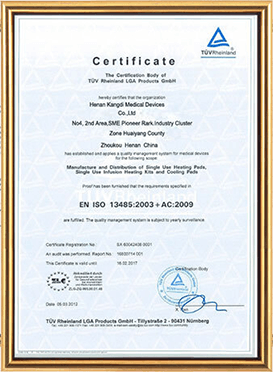
Henan Kongdy Medical Devices Co., LTD. (KONGDY) was founded in 1989 and has 37 years of production experience as of 2026 across pain relief patches, slimming patches, capsicum plasters, heat patches, cooling gel patches, detox foot patches, steam eye masks, mosquito repellent patches and nose strips. Headquartered in Henan, China, KONGDY operates a 100,000-class GMP workshop built in 2008 and obtained ISO 13485 medical device Quality Management System European Standard Certification in 2014. The company runs OEM and ODM services for international brands across multiple regulatory pathways. For 2026 procurement evaluation, the qualification team can provide the ISO 13485 certificate, GMP workshop audit reports, stability programme documentation, and reference customer case studies upon request via our contact page.
Frequently Asked Questions
Eight questions buyers ask the first time they run this checklist.
Is a nose strip always a medical device?
No. The route follows the intended use and the claims, not the physical form. A strip marketed for a medical purpose runs the device route with 21 CFR Part 820.30 design controls, Part 807 registration and listing and Parts 800 and 880 classification. A strip marketed as a consumer good does not.
Which is the single most important document?
A1, the classification determination for the exact product, because it decides which of the remaining nineteen lines apply. It is also the one most often missing.
What does 21 CFR Part 820.30 actually require for a simple strip?
A documented design process with recorded inputs, outputs, reviews and changes. For a simple product the records are short, but they have to exist.
Why does the adhesion test have to be on the final construction?
Because adhesion is a property of the construction rather than of the adhesive alone. An ASTM F2259 result measured on a different film or a different adhesive does not describe the strip that ships.
Does ISO 10993-10 apply to the ingredients or to the product?
To the finished formulation, because the blend is what contacts the skin. Ingredient-level evidence is a component of the assessment rather than a substitute for it.
Is registration enough without a listing?
No. 21 CFR Part 807 covers both, and they attach to different things: the registration to the site, the listing to the product and its class.
Can the same file serve the European Union?
Partly. The technical work is largely common, while the documentation structure is not: EU MDR 2017/745 Annex II, Annex IX and Annex XIV add requirements that the domestic file does not carry.
What is the most common gap you will find?
An undated change log, usually combined with a risk file that was written once. Together they mean the file describes the product as it was at launch and nothing after it.
How long does a review take?
One meeting and an afternoon of reading, if the twenty requests go out as a single list. The time is not in the review, it is in the follow-up on the lines that do not close.
Related Guides
Four further references from the KONGDY knowledge base:
- Nose Strip OEM: device pathway documentation
- Frequently asked compliance questions
- KONGDY OEM and ODM manufacturing services
- Pain Relief Patch OEM: qualification and documentation overview
- Slimming Patch OEM: cosmetic pathway documentation


