-
 KONGDY
Steam Eye Mask OEM Heat Output and Classification: 12 Questions Buyers Ask Before Signing in 2026
Steam Eye Mask OEM Heat Output and Classification: 12 Questions Buyers Ask Before Signing in 2026
A steam eye mask OEM can describe the iron powder mixture and the moisture content of a sachet in detail, and the buyer still needs to know how hot the product gets, where it gets used, and which framework follows from the answer.
For a steam eye mask OEM the heat question comes first because it narrows everything else.
A steam eye mask OEM programme is ready to sign when the file answers the heat question, the route question and the file question, and the twelve questions below are the order in which those three get answered.
Each answer below opens with the shortest defensible answer and then gives the reasoning and the published text behind it. Where the framework does not answer the question precisely, the answer says so rather than supplying a figure that sounds authoritative.
The heat standard that matters here is ASTM F2871, which sets a peak temperature at or below 50 degrees Celsius for self-heating products. That single number governs a surprising amount of the programme, because it decides what the product may be called, how long it may be used, and which claims the label can carry. The other references used below are ASTM F2259 for peel and shear, ISO 14971 for risk management, ISO 10993-10 for skin sensitisation, ISO 13485:2016 for the quality system, 21 CFR Parts 800 and 880 and Part 807 for the United States device route, and EU MDR 2017/745 Annex VIII, Annex II, Annex IX and Annex XIV for Europe.
The order of the twelve follows how a buyer actually asks them: heat first, then classification, then testing, then the file. A programme that answers question one well has already narrowed the other eleven.
1. How hot is a steam eye mask allowed to get?
The peak temperature is capped at 50 degrees Celsius under ASTM F2871, and that cap is the single most consequential number in the whole product category.
A steam eye mask OEM that has the profile on the finished product in the commercial pack can answer four separate buyer questions from one report.
A self-heating sachet produces heat by oxidising iron in the presence of water and salt, and the mixture is tuned to reach a target rather than a maximum. A mixture designed for a body warmer and a mixture designed for an eye mask are the same chemistry with different targets, and the eye target is lower because the product sits over the eye.
Three consequences follow for a steam eye mask OEM programme. The peak temperature decides the wear time, because the useful output is bounded by the time before the mixture exhausts. It decides the labelling, because the instructions have to describe a use pattern consistent with the heat the product produces. And it decides the claims, because a temperature claim is a measurable claim that the buyer will check against the test report.
The measurement itself belongs in the file, not in a brochure. A steam eye mask OEM that states a temperature without a dated report under ASTM F2871 has stated a target rather than a result.

2. Is a steam eye mask a medical device or a consumer product?
For a steam eye mask OEM the route question is the one that is usually settled informally.
It depends entirely on the intended use and the claims, and a self-heating product can sit on either side of that line.
| Claim in the marketing | Route implication | What it drags in |
|---|---|---|
| Relieves eye strain, relieves tired eyes, relieves puffiness around the eyes | A therapeutic claim, which points to the medical device route | A determination under 21 CFR Parts 800 and 880, design controls under Part 820.30, registration and listing under Part 807 |
| Warming, relaxing, soothing, comfortable heat | A comfort claim, which may stay on the consumer route | A general product safety frame, consumer labelling, and no device file |
| Relieves eye strain as a medical claim, and warming as a comfort claim | The stronger claim governs the route | The device route, with the comfort language written to fit inside it |
The third row is the one that catches programmes out. Adding a comfort benefit to a therapeutic claim does not produce a product with two lighter frameworks; the therapeutic claim sets the route and the comfort language has to live inside it.
A steam eye mask OEM that cannot show a written determination for the exact product is a supplier who has settled the question informally, and the buyer inherits the question rather than the answer.
3. What does ASTM F2871 actually test?
A steam eye mask OEM that reports the peak alone has reported the number a buyer can check against a limit and not the number that describes the product.
It sets the safety envelope for self-heating products, and the peak temperature limit of 50 degrees Celsius is the part most buyers know.
The other part matters just as much commercially, and it is that the measurement has to be on the finished product in its final pack. A sachet measured loose on a bench and a sachet inside a folded eye mask do not reach the same temperature, because the pack changes how the heat leaves the product.
That is the same principle that runs through the rest of a device file. A test on the wrong configuration is not a conservative result; it is a result about a different product. For a steam eye mask OEM the configuration is not an academic detail, because the eye mask shape is what a buyer will actually receive.
The practical request is therefore precise: the report under ASTM F2871, on the finished product in the commercial pack, with the temperature profile rather than a single peak figure, because the profile tells the buyer how long the useful output lasts.

4. How long does a steam eye mask stay warm?
A steam eye mask OEM that states a duration without a profile behind it has stated a marketing number, and the two behave very differently the moment a customer tests the product.
For as long as the chemistry sustains it, which is a property of the mixture and the pack rather than a marketing number, and it should come from the same report as the peak temperature.
The reason to ask for the profile rather than the claim is that a stated duration is a measurable assertion. A buyer that receives "8 hours" with no profile behind it has received a number to repeat rather than a specification to build on, and the two behave very differently when the product is tested by a customer.
A steam eye mask OEM that supplies the temperature profile also supplies the evidence for the wear instruction, the number of sessions a pouch supports, and the claim wording. One measurement answers four questions, which is why the request is worth making precisely.
5. What testing does the skin need?
The product contacts the skin around the eye, so a steam eye mask OEM needs skin sensitisation evidence under ISO 10993-10, not ingredient-level data.
The product contacts the skin around the eye, so the finished formulation needs skin sensitisation evidence under ISO 10993-10, not ingredient-level data.
The distinction is the same one that applies to every transdermal and wear-contact product, and it is the most common shortcut in this category. The blend is what touches the skin, so the assessment describes the blend. Ingredient-level evidence is a component of that assessment rather than a substitute for it.
Two features of this particular product make it more than a formality. The skin around the eye is thin and is the skin people report reactions on first, and the product is usually worn without the user reading anything beyond a short instruction. A steam eye mask OEM that has only ingredient-level evidence is relying on the customer to be the first to discover a blend effect.
The other side of the question is the risk file. ISO 14971 governs the risk management record, and a heat product has risks that a cool product does not, which is the subject of the next question.

6. What risks does a self-heating product carry that a cooling one does not?
For a steam eye mask OEM the second risk is the one that decides whether the instructions are written by a technician or by somebody who has thought about it.
Three that are specific to heat: a burn risk from the peak temperature, a burn risk from prolonged contact after the useful output has ended, and a risk from use on damaged or insensate skin.
The second one is the subtle one, and it is where a risk file earns its keep. A product that has produced its heat for twenty minutes does not stop being warm, and the instruction has to say so. A heated eye mask programme whose risk file addresses only the peak temperature has addressed the first risk and left the second one unowned.
The third risk is the one that changes the claim set rather than the instructions. A product marketed for use on tired eyes is not a product a user will apply to skin that is numb or cut, and a risk file that records this produces label wording that a marketing team will then have to work within.
A practical structure for a warm eye mask OEM is to treat the temperature profile as a risk control rather than as a product spec. The control has a limit, the limit has a source, and the source has a test.
7. Does the eye area change the testing?
The cheapest route to keeping the consumer framing is to keep the claims at the level of comfort and warmth, and the most expensive mistake is to let a marketing sentence raise the claim without raising the file with it.
It changes the risk assessment and the instructions, and it does not change the test standard itself.
The eye area changes the severity and likelihood assumptions in the risk file under ISO 14971, and the length of time the product is in contact with the skin.
ASTM F2871 and ASTM F2259 apply to the product whatever it is used on. What the eye area changes is the severity and likelihood assumptions in the risk file under ISO 14971, and the length of time the product is in contact with the skin.
It also changes the claims in a way that is worth stating plainly, because it is a commercial consequence rather than a technical one. Any wording that positions the product as treating an eye condition rather than providing warmth pulls the product onto the device route, and the device route brings 21 CFR Part 820.30 design controls, Part 807 registration and listing, and a device label format with it.
For a self-heating eye mask the cheapest route to keeping the consumer framing is to keep the claims at the level of comfort and warmth, and the most expensive mistake is to let a marketing sentence raise the claim without raising the file with it.
8. Is a steam eye mask regulated in the European Union?
For a steam eye mask OEM the European question is a documentation question, because the product and the tests are already the same.
Only if the claim puts it there, and if it does, the EU MDR 2017/745 file is materially larger than the domestic one.
| Element | Consumer route | EU MDR device route |
|---|---|---|
| Classification | General product safety obligations | Annex VIII Rule 1 applied to the intended purpose |
| Technical documentation | Not a formal EU MDR requirement | Annex II technical documentation |
| Quality system | A good practice rather than a legal file | Annex IX quality management system |
| Post-market | General product safety obligations | Annex XIV post-market surveillance and vigilance |
| Labelling | General consumer labelling rules | The labelling requirements for the market of sale |
The technical work is largely common between the two, because the product is the same and the tests do not change. The documentation structure is not common at all, and that is where the months go. A eye mask manufacturer that has already built the test file has most of the substance for the European file and none of its structure.

9. What does the buyer ask for in the file?
A steam eye mask OEM that answers all five with documents has a programme, and one that answers with descriptions has a brochure.
A steam eye mask OEM buyer who collects the five documents in question nine has, without asking for anything else, most of what a technical review would ask for, and the difference between collecting them and being told about them is the difference between a review and a conversation.
Five documents, and each one is a document rather than a description.
- The classification determination for the exact product. The intended use and the regulation cited together, dated.
- The ASTM F2871 report on the finished product in the commercial pack. The full temperature profile, not a peak figure alone.
- The risk management file under ISO 14971. Hazards, controls and residual risk, including the risks that come from heat rather than from chemistry.
- The skin sensitisation assessment under ISO 10993-10 on the finished formulation. The blend, not the ingredients.
- The peel and shear report under ASTM F2259 on the final construction. The shipped product, not a sample of the film.
Those five are diagnostic rather than complete, and the reason is worth understanding. Each one forces a supplier to produce a record that could only have been made by doing the work, and each one is cheap to request. A heated eye mask programme that answers all five with documents has a programme; a supplier that answers with descriptions has a brochure.
10. What is the most common gap in a steam eye mask file?
A steam eye mask OEM with a real programme answers the configuration question immediately, because the configuration is part of how they describe their own product.
The configuration mismatch: a test performed on a different construction from the one that ships.
It appears in three places and it is the same error each time. Heat measured on a loose sachet rather than in the folded pack. Adhesion measured on the film rather than on the finished mask. Sensitisation assessed on the components rather than on the blend. In each case the number is real and it does not describe the product.
The second most common gap is the risk file, and it has a recognisable shape. The hazards are listed, the controls are missing, and the file was written once. A warm eye mask OEM whose risk file has not been updated since the formula changed is running the risk assessment for a product it no longer makes.
Both gaps are visible to a buyer who asks one question: on what configuration was this measured. A supplier with a real programme answers immediately, because the configuration is part of how they describe their own product.
11. Who signs the file off?
A steam eye mask OEM whose file is signed by the quality function with a dated record naming the configuration is re-qualifiable after a change, and one without it has to be rebuilt.
The quality function, and the record is a dated one that names the product, the configuration and the documents it covers.
ISO 13485:2016 places responsibility for the quality system on the organisation, and a self-heating product puts the organisation at the centre of a hazard that is visible and measurable. A file signed by production alone is a commercial position, not a quality decision, and it will not survive the first reviewer who asks who accepted the temperature limit.
The practical benefit of a signed record is that it makes the file checkable against the product. A self-heating eye mask that has one dated document naming the formula revision, the pack and the test configuration can be re-qualified against it after a change. One without it has to be rebuilt.
12. What is the shortest defensible steam eye mask file?
A classification determination, a temperature profile on the finished product, a risk file that addresses heat, and a skin assessment on the blend.
| Component | The minimum version | Why it is defensible |
|---|---|---|
| Route | One determination with the intended use attached | It fixes every other requirement in the file |
| Heat evidence | The temperature profile on the commercial pack | It supports the wear instruction, the claim and the risk control at once |
| Risk | Hazards, controls and residual risk, dated | It covers the risks that heat creates rather than only the risks chemistry creates |
| Skin | ISO 10993-10 on the finished formulation | The blend is what contacts the skin |
| Sign-off | One dated record naming the configuration | It makes the file re-qualifiable rather than a one-off document |
The heat elements are specific to self-heating products, and the file structure is not.
Short is not the same as cautious, and this is the case where the distinction is clear. The file above is short because each element does several jobs, and every one of those jobs is a question a buyer or a reviewer will eventually ask.
The same structure applies to a heat patch OEM programme and to a nose strip OEM programme on the device route, with the framework swapped at the classification step and the rest unchanged. The heat elements are specific to self-heating products, and the file structure is not.
About KONGDY Medical

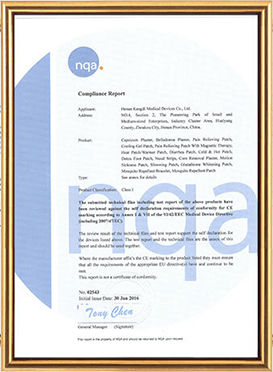
Henan Kongdy Medical Devices Co., LTD. (KONGDY) was founded in 1989 and has 37 years of production experience as of 2026 across pain relief patches, slimming patches, capsicum plasters, heat patches, cooling gel patches, detox foot patches, steam eye masks, mosquito repellent patches and nose strips. Headquartered in Henan, China, KONGDY operates a 100,000-class GMP workshop built in 2008 and obtained ISO 13485 medical device Quality Management System European Standard Certification in 2014. The company runs OEM and ODM services for international brands across multiple regulatory pathways. For 2026 procurement evaluation, the qualification team can provide the ISO 13485 certificate, GMP workshop audit reports, stability programme documentation, and reference customer case studies upon request via our contact page.
Related Guides
Four further references from the KONGDY knowledge base:
- Nose Strip OEM: device pathway documentation
- Frequently asked compliance questions
- KONGDY OEM and ODM manufacturing services
- Heat Patch OEM: qualification and documentation overview
- Cooling Gel Patch OEM: regulatory categories and stability evidence


