-
 KONGDY
When the Laboratory Is Somebody Else: 12 Questions for a Heat Patch OEM Releasing Batches Through a Third-Party Laboratory in 2026
When the Laboratory Is Somebody Else: 12 Questions for a Heat Patch OEM Releasing Batches Through a Third-Party Laboratory in 2026

A warning letter issued on 14 April 2026 records that a manufacturer of topical analgesic products told the agency it does not perform finished product testing, and that its response to the inspection was to say it had contracted a third-party laboratory to do the work.
The letter does not reject that answer. It sets out five things it wants instead, and the fifth of them is the one that decides whether the arrangement is a control or a delegation.
That fifth item asks for the name, the address and the supplier qualification report of the third-party laboratory that is conducting the release testing. The agency accepts the arrangement and treats the laboratory as a supplier that has to be qualified like any other.
For a heat patch OEM the arrangement is not unusual. A contract manufacturer of a self-heating patch often does not run a chemistry laboratory, and the release testing is placed with an outside laboratory against a specification the manufacturer wrote.
The twelve questions below are what has to be answerable on the day an inspector asks. They are written in the order the letter asks them, because the order is the order in which the evidence is normally missing.
1. Is releasing a batch through an outside laboratory allowed at all?
Yes. The letter sets out what a firm has to do when it uses one, and the list does not include a prohibition.
That is the useful thing about this case, because it settles a question many manufacturers ask internally and rarely get a written answer to.
| What the letter accepts | What the letter requires alongside it |
|---|---|
| Contracting a third-party laboratory to perform full release testing | A comprehensive independent assessment of laboratory practices, procedures, methods, equipment, documentation and analyst competencies |
| Implementing finished product specifications | A list of chemical and microbial specifications including the test methods |
| Certificates of analysis from that laboratory | The name, the address and the supplier qualification report for the laboratory |
| A standard operating procedure for identity, strength, purity and microbial testing | A detailed remediation plan and an evaluation of the effectiveness of the laboratory system |
The third row is the one that is easy to overlook, because a certificate from a laboratory feels like the finished product. It is not. The certificate is the output of one batch, and the qualification is the evidence that the next batch will be tested the same way.
A heat patch OEM that has a laboratory, a specification and a signed service agreement has three of the five. A heat patch OEM that has the three and has never qualified the laboratory has answered the question that was asked.
2. What exactly does the supplier qualification report have to cover?
The letter asks for the report itself, and the detail it asks for elsewhere in the document defines what it has to contain.
The laboratory assessment is required to cover practices, procedures, methods, equipment, documentation and analyst competencies. That list is the answer, because it is the agency describing what it considers to be a laboratory.
| The element in the assessment | The question behind it |
|---|---|
| Practices and procedures | Does the laboratory work to written instructions that are the same for every client |
| Methods | Are the methods appropriate to what is being measured, and are they the ones the specification names |
| Equipment | Is the instrumentation suitable and is it maintained and calibrated |
| Documentation | Does the laboratory keep the raw data behind every certificate it issues |
| Analyst competencies | Has the person who signs the result been shown to be able to produce it |
The fifth row is the one that separates a laboratory from a testing service. A laboratory that employs people who have been shown to do the work produces a result that can be defended; a service that forwards a sample to somebody else produces a certificate.
A heat patch OEM should ask the laboratory for its qualification report on the same terms it would expect from any other supplier, and should read the analyst competency section first.
3. What has to be in the finished product specification?
The attributes and the limits and the methods, and the letter asks for all three by name.
The required list is a list of chemical and microbial specifications including test methods used to analyse each batch before a batch disposition decision. The letter separately states that drug product batches must be tested for identity, strength, quality and purity before release.
| The attribute | What the specification has to fix |
|---|---|
| Identity | Which active ingredient, and which test establishes it |
| Strength | The permitted range, as a number, not as a description |
| Purity and impurities | Which degradation products and at what limit |
| Microbiological attributes | Where the product requires it, and the limit and the method |
| The method | A named method the laboratory can run and the specification can cite |
The second row is where most specifications are weakest, and it is the one the letter singles out. A specification that says strength should conform to its label has not fixed a limit, and a limit that is not fixed cannot be judged against.
For a heat patch OEM the practical version is that the specification has to be written before the laboratory is engaged, because a laboratory asked to develop a method and a specification at the same time is being asked to write the acceptance criteria for the work it is being paid to do.
4. Is a certificate of analysis from the laboratory enough?
No, because a certificate reports a batch rather than a method.
The letter treats the certificate as one element of a response rather than as the determination itself, and the reason is visible in what it asks for in parallel: the specifications with methods, the assessment of the laboratory, and a plan for retrospective testing.
| What the certificate establishes | What it does not establish |
|---|---|
| That a particular batch gave particular results | That the method was appropriate for the specification |
| That the laboratory issued it | That the laboratory was qualified to issue it |
| The results on the retain sample | That the raw data behind the results exists and is retrievable |
The third row of the second column is the gap that an inspection finds and a buyer rarely does. A certificate is a summary, and the summary is only as good as the records behind it.
A heat patch OEM that wants to be able to answer the question should hold two things for each lot: the certificate, and the raw data and the method that the certificate summarises.
5. What does the letter mean by a laboratory assessment, and why independent?
A comprehensive assessment of the laboratory, conducted independently, with a detailed plan to remediate and to evaluate the effectiveness of the corrected laboratory system.
The word that carries the weight is independent, and it is the same word the agency used in another letter in this library, where it required a comprehensive independent review of the material system and of laboratory practices, procedures, methods, equipment, documentation and analyst competencies.
| The element | Why the letter separates it |
|---|---|
| The assessment itself | It has to be done by somebody other than the laboratory, for the same reason the agency does not accept a firm assessing its own system |
| The remediation plan | The assessment identifies what is wrong, and the plan is the firm response |
| The evaluation of effectiveness | A plan is not evidence that the plan worked, and the letter asks for the evidence separately |
The third row is the part that separates this requirement from most quality commitments. A firm can produce a plan, a plan can be implemented, and neither fact tells an inspector whether the laboratory now produces reliable results.
A heat patch OEM that has commissioned an independent assessment and has kept the effectiveness check has answered all three, and a heat patch OEM that has commissioned the assessment and stopped there has answered one.
6. What has to happen to the batches that were already distributed?
A retrospective retain testing programme with an action plan and timelines, and a commitment that the letter found missing.
The firm in this case stated that it had contracted a third-party laboratory and implemented specifications, a procedure and testing, and the letter still found the response inadequate partly because it did not commit to retrospective testing of retains for batches already distributed in the United States market.
| The element | What it requires |
|---|---|
| The action plan and timelines | When the retain testing will be done and how it will be resourced |
| The scope | All batches of drug product distributed to the United States that are within expiry as of the date of the letter |
| The method | Full chemical and microbiological testing, not a spot check |
| The summary | A summary of all results obtained from testing retains from each batch |
| The consequence | Rapid corrective action such as notifying customers and product recalls if substandard quality is found |
The third row is the one that turns the exercise from a filing into a safety activity, and it is the row a firm with an outside laboratory tends to treat as optional because the batches are already gone.
A heat patch OEM that has kept retains for every batch can complete this exercise. A heat patch OEM that has not has a retrospective requirement it cannot satisfy, and that is a finding waiting to happen.
7. How are the retains themselves handled?
A written procedure describing how retains are maintained for each batch manufactured at the facility, and the letter asks for the procedure.
| The element | What the procedure has to settle |
|---|---|
| Scope | Every batch manufactured at the facility, not a sample of them |
| Quantity | How much is retained, which is set by the stability protocol |
| Storage conditions | Where and at what temperature the retain lives |
| Retention period | How long, and what happens at the end of it |
| Identification | That the retain can be traced to the batch and to the material used to make it |
| Availability | That it can be produced on request, which is what the retrospective exercise depends on |
The fifth row is where a self-heating patch is no different from any other product, and it is worth saying so plainly. A retain that cannot be traced to the batch and to the material used in it is a sample in a cupboard, and it cannot support a retrospective investigation of either.
A heat patch OEM that keeps its retains for the stability period, traced to the batch, has the one piece of evidence that makes the retrospective exercise possible at all.
8. What about the components, if the laboratory is doing the testing?
The same requirement applies, and it is a separate one, because the incoming material and the finished product are tested by different parties.
21 CFR 211.84(d)(1) requires at least one test to verify the identity of each component, and 211.84(d)(2) requires the firm to validate and establish the reliability of a component supplier test analyses at appropriate intervals. In this case the firm manufactured over-the-counter topical analgesic drug products without adequate assurance of the quality of raw materials and did not test incoming components such as active pharmaceutical ingredients for identity before use.
| The material | Who tests it | What is required |
|---|---|---|
| Incoming active ingredient | The receiving firm, or a qualified supplier under a reliability programme | At least one identity test per lot, plus validation of the supplier result |
| Incoming other components | The same | The same, and conformity with written specifications for purity, strength and quality |
| Finished product | The third-party laboratory | Identity, strength, quality and purity, plus microbial attributes where the product requires them |
The third row is the separation that matters. Outsourcing the finished product testing does not outsource the component testing, and a firm that has moved the first and quietly dropped the second has opened a gap in the middle of its own process.
A heat patch OEM should check both sides separately, and a heat patch OEM whose component identity testing is done by the same laboratory that does the release testing should confirm that the two are qualified as separate suppliers rather than as one.
9. What the arrangement looks like when it is done properly
There is a version of this arrangement that survives an inspection without difficulty, and it is worth setting out because it is not the version most firms build by accident.
| Element | What done properly looks like | What it replaces |
|---|---|---|
| A written specification written first | Attributes, limits and named methods, approved before any laboratory is engaged | A laboratory asked to develop a method and a limit at the same time |
| A qualified laboratory | A named laboratory with a supplier qualification report covering practices, procedures, methods, equipment, documentation and analyst competencies | A laboratory chosen on price and speed |
| An independent assessment with a follow-up | A dated assessment, a remediation plan, and a later effectiveness check | A certificate of good standing standing in for an assessment |
| Retains kept and traceable | A procedure covering every batch, traceable to the batch and to the material used in it | A sample cupboard that nobody has opened |
| A retrospective programme ready to run | The plan written before it is needed, with the scope defined by what is within expiry | A scramble after a letter arrives |
The fifth row is the one that is hardest to arrange and the easiest to regret. A retrospective programme that exists before anything goes wrong can be executed in weeks; the same programme designed after a letter arrives is designed under a deadline set by somebody else.
For a heat patch OEM the five rows together are the difference between having delegated the testing and having delegated the responsibility. The testing is the easy part, and it is the part most firms stop at.
10. The question a buyer asks that this arrangement answers badly
A buyer who wants to know whether a heat patch was tested before it shipped cannot easily find out, and the reason is worth stating because it is a property of the arrangement rather than a failing of any one party.
The determination sits with the laboratory, the specification sits with the manufacturer, the disposition decision sits with the manufacturer, and the batch record links the three. That chain is sound. It also means that the document a buyer would ask for is three documents in three places, and that the place where the answer is assembled is not the place where the test was performed.
| What a buyer asks for | Where the answer actually lives | Why it is hard to assemble |
|---|---|---|
| The assay result for this lot | With the laboratory | It arrives as a certificate, and the certificate is a summary |
| The specification it was judged against | With the manufacturer | The copy a buyer receives is usually the finished specification, not the one in force at the time |
| The release decision | With the manufacturer | It is in the batch record, and the batch record may not travel with the goods |
| The raw data | With the laboratory | It is retained by the laboratory under its own procedures and is not normally offered on request |
The second row is the one with a practical fix that costs nothing. A manufacturer that keeps the specification version in force on the date of each batch, with the laboratory method reference against it, has made the answer assembleable.
A heat patch OEM that does that can answer a buyer from its own files, and a heat patch OEM that does not has to ask its laboratory, which takes weeks and produces a document rather than an answer.
About KONGDY Medical

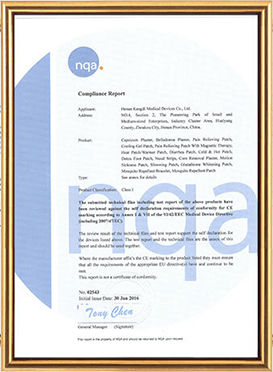
Henan Kongdy Medical Devices Co., LTD. (KONGDY) was founded in 1989 and has 37 years of production experience as of 2026 across pain relief patches, slimming patches, capsicum plasters, heat patches, cooling gel patches, detox foot patches, steam eye masks, mosquito repellent patches and nose strips. Headquartered in Henan, China, KONGDY operates a 100,000-class GMP workshop built in 2008 and obtained ISO 13485 medical device Quality Management System European Standard Certification in 2014. The company runs OEM and ODM services for international brands across multiple regulatory pathways.
For a 2026 procurement evaluation the qualification team can supply the ISO 13485 certificate, GMP workshop audit reports, stability programme documentation, and reference customer case studies upon request via our contact page.
Frequently asked questions
Is it acceptable to release batches using a third-party laboratory?
The letter does not prohibit it. It requires a comprehensive independent assessment of the laboratory practices, procedures, methods, equipment, documentation and analyst competencies, a detailed remediation plan and an evaluation of the effectiveness of the laboratory system, the procedures for retains, the specifications with methods, the retrospective testing commitment, and the name, address and supplier qualification report for the laboratory.
What did the firm in this letter say about its own testing?
That it does not perform finished product testing. The letter records the statement directly, and it is a different position from the case in this library where a firm said it tested every batch and could produce no records when asked.
Why was the response inadequate when the firm had engaged a laboratory?
Because it did not provide sufficient details about the test methods and specifications implemented for the over-the-counter drug products, and because it did not commit to retrospective testing of retains for batches already distributed in the United States market. The letter also records the general ground, that the response failed to provide supportive documentation for evaluation or adequate evidence of corrective actions taken.
Does the contract with the laboratory discharge the obligation?
No. A contract establishes an arrangement, and the letter asks for evidence that the laboratory is competent and that the methods are appropriate for the specification. A heat patch OEM that has a signed agreement and no qualification report has discharged the commercial step and not the regulatory one.
What is the single most common failure in this arrangement?
Moving the finished product testing outside while leaving the component identity testing unstated. It is easy to do because the two feel like one activity, and the 21 CFR 211.84(d) obligation does not move with the release testing.
Does the letter say anything about how long the laboratory assessment takes?
No, and no published text in this library states a period for it. What the letter does state is that a remediation plan has to be accompanied by an evaluation of the effectiveness of the corrected laboratory system, which is the step that cannot be compressed by putting more people on it.
Why does the letter ask for the laboratory name and address at all?
Because the firm that answers the letter is the firm that answers the agency, and the laboratory is the party that produced the evidence the firm is relying on. A heat patch OEM that cannot name the laboratory that released its batches has described an arrangement it cannot audit.
Does this apply to a device product?
The provisions quoted here are from the drug manufacturing framework, and they apply to a product marketed as a drug. A product on the device route is governed by the device quality system requirements instead, but the underlying question is the same one: who is qualified to produce the evidence, and can the record be reproduced.
Related Guides
Five further references from the KONGDY knowledge base:
- Cooling Gel Patch OEM: the glycerin and DEG questions
- Detox Foot Patch OEM: the 20-point change control checklist
- Frequently asked compliance questions
- KONGWY OEM and ODM manufacturing services
- Pain Relief Patch OEM: the homeopathic label in twelve questions


