
-
 KONGDY
The Same Three Products, Two Platforms and a Manufacturer: What FDA Warning Letter 736557 Shows a Cooling Gel Patch OEM in 2026
The Same Three Products, Two Platforms and a Manufacturer: What FDA Warning Letter 736557 Shows a Cooling Gel Patch OEM in 2026
On 1 October 2026 the Center for Drug Evaluation and Research issued warning letter MARCS-CMS 736557 to Walmart, Inc., addressed to John Furner as President and Chief Executive Officer, and delivered by electronic mail with a read receipt requested.
The letter concerns three products that FDA purchased from www.walmart.com in July 2026. All three also appear in another warning letter issued the same day, and two of them also appear in letters to the firms that make them.
That is the reason this letter is worth reading as a case rather than as a list of findings. It is the first document in this library that shows the same labelling problem recorded against three different parties at once, and a reader can see from it exactly where responsibility sits and where it does not.
For a cooling gel patch OEM the useful output is a map of the chain, because a firm selling through a marketplace is inside a chain with more parties in it than a firm selling direct, and each party is reached by a different kind of evidence.
1. The facts, exactly as the letter states them
The identification facts come first, and the two addresses and two email routes are worth noticing.
| Item | What the letter states |
|---|---|
| Letter | MARCS-CMS 736557, dated 1 October 2026 |
| Firm | Walmart, Inc. |
| Recipient | John Furner, President and CEO |
| Address | 702 SW 8th Street, Bentonville, AR 72716-6299 |
| Contact given | HWSCSAFETY@wal-mart.com |
| Issuing office | Center for Drug Evaluation and Research |
| Signed by | Tina Smith, M.S., Captain, United States Public Health Service, Director, Office of Unapproved Drugs and Labeling Compliance, Office of Compliance |
| Delivery | By electronic mail, read receipt requested |
| How the finding arose | FDA purchased the products on www.walmart.com in July 2026 and reviewed the labelling |
| Products | HClear for him, Herstat GST, Terragen HG Formula |
| Response period | Fifteen business days, to FDAAdvisory@fda.hhs.gov |
The fifth row is worth a moment. A separate safety address rather than a general legal one is a small indication that the firm treats these letters as a distinct workstream, and a cooling gel patch OEM that is asked to supply a similar address is being asked to acknowledge that the correspondence has a home.
The seventh row is the one that will be used below. The same person signed the letter issued to Amazon on the same date, from the same office, about three of the same products.
2. The three products and the four letters
This is the structural finding, and it is the first time this library can show it.
| Product | Manufacturer letter | Amazon letter | Walmart letter |
|---|---|---|---|
| HClear for him | None held | 736006, 1 October 2026 | 736557, 1 October 2026 |
| Herstat GST | 718720, Sinsin Pharmaceutical | 736006, 1 October 2026 | 736557, 1 October 2026 |
| Terragen HG Formula | 735346, Aidance Scientific | 736006, 1 October 2026 | 736557, 1 October 2026 |
Read down the Terragen column and the same product appears in three letters addressed to three different parties. Read across the Terragen row and the same product appears in the same letter addressed to a manufacturer and to two platforms on the same day.
The conclusion is the one the letters themselves support and it is a narrow one. The labelling problem is a single event. It is recorded against the firm that made the product and against each party that handled it, and the reason a platform can be named is set out in the next section.
For a cooling gel patch OEM the practical reading is that a claim-level problem does not stay in one register. It is visible in the manufacturer file and in the platform files at the same time, and a cooling gel patch OEM that corrects only its own label and not the listing it appears on has corrected one of three records.
3. Why a platform can be named at all
The mechanism is the fulfilment service, and the letter establishes it by quoting the platform own description of it.
The footnote records that the products were distributed directly to individual United States consumers on behalf of third parties and were fulfilled by Walmart, and then quotes the company page: the service allows marketplace sellers to use end-to-end logistics from imports to storage to fulfillment, and when a customer places an order the platform will pick, pack and ship the item on the seller behalf and handle all customer support and returns.
| What the fulfilment service does | What that makes the platform |
|---|---|
| Imports and storage | The holder of the goods before dispatch |
| Pick, pack and ship | The last physical handler before the consumer |
| Customer support | The visible party in every complaint |
| Returns | The party that receives goods back from consumers |
| Consequently | A party that introduced the products for introduction into interstate commerce, which is what the statute prohibits |
The last row is the reasoning, and it is the same reasoning in the letter issued to Amazon the same day, where the corresponding footnote records the picking, packing, shipping, customer service and returns performed on behalf of third parties.
The two platforms arrived at the same structure independently, and the agency treated them identically, which tells a cooling gel patch OEM something about how the route works rather than about how either company behaves.
4. The claims, as the agency quoted them
The letter quotes the labelling of each product at length, and one of the quoted statements has not appeared in this library before.
| Product | Quoted claims |
|---|---|
| HClear for him | GENITAL HERPES SYMPTOMS; more than 90 of users reported less severe outbreaks; fast-acting outbreak symptom relief itching, tingling, pain and burning; intended to relieve symptoms associated with diagnosed genital herpes, including itching, burning and or pain; best used at first sign of outbreak, early use ensures the best results |
| Herstat GST | Genital Sore Treatment; soothes and calms genital sores; relieves pain and itching associated with genital sores |
| Terragen HG Formula | Uses: relief of swelling and pain associated with genital sores |
The statement that more than ninety of users reported less severe outbreaks is the new one, and it is quoted in the same list as the therapeutic claims. The agency did not treat it as a different kind of statement.
A cooling gel patch OEM that has taken a figure from a trial and put it on the pack has made a claim about what the product does, and it belongs in the claim file rather than in the marketing file.
5. The definitional finding on the homeopathic label
The third footnote is the most valuable part of this letter and it is a two-part finding that closes both routes.
The December 2022 guidance defines a homeopathic drug product as one that is labelled as homeopathic and is labelled as containing only active ingredients and dilutions, such as 10X or 20X, listed for those active ingredients in the Homeopathic Pharmacopeia of the United States.
| The step | What the letter concludes |
|---|---|
| Does the product meet the definition | It includes lemongrass 2X HPUS, and lemongrass is not listed in the Homeopathic Pharmacopeia as an active ingredient, so it does not meet the definition |
| What follows from that | The product falls outside the scope of the products addressed in the guidance |
| And the second step | Even if it were considered a homeopathic drug product, it would fall under the category of homeopathic drug products marketed without the required approval that the agency views as potentially posing higher risks to public health and intends to prioritise for enforcement |
The third row is why this is worth a section of its own. The finding does not say that a homeopathic designation is worth less. It says that the designation is worth nothing either way.
For a cooling gel patch OEM the consequence is a simple instruction to the labelling function. A homeopathic statement on a pack is a factual assertion about formulation and presentation, it attracts a specific documentary test, and passing that test does not produce a lighter treatment.

6. The monograph footnote, and what it settles
The second footnote gives the permitted indications in full and applies them to one product, and the wording is now the reference formulation for this category in this library.
The permitted indications under OTC Monograph M017 for the treatment of pain, itching and minor skin irritation generally and for the prevention of premature ejaculation. The Herstat GST product is intended to provide relief from genital sores and their associated symptoms, which goes beyond those indications, so it does not conform to M017 or any other final order, and there is no basis under section 505G for it to be marketed without an approved application.
Two things about this footnote are worth carrying into a supplier conversation. The first is that the indication list includes something that is not a pain indication at all, which shows the list is a list of permitted uses rather than a description of what the product does. The second is that the conclusion is about the indication, not about the ingredient.
A cooling gel patch OEM that checks its formulation against a permitted ingredient list and stops there has not answered the question this footnote answers.
7. What the letter asks, and a detail in its own closing paragraph
The requirements are standard, and the closing paragraph contains an error that is worth recording rather than correcting.
| What is required | The condition |
|---|---|
| A written response | Within fifteen business days of receipt, to FDAAdvisory@fda.hhs.gov |
| The specific steps taken to correct any violations | Named steps, not a description of intent |
| An explanation of each step being taken to prevent recurrence | One explanation per step |
| Copies of related documentation | The documents behind the steps |
| Any information the firm believes demonstrates its products are not in violation | Included for consideration |
| The reference number for the subject line | The letter prints 760557, while the reference number on the letter is 736557 |
The last row is a detail in the agency own letter. The closing instruction asks for the response to be identified with reference number 760557, and the reference number printed at the top of the same letter is 736557.
It is recorded here as printed rather than corrected, because it is a useful reminder that a firm reading a letter should quote the number from the header and verify it against any number quoted in the body. A cooling gel patch OEM that replies using the number from the closing paragraph has used the number the agency asked for, which is at least a reply and not a nullity.
8. Six questions a buyer can ask
Each question corresponds to something in this letter or to the chain it completes.
- Who is the responsible party for the labelling on the listing I will buy from? The manufacturer, the platform, or both, and the answer determines who can fix it.
- Does the listing wording match the artwork on the pack? The agency quoted the listing, and the pack was not the source of the finding.
- Does the product carry a homeopathic statement, and is every named ingredient listed in the Homeopathic Pharmacopeia? The dilution notation is a checkable assertion.
- Are there any user-reported figures on the label? They are claims, and the agency quoted them as evidence of intended use.
- Which permitted indication does each claim map to? Not which ingredient the formula contains.
- Which fulfilment route is used for my orders? The route determines how many parties are in the chain and who answers a complaint.
The first question is the one that changes a procurement conversation, because most buyers ask about the manufacturer and the answer is that the manufacturer is one of three parties to the same labelling problem.
A cooling gel patch OEM that can answer all six is not in a stronger position than a cooling gel patch OEM that cannot, it is simply a more useful supplier to a buyer who has just read this letter.

9. The chain, and what each party has to answer
The three-party structure is the most transferable thing in this letter, and it can be set out as a table of who answers what.
| The party | What it is answerable for | The evidence that reaches it |
|---|---|---|
| The manufacturer | The formula, the ingredients, the active ingredients and their permitted status, the dilution notation | The manufacturer's own file, and the label it approved |
| The platform | The listing as published, the fulfilment operation, and the return and customer service function | The listing itself, which the agency read by buying the product |
| The agency | What the claim means and which framework it engages | The published letter, which is public for both the manufacturer and the platform |
The third row of the second column is the asymmetry in the structure. The platform is answerable for a listing it published without knowing the manufacturer file, and the manufacturer is answerable for a formulation it made without knowing what the listing said.
For a cooling gel patch OEM that sells into a marketplace, the practical consequence is that the two files have to be reconciled rather than each maintained separately. A cooling gel patch OEM that approves a claim for its own artwork and assumes the platform will write its own description is running two claim registers, and only one of them is under its control.
That is also the shortest route to a defensible position. The cooling gel patch OEM that issues an approved copy block for the platform to use, and checks the published listing against it on a cycle, has answered the question in both registers at once, and a cooling gel patch OEM that does neither has answered it in neither.
There is a second reason the structure is worth mapping rather than describing. The three parties do not learn about the problem at the same time or from the same source. The platform learns first, because the agency bought from it. The manufacturer learns when the letter arrives at the door, which in this case was twenty-two business days after the letter to the platform was issued.
That asymmetry is why a supplier whose product is sold through a marketplace can receive a complaint from a customer about wording that the supplier never wrote and never saw. A cooling gel patch OEM that wants to avoid that has one mechanism available, and it is the same one this article has recommended in every part: a copy block that the platform is bound to use.
A cooling gel patch OEM that has one is not exposed to the discovery order at all, because the thing the platform would have been asked to produce is already in the manufacturer file and already approved.
About KONGDY Medical

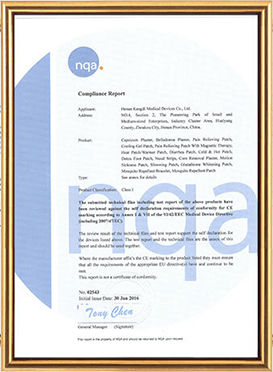
Henan Kongdy Medical Devices Co., LTD. (KONGDY) was founded in 1989 and has 37 years of production experience as of 2026 across pain relief patches, slimming patches, capsicum plasters, heat patches, cooling gel patches, detox foot patches, steam eye masks, mosquito repellent patches and nose strips. Headquartered in Henan, China, KONGDY operates a 100,000-class GMP workshop built in 2008 and obtained ISO 13485 medical device Quality Management System European Standard Certification in 2014. The company runs OEM and ODM services for international brands across multiple regulatory pathways.
For a 2026 procurement evaluation the qualification team can supply the ISO 13485 certificate, GMP workshop audit reports, stability programme documentation, and reference customer case studies upon request via our contact page.
Frequently asked questions
What is warning letter MARCS-CMS 736557?
A warning letter dated 1 October 2026 from the Center for Drug Evaluation and Research to Walmart, Inc., addressed to John Furner as President and CEO, concerning three products purchased from www.walmart.com in July 2026 and reviewed for their labelling. A response was required within fifteen business days.
Why do the same three products appear in the Amazon letter?
Because they are the same products with the same labelling. The letter to Amazon was issued on the same day, by the same office, and signed by the same person, and it names nine products of which these three are the overlap. Two of them also appear in letters addressed to the firms that make them.
What does the fulfilment footnote establish?
That the products were distributed directly to United States consumers on behalf of third parties and were fulfilled by the platform, quoting the company own description of pick, pack and ship and all customer support and returns. That is what makes the platform a party that introduced the products for introduction into interstate commerce.
What is the homeopathic finding?
That the product labelled as containing lemongrass 2X HPUS does not meet the guidance definition, because lemongrass is not listed in the Homeopathic Pharmacopeia as an active ingredient, and therefore falls outside the guidance scope; and that even if it did meet the definition it would fall under the category the agency intends to prioritise for enforcement.
What are the permitted indications for this category?
Under OTC Monograph M017: the treatment of pain, itching and minor skin irritation generally, and the prevention of premature ejaculation. The finding in the letter is that a product intended for the relief of genital sores and their associated symptoms goes beyond them, so there is no basis under section 505G for it to be marketed without an approved application.
Why does a user-reported percentage matter?
Because the agency quoted it among the claims observed on the labelling that provide evidence of intended use. A statement that more than ninety of users reported less severe outbreaks is a claim about what the product does, and it is treated as one.
Is there an error in the letter itself?
The closing instruction asks for the response to be identified with reference number 760557, while the reference number printed on the letter is 736557. The number in the body of the letter should be checked against the header before it is used.
What should a supplier do with this?
Read the claim panel and the ingredient panel of every listing together, check any homeopathic statement against the Homeopathic Pharmacopeia, and know which party in the chain is the visible one. A cooling gel patch OEM that has done those three things has closed what this letter is about.
Related Guides
Five further references from the KONGDY knowledge base:
- Pain Relief Patch OEM: the homeopathic label in twelve questions
- Detox Foot Patch OEM: the 20-point change control checklist
- Frequently asked compliance questions
- KONGDY OEM and ODM manufacturing services
- Nose Strip OEM: three enforcement routes compared


