
-
 KONGDY
Two Measurements Nine Days Apart: Reading the FDA Warning Letter Register as a Rate for a Nose Strip OEM in 2026
Two Measurements Nine Days Apart: Reading the FDA Warning Letter Register as a Rate for a Nose Strip OEM in 2026

Two readings of the same public register, nine days apart, produce a number that validates itself. On 28 October 2026 the FDA warning letters database held 3,779 entries. On 6 November 2026 it held 3,797.
Eighteen entries in nine days is two entries a day, which is 730 a year. The database also reports 737 letters issued in calendar year 2025, which is 2.02 a day.
The two figures agree to within one percent, and they were arrived at by different routes. One is an extrapolation from a nine-day window; the other is a full-year count queried by issue date. When two independent measurements of the same thing agree that closely, the thing being measured is established.
What it establishes is narrower than it sounds and more useful than it looks. The register is a live issuance stream rather than an archive being backfilled. That single fact makes the year counts trustworthy, and it makes a different finding possible.
For a nose strip OEM the value of the exercise is not the total. It is that the arithmetic can be repeated from public pages in about ten minutes, which means a supplier claim about enforcement trends can be checked rather than accepted.
1. The two measurements, with their inputs
Both figures come from the same page and the same filter mechanism, which is the Year dropdown on the warning letters database.
| Measurement | Date taken | Value | What it is |
|---|---|---|---|
| Total register size | 2026-10-28 | 3,779 entries | Every letter in the database, all years, all product categories |
| Total register size | 2026-11-06 | 3,797 entries | The same field, nine days later |
| Calendar 2025 letters | 2026-11-06 | 737 | Letters with a 2025 issue date, all product categories |
| Calendar 2024 letters | 2026-11-06 | 569 | Letters with a 2024 issue date, all product categories |
| Calendar 2026 letters | 2026-11-06 | 503 | Letters with a 2026 issue date, to 6 November, which is 310 days |
The first two rows are the same field read twice, and they are the ones that make the rest usable. The third row is a full-year count on the same basis as the fifth, which is why 737 and 503 can be compared and 737 and 303 cannot.
The mechanism matters for repetition. The year filter sits on a dropdown and the result appears only after the filter area Search control is used, so a reader pasting a query parameter into the address bar will see the unfiltered total and conclude that the filter does not work.
2. The arithmetic, and what it proves
Four calculations, each with its inputs stated so that a reader can repeat them.
| Calculation | Inputs | Result |
|---|---|---|
| Register growth rate | 3,797 minus 3,779 equals 18 entries, over 9 days | 2.0 entries per day, or about 730 a year |
| Calendar 2025 issuance rate | 737 letters over 365 days | 2.02 letters per day |
| Agreement between them | 730 against 737 | A difference of 0.95 percent |
| Calendar 2026 issuance rate to date | 503 letters over 310 days | 1.62 letters per day, or about 592 annualised |
The third row is the finding. Two routes to the same quantity, one extrapolated from nine days and one counted across a full year, land within one percent of each other.
That agreement rules out the most important alternative explanation. If the register were being systematically backfilled with historical letters, the nine-day growth rate would exceed the current issuance rate. It does not. If the register had stalled and were only being updated in occasional batches, the nine-day rate would undershoot the annual rate badly. It does not. The register is growing at the rate letters are being issued.
A nose strip OEM can therefore treat the calendar year counts as measurements of issuance rather than of database activity, which is the assumption every trend statement about this register depends on.
3. The number that does not agree, and why
The fourth calculation does not agree with the other three, and the disagreement is the second finding.
If the register is growing at 2.0 entries a day and 2026-dated letters are being issued at 1.62 a day, then about 0.38 entries a day are arriving for issue dates that are not in 2026. Over nine days that is roughly three or four of the eighteen entries.
| The two rates | Value | The gap |
|---|---|---|
| Register growth | 2.0 entries per day | Measures entry into the database |
| 2026 issuance | 1.62 letters per day | Measures letters dated this year |
| The difference | About 0.38 per day | Entries for earlier issue dates arriving now |
The gap has a straightforward explanation and it is not an error. A letter is counted in the year of its issue date, and it enters the database on its posting date. The lag between the two is normally short, and it is measurable: on 6 November the register showed letters issued on 26 October with a posting date of 3 November, which is eight days.
Eight days is short enough that most letters land in the same month and many in the same quarter, which is why the two rates are close. It is long enough that some letters cross a reporting boundary, which is why they are not identical.
For a nose strip OEM the practical lesson is about reading a monthly count. A monthly figure drawn from this register mixes letters issued in that month with letters issued in the previous one, and the mixture is the source of most apparent volatility.

4. The direction, stated carefully
The same-base comparison is 2026 against 2025, and on that basis the direction is not the one the headline figures suggest.
| Comparison | Basis | Result |
|---|---|---|
| 2024 against earlier | Calendar year, all categories | 569 letters, the base for the following year |
| 2025 against 2024 | Calendar year, all categories | 737 against 569, an increase of 29.5 percent |
| 2026 annualised against 2025 | Calendar year to date, all categories | About 592 against 737, a decrease of about 19.7 percent |
| Fiscal 2025 drug and biological subset | Fiscal year, drug and biological manufacturers only | 303 letters, which cannot be compared with any row above |
The second row is the increase that gets quoted, and it is real: 29.5 percent from 2024 to 2025 on a consistent calendar basis across all categories.
The third row is the one that is missing from most summaries, and it points the other way. On the same basis, 2026 is running below 2025. The fourth row is the number most often confused with the second and third, and it is on a different base entirely: fiscal rather than calendar, and one product subset rather than all of them.
A nose strip OEM quoting any of these figures should say which base it is on, because a reader who checks will find all four and will notice which one was omitted.

5. What the rate means for a single firm
A rate of two letters a day across every product category says almost nothing about one manufacturer until it is put against the size of the population being regulated.
The register does not publish a denominator, and this article will not invent one. What can be done instead is to convert the rate into a working assumption with an explicit uncertainty attached.
| If the question is | The rate answers it as | The uncertainty |
|---|---|---|
| How often does a letter appear in this register | About two a day, all categories | The category mix is not published in the same view |
| How long from an inspection to a visible letter | About five and a half to six and a half months | Computed from the four inspection cases in this library, so a small sample |
| How long from an online review to a visible letter | About two and a half to three months | Computed from two cases, and the source records a month rather than a day |
| How current is the register | About eight days behind the letters | One observation, and the lag may vary by office |
The second and third rows are the ones a manufacturer can plan against, and both are computed from a handful of cases rather than from a dataset. That is worth saying rather than hiding, because a supplier that presents a two-case interval as an industry norm has presented an anecdote as a schedule.
For a nose strip OEM the useful form of the numbers is a question rather than a forecast. The question is what the firm file would show if a letter arrived in six months, and the rate is only the reason to ask it.

6. The contrast with the European record
The European alert system publishes a different quantity and it is worth putting the two side by side once, with the difference named.
| Record | What it counts | The 2025 figure |
|---|---|---|
| FDA warning letters, calendar 2025 | Letters issued to firms, all product categories | 737 |
| EU Safety Gate, 2025 | Validated alerts naming products | 4,671 |
| EU Safety Gate follow-up actions, 2025 | Decisions taken by national authorities | 5,794 |
The two records are not measuring the same thing at any level. One names a firm and the other names a product. One is issued by a single agency and the other is entered by any of thirty national authorities. One counts letters and the other counts alerts plus the follow-up decisions they produce.
That is why an apparent difference of six to one between 737 and 4,671 is not a statement about enforcement intensity in either direction. It is a statement that two institutions count different objects, and a supplier who compares them has compared nothing.
A nose strip OEM selling into both markets should keep the two records in two columns and never in one total.

7. What to do with a register that can be measured
The register is cheap to measure and almost nobody measures it, which is the whole opportunity.
- Record the total on a fixed day each month. A series of totals is a rate, and a rate is what distinguishes a trend from a recollection. Two readings nine days apart were enough to establish the base rate for this article.
- Query by year rather than by memory. The year filter produces a count on a stated basis. The same filter on two different bases produces two numbers that cannot be compared, and that is the most common error in this area.
- Keep the base attached to every number you quote. Calendar or fiscal, all categories or one subset. A number without its base is not a fact, it is a claim.
- Use the register to find firms, not to estimate your own risk. The register names organisations, and the rate is not a probability for any particular one.
- Ask the supplier for the thing the register does not hold. A Form FDA 483 is not in the public database, so the question that matters cannot be answered by searching.
The fifth point is the one that makes the other four worth doing. Everything measurable here is downstream of an event that is not published, and a nose strip OEM that has prepared the answer to the unpublished question has prepared the only part that a competitor cannot copy from a search.

8. What this dataset settles and what it does not
An honest close, because the arithmetic is precise and the conclusions are not.
| The dataset settles | The dataset does not settle |
|---|---|
| That the register grows at about two entries a day | Why the rate is what it is |
| That the register growth rate matches the calendar 2025 issuance rate within one percent | Whether that relationship held in earlier years, since only two readings exist |
| That 2025 was about 29.5 percent above 2024 on a calendar basis | Whether 2026 will finish above or below 2025, since the year is not complete |
| That the posting lag was about eight days on one observation | Whether the lag is uniform across issuing offices |
| That the fiscal 303 figure is on a different base from all the others | What the fiscal 2026 subset figure is, which was not measured here |
The second row of the second column is the limit of a two-point series. Two readings establish a rate for nine days and suggest a relationship; they do not establish that the relationship is stable. A reader who wants more should take the reading monthly and keep the series.
What the dataset does establish is that a public register can be measured rather than described, and that the measurement takes ten minutes. For a nose strip OEM that is a lower cost of being right than most of the alternatives.
9. A worked example of the mistake this prevents
The basis problem is easier to see in a concrete case than in a definition, so here is one built from the figures in this article.
| What a supplier might say | The base it actually uses | What it should have said |
|---|---|---|
| Letters are up 66 percent this year | 503 in ten months of calendar 2026 against 303 in fiscal 2025 for one product subset | Nothing, because those two numbers cannot be compared at all |
| Letters are up 29.5 percent | 737 in calendar 2025 against 569 in calendar 2024, all categories | This one is correct and should carry the two calendar years with it |
| Enforcement is accelerating | Not derivable from any figure in this article | That 2025 rose on a calendar basis and 2026 is running below it when annualised |
| The register is current | True for letters, with an eight-day lag measured once | The register is current to about eight days, and the letters lag the events by months |
The first row is the one that appears most often, and it is not a lie. Every number in it is real. What makes it wrong is that the two figures were drawn from different populations and different year definitions, and the sentence joined them.
A nose strip OEM that has to answer this in a customer meeting is in a better position than one that repeats it, because the answer is a question rather than a correction. The question is which base, and it takes one sentence to ask.
The third row is the harder one to give up. A statement about acceleration feels like an observation about the world, and it is actually a conclusion that requires a consistent series. Without one, the honest version is the narrower statement in the third column, and a nose strip OEM should prefer the narrow statement to the memorable one.
There is a commercial reason to prefer it as well. A buyer who hears an exaggerated trend and later checks the register will trust the next claim less, and the cost of that is not paid in the meeting where the claim was made. The narrow statement costs one sentence and survives a check.
About KONGDY Medical

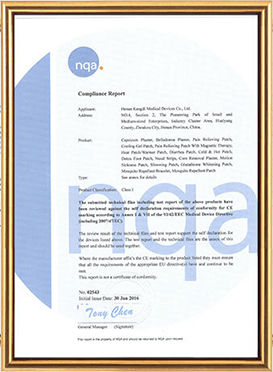
Henan Kongdy Medical Devices Co., LTD. (KONGDY) was founded in 1989 and has 37 years of production experience as of 2026 across pain relief patches, slimming patches, capsicum plasters, heat patches, cooling gel patches, detox foot patches, steam eye masks, mosquito repellent patches and nose strips. Headquartered in Henan, China, KONGDY operates a 100,000-class GMP workshop built in 2008 and obtained ISO 13485 medical device Quality Management System European Standard Certification in 2014. The company runs OEM and ODM services for international brands across multiple regulatory pathways.
For a 2026 procurement evaluation the qualification team can supply the ISO 13485 certificate, GMP workshop audit reports, stability programme documentation, and reference customer case studies upon request via our contact page.

Frequently asked questions
How many warning letters are in the FDA database?
3,797 entries on 6 November 2026, against 3,779 on 28 October 2026. The field is visible at the top of the warning letters database once entries are displayed. A nose strip OEM should record it monthly rather than recall it.
How many letters were issued in each year?
Using the Year filter on the same database: 569 letters with a 2024 issue date, 737 with a 2025 issue date, and 503 with a 2026 issue date as of 6 November 2026. All three counts cover every product category. A nose strip OEM should quote the year and the category scope together.
Why do the counts not match the 303 figure often quoted for fiscal 2025?
Because that figure is on a different base. The 303 covers fiscal year 2025, which runs from October to September, and it counts drug and biological product manufacturers only. The 569, 737 and 503 figures are calendar year counts across all product categories including food, devices, cosmetics and tobacco. That distinction is the one a nose strip OEM is most likely to blur when quoting a figure.
What does the nine-day growth rate prove?
That the register is a live issuance stream rather than an archive being backfilled. Eighteen entries in nine days is two a day or about 730 a year, and the calendar 2025 count of 737 works out at 2.02 a day. The two agree within one percent, and they were reached by different routes. A nose strip OEM can repeat both readings from public pages in about ten minutes.
Is enforcement increasing?
On a consistent calendar basis, 2025 rose about 29.5 percent over 2024, and 2026 is running about 19.7 percent below 2025 when annualised. A year to date is not a year, so the second statement is provisional. What is not provisional is that the two statements are on the same base and the fiscal 303 figure is not. A nose strip OEM should prefer the provisional statement to the memorable one.
How current is the register?
On 6 November 2026 it showed letters issued on 26 October 2026 with a posting date of 3 November 2026, an eight-day lag. The register is current relative to the letters, and the letters lag the underlying inspections and reviews by months. A nose strip OEM should treat a clean monthly search as evidence about one register only.
Where does the number 3,779 come from?
It is the same total field read on 28 October 2026. Keeping a monthly reading of that field is the cheapest way to turn a register into a rate, and it is what made this article possible.
Can this rate be used to estimate a single firm risk?
No. The rate is across every product category and the register does not publish the population being regulated, so no denominator is available. The rate is useful for establishing that the register can be measured and for checking a supplier claim, not for assigning a probability to one product. A nose strip OEM should use the rate to check a supplier claim rather than to estimate its own odds.
Related Guides
Five further references from the KONGDY knowledge base:
- Steam Eye Mask OEM: three enforcement systems compared
- Heat Patch OEM: twelve record gates from material to release
- Frequently asked compliance questions
- KONGDY OEM and ODM manufacturing services
- Cooling Gel Patch OEM: the 24-point data integrity walkthrough


