
-
 KONGDY
Three Doors, Three Discovery Methods: Comparing FDA, EU Safety Gate and EU Customs for a Steam Eye Mask OEM in 2026
Three Doors, Three Discovery Methods: Comparing FDA, EU Safety Gate and EU Customs for a Steam Eye Mask OEM in 2026

Three enforcement systems can reach a patch manufacturer selling into the United States and the European Union. They are usually described by what they punish, and that is the less useful way to compare them.
What distinguishes them is how each one finds a problem. A buyer who checks one system has checked one third of the exposure, and the third that is checked is usually the easiest to check rather than the largest.
The three are the United States Food and Drug Administration, the European Safety Gate network, and European customs acting under the product compliance framework. Each has a different trigger, a different form of evidence, a different unit of naming, and a different public record.
For a steam eye mask OEM the comparison is not academic. A self-heating eye mask touches a device question in the United States, a cosmetic or quasi-drug question in parts of Europe, and a general product safety question at the European border. Three doors, one product. A steam eye mask OEM should read that sentence twice.
One warning before the grids. The numbers below come from three datasets measured on different dates and counted on different bases, and this article states which base each figure uses rather than presenting them as a single total. A steam eye mask OEM should read that sentence twice.
1. The trigger: what makes each system look
The first grid is about initiation, and the three systems differ more here than anywhere else.
| System | What starts a case | What it needs before anyone looks |
|---|---|---|
| FDA, United States | A site inspection, or a review of a website and the purchase of the product | A facility to inspect, or a listing to buy from |
| EU Safety Gate | A national market surveillance authority entering a notification, or a consumer report through the Consumer Safety Gateway | A member state decided to act, or a consumer decided to complain |
| EU customs | A targeted control operation under a priority control area, or a documentary check at the border | A consignment, and a category someone chose to examine |
The second row of the FDA entry is the one that changed the arithmetic. Two letters in this library arose from a review rather than a visit: 735346 came from a review of a firm website and storefront in July 2026, and 736006 came from products purchased on a website in July 2026. Neither involved a facility inspection.
For a steam eye mask OEM that sells through marketplaces, the second trigger is the one that applies most often, and it requires nothing from the manufacturer except a listing.
2. The evidence: what each system treats as proof
The second grid is about what counts as evidence, and it decides what a manufacturer can do in advance.
| System | The evidence | Whether a laboratory is needed |
|---|---|---|
| FDA, inspection route | Observations recorded by investigators on site, issued as a Form FDA 483 | Often yes, but the finding can be purely documentary |
| FDA, review route | The product labelling as published, and the claim the label carries | No. The entire finding in 735346 and 736006 was made from text |
| EU Safety Gate | A notification by a member state authority naming a product and a risk | Depends on the risk type, and a chemical finding usually involves a test |
| EU customs | Documentation, marking, labelling, or an identifiable economic operator | No. Article 26(1) of Regulation (EU) 2019/1020 allows suspension on documentary grounds alone |
The fourth row is the one that surprises exporters. Regulation (EU) 2019/1020, Article 26(1) allows border authorities to suspend release where the product is not accompanied by the documentation required by Union law, or where there is reasonable doubt as to the authenticity, accuracy or completeness of that documentation. No test, no defect and no finding of danger is required.
A steam eye mask OEM therefore faces two systems that can find against it without testing the product at all, and one that usually tests. That distribution is worth knowing before deciding where to spend on evidence. A steam eye mask OEM should read that sentence twice.
3. The unit of naming: what gets identified
The third grid is the one that determines what a buyer can actually search, and it is where the three systems diverge most sharply.
| System | What the public record names | What it therefore cannot tell you |
|---|---|---|
| FDA | A firm, an issuing office, a facility identifier where given, and a reference number | Which batches, which consignments, or whether a certificate has been withheld |
| EU Safety Gate | A product, a brand, a risk, a notifying country and a measure | Which firm made it, and whether the same firm has other products |
| EU customs | A consignment or a category, in aggregate reporting | Which individual product or firm, in the published aggregate |
The contrast between the first two rows is the single most useful thing in this article. In the United States the record names an organisation and you can search a supplier. In the European alert system the record names a product and you can search a product.
The consequence for a steam eye mask OEM is that the same question requires two different searches. Asking whether a supplier has been named works in one register and does not work in the other, and a buyer who assumes the registers are equivalent will conclude that a European alert does not concern their supplier when the register simply does not record it that way.

4. The numbers, with their bases stated
The fourth grid carries the counts, and each one is labelled with the base it was measured on. The labels are the point.
| System and figure | Base | Measured |
|---|---|---|
| FDA, 2024 | Calendar year, all product categories | 569 letters |
| FDA, 2025 | Calendar year, all product categories | 737 letters |
| FDA, 2026 to 6 November | Calendar year to date, all product categories | 503 letters over 310 days |
| FDA, whole database | All years, all categories | 3,797 entries on 2026-11-06, against 3,779 on 2026-10-28 |
| FDA, fiscal 2025 drug and biological subset | Fiscal year, drug and biological product manufacturers only | 303 letters |
| EU Safety Gate, 2025 | Calendar year, validated alerts | 4,671 alerts |
| EU Safety Gate, 2026 weeks 1 to 38 | Year to date, validated alerts | 2,663 notifications |
| EU customs, 2024 | Calendar year, released products | 13 refusals per million, against 4.6 billion packages |
Two rows in that grid cannot be subtracted from each other and the temptation to do it is strong. The 503 is a calendar year to date across every product category. The 303 is a fiscal year across drug and biological manufacturers only. A comparison between them would produce a 66 percent increase that does not exist.
The honest same-base comparison is 503 against the calendar-year figures. Annualised, 503 over 310 days is about 592 letters, which is below the 737 recorded for 2025. A steam eye mask OEM should be careful with that conclusion too, because a year to date is not a year. A steam eye mask OEM should read that sentence twice.
5. The lag: how long before a finding becomes visible
The fifth grid compares the interval between the event and the public record, because that interval is what makes a clean register misleading.
| System | The interval | The evidence for it |
|---|---|---|
| FDA, inspection to letter | About 5.4 to 6.4 months | 320-26-12, 724506, 320-26-99 and 320-26-105, computed from the dates in this library |
| FDA, review to letter | About 2.5 to 3 months | 735346 and 736006, both reviewed or purchased in July 2026 and issued on 1 October 2026 |
| FDA, letter to publication | About 8 days | Observed on 2026-11-06 for letters issued 2026-10-26 and posted 2026-11-03 |
| EU Safety Gate | Publication follows validation | The system publishes validated alerts continuously, at almost 100 a week in 2025 |
| EU customs | At the border, in the transaction | Article 27 of Regulation (EU) 2019/1020 sets four working days for a suspension to lapse |
The third row is worth separating from the first two. The database is current relative to the letters, and the letters lag the events. So a buyer checking the register is reading something that is up to date about matters that are months old.
The fifth row is the opposite case. A customs suspension is a live event with a four working day clock, and it is the only one of the three where the manufacturer can still affect the outcome within the same week. A steam eye mask OEM should read that sentence twice.

6. The consequence: what each system can do next
The sixth grid compares what follows, and the three systems are not interchangeable in what they can reach.
| System | What it can reach | What it cannot reach |
|---|---|---|
| FDA | The product, the site, and through the export certificate and the application route, the commercial relationships | A consignment already inside the country under another party name |
| EU Safety Gate | The listing, the market, and through the general product safety framework the consumer remedy obligation | The manufacturing site as such, unless it is named in the notification |
| EU customs | The consignment, at the point of entry, before it reaches a consumer | Product that has already cleared |
The third row of the second column is the structural limit worth noting. Customs acts before the goods arrive, and the Safety Gate acts after they have arrived and been sold. There is no single system that covers both ends, which is why the eSurveillance Webcrawler exists as a third mechanism inside the European framework.
That mechanism found more than 20,800 products in 2025 that had already been notified and were still being offered, which is a measure of the gap between the two ends of the pipeline.
7. Where a steam eye mask actually sits
Applying the three systems to one product produces a specific answer rather than a general one.
| Question the product raises | Which system answers it | The basis |
|---|---|---|
| Is it a device because it heats? | FDA, in the United States | Classification depends on intended use and claims, with ASTM F2871 governing the self-heating safety envelope |
| Is the packaging and labelling adequate? | EU customs, at the border | Article 26(1) allows suspension on marking and labelling grounds |
| Is the product safe in the market? | EU Safety Gate, after sale | A member state notification names a product and a risk |
| Is the quality system adequate? | FDA, on inspection | 21 CFR 211.165(a) type determinations, or the device quality requirements |
The second row is the one a manufacturer underestimates. A labelling question is answered by customs before the product is ever assessed for safety, and the answer arrives as a suspended consignment rather than as a finding.
For a steam eye mask OEM the practical consequence is that three different documents answer three different systems. A device classification does not satisfy a labelling check, and a labelling check does not answer a market surveillance notification.

8. What the comparison settles and what it does not
A three-way comparison invites a conclusion about which system is strictest, and that conclusion is not available from the data.
| The comparison settles | The comparison does not settle |
|---|---|
| That each system has a distinct trigger and a distinct unit of naming | Which system is most likely to reach a given product |
| That two of the three can find against a product without testing it | How often each trigger is used in a given category |
| That the intervals differ by an order of magnitude between inspection and review routes | Whether the intervals are shortening |
| That the counts are not comparable across bases | What the true 2026 total will be, since the year is not finished |
| That the registers name different things | Whether a supplier is clean, since one register cannot answer that question |
The last row of the second column is the one a buyer should carry away. No single register answers the question a buyer is actually asking, and the answer is assembled from three searches plus a question to the supplier that no register can answer.
A steam eye mask OEM that has assembled those three searches for its own file has done something a buyer cannot do without cooperation, which is the only durable commercial advantage in this area. A steam eye mask OEM should read that sentence twice.
About KONGDY Medical

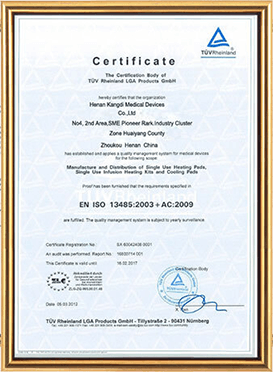
Henan Kongdy Medical Devices Co., LTD. (KONGDY) was founded in 1989 and has 37 years of production experience as of 2026 across pain relief patches, slimming patches, capsicum plasters, heat patches, cooling gel patches, detox foot patches, steam eye masks, mosquito repellent patches and nose strips. Headquartered in Henan, China, KONGDY operates a 100,000-class GMP workshop built in 2008 and obtained ISO 13485 medical device Quality Management System European Standard Certification in 2014. The company runs OEM and ODM services for international brands across multiple regulatory pathways.
For a 2026 procurement evaluation the qualification team can supply the ISO 13485 certificate, GMP workshop audit reports, stability programme documentation, and reference customer case studies upon request via our contact page.

9. One file that has to satisfy three doors
The practical output of a three-way comparison is a single list, because three regulators asking three questions still only accept documents from the same folder.
| What the file needs | Which door it closes | What makes it acceptable |
|---|---|---|
| A classification determination naming the intended use and the framework | The FDA door | A dated determination, not a marketing description |
| A claim set checked against the permitted indications | The FDA door, review route | A record showing each live listing was checked against an approved block |
| A complete technical file, retrievable, kept for the required period | The customs door | Article 9(2) of Regulation (EU) 2023/988 requires the internal risk analysis and technical documentation, kept ten years |
| Labelling and marking correct on the product as shipped | The customs door | Article 26(1) of Regulation (EU) 2019/1020 allows suspension on labelling grounds |
| A party inside the European Union who answers | The customs door and the Safety Gate door | Named on the product, the packaging, the parcel or an accompanying document |
| A traceability record linking lot, market and customer | All three | It is what allows a measure to be bounded rather than guessed at |
The sixth row is the one that pays across all three doors and is the one most often left until a finding arrives. A traceability record is not a compliance document in any of the three systems; it is the record that lets a firm answer the first question any of them asks.
For a steam eye mask OEM the list is short enough to assemble once and long enough to be worth dating. Six items, three doors, and the same folder serves all of them.
A steam eye mask OEM that has dated all six has something no register can supply, which is a description of its own position rather than a search of somebody else record.
There is a second reason the annualised figure should be treated as indicative rather than predictive. Letters are counted by issue date, and the register receives them in batches, so the monthly distribution is not flat. A batch of letters issued in one month and posted in the next appears in the year of issue and not the year of publication, which means a reader counting at the end of December will still see entries arrive for dates already past.
That batching effect is why the posting lag matters beyond curiosity. A steam eye mask OEM that checks the register monthly will see the count move in steps rather than smoothly, and a step is a batch rather than a change in enforcement.
A steam eye mask OEM should therefore read the register for named firms and read the datasets for direction, and should not use one to answer the other question.
Frequently asked questions
How many warning letters has FDA issued in 2026?
The warning letters database records 503 letters with a 2026 issue date as of 6 November 2026, measured with the year filter. For comparison, the same database records 737 for calendar year 2025 and 569 for calendar year 2024, all product categories.
Why does the 303 figure not match those numbers?
Because it uses a different base. The 303 is a fiscal year figure for drug and biological product manufacturers only, while the 569, 737 and 503 figures are calendar year counts across all product categories including food, devices, cosmetics and tobacco. The two cannot be subtracted from each other.
Is enforcement increasing in 2026?
On a same-base comparison the calendar year figures do not support that. Annualised, 503 letters over 310 days is about 592, which is below the 737 recorded for 2025. A year to date is not a year, so the conclusion is provisional, but the direction on this base is not upward.
What does the European alert system name?
A product, a brand, a risk, the notifying country and the measure taken. It does not name the manufacturing firm in the way a United States warning letter does, which means a buyer can search for a product in one register and for a supplier in the other, and neither search answers the other question.
Can customs stop a consignment without testing it?
Yes. Regulation (EU) 2019/1020, Article 26(1) allows suspension of release where the product is not accompanied by the required documentation, where there is reasonable doubt about that documentation, where marking or labelling is missing, or where the economic operator cannot be identified. A laboratory result is not required for any of those grounds.
How current is the FDA register?
Measured on 6 November 2026, letters issued on 26 October 2026 appeared with a posting date of 3 November 2026, which is a lag of about eight days. The register is current relative to the letters, and the letters lag the underlying events by months.
Which system should a manufacturer prepare for first?
The one whose evidence a firm can produce cheapest. Two of the three can find against a product on documents or on labelling alone, so a complete documentary file and a corrected claim set close the two doors that need no laboratory work. The third door is closed by testing or by a classification determination.
Does a clean search in one register mean anything?
It means one register had nothing. Given that the registers name different things and cover different territories, a clean search in one of them is evidence about that one rather than about the product. The question that no register answers is whether the supplier has received a Form FDA 483, which is not published.
Related Guides
Five further references from the KONGDY knowledge base:
- Heat Patch OEM: twelve record gates from material to release
- Cooling Gel Patch OEM: the 24-point data integrity walkthrough
- Frequently asked compliance questions
- KONGDY OEM and ODM manufacturing services
- Capsicum Plaster OEM: export certificates and withheld approvals


