-
 KONGDY
FDA Warning Letter 726976: What a Pain Relief Patch OEM Should Learn from a Cleaning Record That Did Not Exist in 2026
FDA Warning Letter 726976: What a Pain Relief Patch OEM Should Learn from a Cleaning Record That Did Not Exist in 2026
On 31 July 2026 the Center for Drug Evaluation and Research issued warning letter MARCS-CMS 726976 to FairyGene, Inc., at 2 Pearl Buck Court, Suite 1, Bristol, following an inspection from 12 to 15 January 2026 and a Form FDA 483 response dated 28 January 2026 that the agency found inadequate.
The letter is worth a full reading for a reason that has nothing to do with its severity. It is the only letter in this library that documents a cleaning programme in which the batch record contained a step for equipment cleaning, and that step was left blank across multiple drug product lots.
That single detail is the most transferable thing in the document. A step that exists in a form and is not completed is not a training failure and it is not a documentation slip. It is evidence that the step was understood as a formality by everyone who touched it, which is a different and larger finding.
The site also contract manufactures over-the-counter drug products alongside non-drug products, and it does so on non-dedicated equipment. One of its five named products, PRIMAL VIKING ULTIMATE JOINT & MUSCLE REPAIR BALM, sits in the same therapeutic territory as a pain relief patch OEM product, which is why the case belongs in this knowledge base rather than in a general enforcement summary.
One more detail establishes the standard the rest of the article is measured against. The letter records that the firm could not provide any cleaning or sanitization logs to demonstrate that cleaning was performed on its equipment.
1. The facts, exactly as the letter states them
The identification facts below are the whole of what the letter establishes about its own origin, and they are worth having in one place because each one is checkable.
| Item | What the letter states |
|---|---|
| Letter | MARCS-CMS 726976, dated 31 July 2026 |
| Firm | FairyGene, Inc., FEI 3023594691 |
| Address | 2 Pearl Buck Court, Suite 1, Bristol |
| Recipient | Mr. Liu |
| Inspection | 12 to 15 January 2026 |
| 483 response | 28 January 2026, found inadequate because it lacked supportive documentation for evaluation and adequate evidence of corrective actions |
| Response period | 15 working days |
| Products named | FROYA Instant Rosacea Acne & Redness Stopper; [Norse] ACNE SCARS HEALER & PREVENTER 2.0 FACE BALM; [Norse] BODY ACNE KILLER BODY BALM; FROYA Hyper Fast Eczema & Psoriasis Stopper for Body & Face; PRIMAL VIKING ULTIMATE JOINT & MUSCLE REPAIR BALM |
| Statutory findings | Unapproved new drugs under 21 U.S.C. 355(a); misbranded under 21 U.S.C. 352(ee); introduction prohibited under 21 U.S.C. 331(d) and 331(a) |
| CGMP findings | 21 CFR 211.42(b) and (c); 21 CFR 211.67(a) and (b); 21 CFR 211.22 |
The third row is the one a buyer should note first, because a facility identifier belongs to a site rather than to a company. A firm with several sites can present one and ship from another, and the finding attaches to the address rather than to the brand. A pain relief patch OEM selling through a contract site should therefore know the FEI of that site rather than the name of the company that owns it.
2. Finding one: space, and the absence of defined areas
The first finding is about the building, and the detail is unusually concrete for a regulatory document.
21 CFR 211.42(b) requires adequate space for the orderly placement of equipment and materials to prevent mix-ups and contamination, and 211.42(c) requires separate or defined areas or other control systems for the same purpose. The letter records that components and raw materials were stored haphazardly on floors, along walls and in hallways between packaging lines used for the manufacturing of drug products.
| What the letter records | Why it is a finding rather than a housekeeping note |
|---|---|
| Materials stored on floors, along walls and in hallways between packaging lines | A hallway is a route, and material standing in a route is material that can be moved by accident into the wrong batch |
| Materials lacking identification of contents and intended use | An unlabelled container is a container whose contents are established by assumption |
| Materials lacking designated status of quarantined, approved or rejected | Without a status, rejected material is indistinguishable from approved material |
| Materials lacking production run association | A material that is not tied to a run can be used in a run it was not intended for |
| No designated areas for quarantining incoming materials or segregating approved from rejected | The control depends on there being somewhere for the material to be |
A pain relief patch OEM should look for the place before reading the procedure. The third row is the one that converts a storage problem into a quality problem. Every quality system has a quarantine concept, and the concept requires a place. A site with no place for quarantine has a concept without a mechanism. A pain relief patch OEM should be able to point at the place rather than describe the rule.

3. The building itself, described in the letter
The letter describes the manufacturing environment in physical terms, and the description is the most quotable passage in the document.
It records concrete floors, metal sheeting over cinderblock walls, exposed ceiling vents, exposed piping, exposed joists and ceiling fans. It states that the lack of adequate ventilation systems for drug manufacturing areas can create risks for microbial and particulate contamination of drug products.
| Feature described | The concern it raises |
|---|---|
| Concrete floors | A surface that must be cleanable and that can be sealed, or it becomes a reservoir |
| Metal sheeting over cinderblock walls | Joints and fixings that trap material and resist cleaning |
| Exposed ceiling vents, piping and joists | Horizontal surfaces above open product that collect dust and shed it |
| Ceiling fans | A device whose function is to move air, and therefore to move particles, above an open product |
| Absence of adequate ventilation | No control over the direction or the cleanliness of the air reaching the product |
The fourth row is the one a manufacturer remembers, because it is a piece of equipment whose entire purpose is movement. A fan above an open product is a particle distribution system, and the letter does not treat it as a comfort feature.
The letter also records that the firm stated it planned to acquire a new warehouse by Autumn 2026, and then finds that the current environment is not of suitable construction or design to facilitate adequate cleaning and maintenance for drug manufacturing operations. The plan is noted; the finding stands on the present condition. A pain relief patch OEM that has walked its own building with this list in hand will notice the fans. A pain relief patch OEM should notice the fans first, because they are the cheapest thing to change.
4. Finding two: the cleaning programme that was not recorded
The second finding is the one this article is named for, and it has four parts that should be read separately.
21 CFR 211.67(a) requires equipment to be cleaned, maintained and as appropriate sanitized or sterilized at appropriate intervals to prevent contamination that would alter the safety, identity, strength, quality or purity of the drug product, and 211.67(b) requires adequate written procedures for cleaning and maintenance.
| The part | What the letter records |
|---|---|
| The procedure was incomplete | The cleaning and maintenance procedure lacked critical details including the types of cleaning agents, the cleaning agent concentrations or dilutions, contact times, sampling requirements and testing specifications |
| The equipment was not dedicated | The firm manufactures OTC drug products on the same non-dedicated equipment used to manufacture non-drug products |
| There were no logs at all | The firm could not provide any cleaning or sanitization logs to demonstrate that cleaning was performed on its equipment |
| The step existed and was left blank | While the batch records contained a designated step for documenting equipment cleaning, this step was not completed for multiple drug product lots |
| A failing medium stayed in use | The medium used in equipment cleaning repeatedly yielded too-numerous-to-count bioburden results during routine sampling, and the firm continued using it without remediation |
The fourth row is the whole article. The step was designed, it was printed, and it was skipped. A buyer reading that finding should ask a different question than "was there a cleaning procedure", because the answer in this case would have been yes.
The fifth row is the one that turns a procedural finding into a contamination finding. A test that produces a result of too numerous to count is a test that has produced a result, and continuing to use the material that produced it is a decision rather than an oversight.
The second row explains why the other four matter more here than they would at a dedicated site. Where drug and non-drug products share equipment, a cleaning step that was designed but not completed is not a documentation gap; it is an unverified transfer route between two product types. A pain relief patch OEM sharing a line with a cosmetic product inherits exactly that burden.

5. Finding three: a quality unit without the authority to function
The third finding names the quality unit, and it lists three specific things the unit failed to ensure.
21 CFR 211.22 requires the quality control unit to have the responsibility and the authority to approve or reject, and the letter frames the finding as a failure to establish an adequate quality unit with the responsibilities and authority to oversee manufacturing.
| What the quality unit failed to ensure | The clause | What it means |
|---|---|---|
| Adequate procedures for production and process controls, and qualification of equipment used to manufacture drug products | 21 CFR 211.100(a) | The unit was not controlling the process or the equipment |
| Establishment of an adequate, ongoing stability programme | 21 CFR 211.166(a) | The unit was not controlling the expiry claim |
| Establishment of adequate written responsibilities and procedures applicable to the quality control unit | 21 CFR 211.22(d) | The unit did not have its own written mandate |
The third row is the most interesting of the three and the easiest to under-read. A quality unit whose own responsibilities are not written down has no basis on which to refuse anything, because there is no document saying that refusing is its job.
The letter points to three published references as the route out: the Quality Systems Approach to Pharmaceutical CGMP Regulations, ICH Q10 on the pharmaceutical quality system, and the Process Validation guidance. Naming them is unusual and it is useful, because it tells a supplier which documents to read rather than which principle to adopt. A pain relief patch OEM can read the same three documents, and the third one is the one that changes how a process is described.

6. The response was rejected for the same reason as the cleaning
The Form FDA 483 response was found inadequate, and the reason given is consistent with the rest of the letter.
The letter states that the response was inadequate because the firm failed to provide supportive documentation for evaluation or adequate evidence of corrective actions taken to bring its operations into compliance with CGMP.
| What the response had to show | What the letter found | The pattern |
|---|---|---|
| Supportive documentation for evaluation | Not provided | The same absence that produced the cleaning finding |
| Adequate evidence of corrective actions taken | Not provided | An action described is not an action evidenced |
| The records behind each claim | Not provided | A second document produced without the first document behind it |
The third row is the point of the pattern. The site had a cleaning procedure and no logs, and it produced a response and no evidence. Both are the same failure at different levels, and the second one is what turned a Form FDA 483 into a warning letter. A pain relief patch OEM should treat a corrective action response as a records exercise rather than a writing exercise.
7. The five consequences stated in the closing paragraph
The letter sets out five consequences in one paragraph, and four of them are invisible to anyone who only checks whether a letter exists.
| Consequence | What it acts on |
|---|---|
| Unresolved violations may prevent other federal agencies from awarding contracts | Public procurement |
| Failure to address violations may cause FDA to withhold issuance of Export Certificates | The document a customer needs to register a product |
| FDA may withhold approval of new applications or supplements listing the firm as a drug manufacturer | The customer application that names this site |
| FDA may re-inspect to verify corrective actions have been completed | The verification step, with no stated period |
| Failure to promptly address the matter may result in regulatory or legal action without further notice, including seizure and injunction | The goods and the activity |
The third row is the one that reaches a customer most directly. Being named on an application is a service a supplier performs for a buyer, and a site under an unresolved finding is a site whose name slows that application down.
The fourth row is honest about the gap. The letters describe re-inspection as the verification step and give no period, so a firm that has done everything still cannot state when the matter closes. A pain relief patch OEM that offers a reopening date is offering something the documents do not offer.

8. What this letter does and does not establish
A warning letter is an enforcement document, and the boundary of what it supports is worth stating as plainly as what it says.
| The letter establishes | The letter does not establish |
|---|---|
| The site stored materials on floors, walls and hallways without status identification | That any specific batch was contaminated |
| There were no cleaning logs and a cleaning step was left blank on multiple lots | That any specific lot was cross-contaminated |
| The cleaning medium repeatedly produced too-numerous-to-count bioburden | That the medium reached a finished product |
| The quality unit did not have written responsibilities of its own | That the quality unit made no decisions at all |
| A new warehouse was planned for Autumn 2026 | That the plan was unacceptable, since the finding rests on present condition |
The fifth row is worth keeping in mind because it is easy to read the letter as a rejection of the plan. It is not. The agency recorded the plan and then assessed the building as it stands, which is the correct order and also the one a buyer should follow. A pain relief patch OEM assessing a supplier should assess the building as it stands rather than as it is planned.
9. Six questions a buyer can ask after reading this letter
Each question is designed to be answerable from a document rather than from a description, and each one corresponds to a finding above.
- Which facility identifier makes this product? The finding attaches to FEI 3023594691, and a firm with several sites can have one in good standing and one not.
- Where are quarantined and rejected materials kept, physically? The first finding is about the absence of a place, and the answer should name a location rather than a procedure.
- Is the equipment dedicated to drug products? Where it is not, the cleaning step carries a burden it does not carry at a dedicated site.
- Show me the cleaning log for the last ten lots. The article cannot recommend a smaller number, because the finding was that no logs existed at all.
- Show me the completed cleaning step in three batch records. A procedure and a log both exist in this case in principle, and the third evidence is the entry.
- Who in the quality unit can refuse a batch, and where is that written? The third finding is about authority rather than about competence.
The fifth question is the one this case is built around, and it is the cheapest of the six to answer. A pain relief patch OEM can run all six on itself in one morning. A supplier that can produce three batch records with the cleaning step completed has demonstrated the thing the letter found missing, and one that cannot has demonstrated the finding. A pain relief patch OEM can run the same test on itself in an afternoon and learn something either way.
10. What to write into the contract
Four clauses, each derived from one of the findings rather than from the letter as a whole.
| Clause | What it should say | Which finding it answers |
|---|---|---|
| Site identification | Each facility by its regulatory identifier, with the products made at each one | The finding attaches to FEI 3023594691 rather than to the company |
| Dedicated equipment disclosure | Whether the equipment is dedicated to drug products, and if not, the cleaning validation that covers the shared use | The non-dedicated equipment finding |
| Record availability | The cleaning log and the completed batch record step for any lot on request, within a stated period | The absence of logs and the blank step |
| Quality unit authority | A named quality function with written authority to reject, and the document that confers it | The 211.22(d) finding |
The fourth clause is the one that sounds like a formality and is not. A quality unit without written responsibilities cannot refuse a batch, A pain relief patch OEM should ask who can refuse a batch. This means the rejection decision a buyer is relying on may not exist as an authorised act. A pain relief patch OEM that cannot produce the document that confers the authority has answered the clause in the negative.

About KONGDY Medical

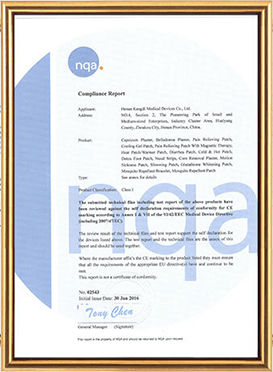
Henan Kongdy Medical Devices Co., LTD. (KONGDY) was founded in 1989 and has 37 years of production experience as of 2026 across pain relief patches, slimming patches, capsicum plasters, heat patches, cooling gel patches, detox foot patches, steam eye masks, mosquito repellent patches and nose strips. Headquartered in Henan, China, KONGDY operates a 100,000-class GMP workshop built in 2008 and obtained ISO 13485 medical device Quality Management System European Standard Certification in 2014. The company runs OEM and ODM services for international brands across multiple regulatory pathways.
For a 2026 procurement evaluation the qualification team can supply the ISO 13485 certificate, GMP workshop audit reports, stability programme documentation, and reference customer case studies upon request via our contact page.
Frequently asked questions
What is warning letter MARCS-CMS 726976 about?
It is a warning letter dated 31 July 2026 to FairyGene, Inc., FEI 3023594691, following an inspection from 12 to 15 January 2026. It contains three CGMP findings under 21 CFR 211.42(b) and (c), 21 CFR 211.67(a) and (b), and 21 CFR 211.22, plus unapproved new drug and misbranding findings against five named products. A pain relief patch OEM reading it should start from the facility identifier.
What was the cleaning finding specifically?
That the cleaning procedure lacked cleaning agents, concentrations or dilutions, contact times, sampling requirements and testing specifications; that the firm could not provide any cleaning or sanitization logs; that a designated cleaning step in the batch record was not completed for multiple drug product lots; and that a cleaning medium repeatedly produced too-numerous-to-count bioburden results while continuing in use.
Why does the blank batch record step matter more than the missing procedure?
Because the procedure existed. The letter states that the batch records contained a designated step for documenting equipment cleaning and that the step was not completed for multiple lots. A designed step that is left blank shows the step was treated as a formality, which is a different finding from not having designed it. A pain relief patch OEM should look for the step nobody completes.
What did the letter say about the building?
It described concrete floors, metal sheeting over cinderblock walls, exposed ceiling vents, exposed piping, exposed joists and ceiling fans, and stated that the lack of adequate ventilation systems can create risks for microbial and particulate contamination. It recorded that the firm planned a new warehouse by Autumn 2026 and found the current environment unsuitable for cleaning and maintenance as it stands. A pain relief patch OEM should walk its own building with the same list.
Why is non-dedicated equipment a separate concern?
Because the site manufactures over-the-counter drug products on the same equipment used for non-drug products. Where equipment is shared, a cleaning step that was designed but not completed is not a documentation gap; it is an unverified transfer route between two product types.
What happened to the Form FDA 483 response?
It was found inadequate. The letter states the firm failed to provide supportive documentation for evaluation or adequate evidence of corrective actions taken, which is the same absence of evidence that produced the cleaning finding, one level up.
What consequences does the letter state?
That unresolved violations may prevent other federal agencies from awarding contracts, that FDA may withhold issuance of Export Certificates, that FDA may withhold approval of new applications or supplements listing the firm as a drug manufacturer until violations are addressed and compliance confirmed, that FDA may re-inspect, and that failure to address the matter may result in seizure and injunction.
Which guidance documents does the letter point to?
The Quality Systems Approach to Pharmaceutical CGMP Regulations, ICH Q10 on the pharmaceutical quality system, and the Process Validation guidance. Naming them is useful because it tells a supplier which documents to read rather than which principle to adopt.
Related Guides
Five further references from the KONGDY knowledge base:
- Capsicum Plaster OEM: export certificates and withheld approvals
- Cooling Gel Patch OEM: the 24-point data integrity walkthrough
- Frequently asked compliance questions
- KONGDY OEM and ODM manufacturing services
- Heat Patch OEM: twelve record gates from material to release


