-
 KONGDY
Beyond the Letter: 12 Questions a Capsicum Plaster OEM Should Ask About Export Certificates and Withheld Approvals in 2026
Beyond the Letter: 12 Questions a Capsicum Plaster OEM Should Ask About Export Certificates and Withheld Approvals in 2026
A warning letter is the part of an enforcement action that gets read. The consequences attached to it in the closing paragraphs are the part that gets skimmed, and they are the part that stops goods moving.
Two letters in this library state those consequences at length. The first is MACRS-CMS 721916, which records that FDA can withhold export certificates and withhold approval of new applications. The second is MACRS-CMS 726976, which sets out five consequences in a single paragraph.
That paragraph is worth reading in the original. It states that unresolved violations may prevent other federal agencies from awarding contracts, that failure to address violations may cause FDA to withhold issuance of export certificates, that FDA may withhold approval of new applications or supplements listing the firm as a drug manufacturer until the violations are completely addressed and compliance is confirmed, and that the agency may re-inspect to verify corrective actions. An earlier sentence adds seizure and injunction.
None of those five is a fine. Each of them is a gate that closes on a commercial activity, and four of the five are invisible to a buyer who only checks whether a letter exists.
For a capsicum plaster OEM the twelve questions below are the ones a customer asks when the goods are ready and the paperwork is not. They are ordered from the consequence to the remedy rather than the other way round, because the consequence is what a procurement conversation is actually about. A capsicum plaster OEM that has read the closing paragraph answers the harder half of the question.
1. What is an export certificate, and who asks for one?
It is a document FDA issues to confirm that a product or a facility stands in a certain relation to United States requirements, and the party that asks for it is rarely the manufacturer.
The request usually comes from the importing country authority, from the buyer registering the product in its own market, or from a customs agent who wants a statement of regulatory status. In each case the certificate is a third-party statement about the firm, and the firm cannot issue it to itself.
| Who asks | Why they ask | What they are trying to establish |
|---|---|---|
| An importing country authority | It is registering or clearing the product | That the manufacturing site is known to the exporting regulator |
| A brand owner or distributor | It is completing its own market access file | That the supplier can evidence a regulatory relationship |
| A customs agent | It is checking a declaration | That the product is what the paperwork says it is |
| A tender or procurement body | It is qualifying a supplier | That the supplier has not been excluded from a regulated activity |
The second row is the one that matters commercially. A brand owner who cannot complete a market access file because a certificate is withheld has a problem that has nothing to do with the quality of the patches in the container. A capsicum plaster OEM should therefore treat the certificate as a customer file item rather than a shipping document.
2. What is the exact wording that makes withholding possible?
Two letters in this library state it, and the wording is short enough to quote rather than paraphrase.
| Letter | The stated consequence |
|---|---|
| MACRS-CMS 721916 | FDA can withhold export certificates and withhold approval of new applications |
| MACRS-CMS 726976 | Unresolved violations may prevent other federal agencies from awarding contracts; failure to address violations may cause FDA to withhold issuance of Export Certificates; FDA may withhold approval of new applications or supplements listing the firm as a drug manufacturer until violations are completely addressed and compliance is confirmed; and FDA may re-inspect to verify that corrective actions have been completed |
The third clause of the second row is the one that a manufacturer feels first. Being listed as a drug manufacturer on a customer application means the customer needs the site to be in good standing, and a site under an unresolved finding is not.
A capsicum plaster OEM that is asked to be added to a customer application should understand that the request creates a dependency on its own standing, and that the dependency is created before the answer is given. A capsicum plaster OEM should know its own standing before agreeing to be named.
3. Does withholding a certificate stop the goods?
Not directly, and the distinction is the one that causes the most expensive misunderstanding in this area.
Withholding a certificate is an act about a document. It is not an import alert, and it does not by itself order a border to refuse a consignment. What it does is remove the document that somebody downstream needs, and the blockage then happens at the point where that document was required.
| Instrument | What it acts on | Where the goods stop |
|---|---|---|
| Withheld export certificate | The document a third party needs | At the buyer market access file or the importing authority |
| Withheld approval of a new application | The customer application naming the site | Before the product is registered anywhere |
| Import alert | The goods at the border | At the port of entry |
| Seizure and injunction | The goods or the activity | Wherever the enforcement is executed |
The first row explains why the effect is often delayed and always commercial. A consignment can clear customs perfectly and still be unusable, because the file the customer needed was never assembled. A capsicum plaster OEM that has planned for a border hold has planned for the wrong event.
4. How would a buyer find out?
Partially, and the gap between what is public and what matters is the reason this article exists.
| What is public | Where | What it does not show |
|---|---|---|
| That a warning letter exists | The FDA warning letters database, and FDA states in its letters that it posts them on www.fda.gov | Whether any certificate has been withheld |
| The letter date and the issuing office | The same database entry | The date printed on the letter can precede the posted date, as in MACRS-CMS 724506, dated 29 May 2026 and posted 9 June 2026 |
| Whether a response or close-out exists | The response and close-out filters on the same database | Whether the site is in good standing for a new application |
| The findings and the clauses | Inside the letter | What the firm has done since the letter |
The second row is a small point with a practical use. A letter dated six weeks ago may have been posted considerably later than its date, so a buyer checking at intervals is not necessarily missing matters that already exist.
A capsicum plaster OEM should assume the buyer can find the letter and cannot find the consequence, and should therefore volunteer the consequence. A capsicum plaster OEM that volunteers it first controls how it is read.
5. What has to be true before the gate reopens?
The letters are unusually specific, and the standard is documentation rather than intention.
The FairyGene letter states the reopening condition for one of the five explicitly: approval of new applications may be withheld until the violations are completely addressed and compliance with CGMP is confirmed. Two words in that sentence are doing the work, and neither of them is about the firm own assessment.
| The phrase | What it requires | What it rules out |
|---|---|---|
| Violations are completely addressed | The corrective action is implemented and evidenced, not committed to | A response letter describing intended actions |
| Compliance is confirmed | The agency has satisfied itself, which in the same letter is connected to re-inspection | An internal conclusion that the matter is closed |
| Corrective actions documented | Records that show each action was performed and when | Summary reports without supporting documentation, which the same letter found inadequate in the Form FDA 483 response |
The third row links this article to the data integrity question. A response that describes corrective actions without records is exactly the failure the letter identified at the earlier stage. A capsicum plaster OEM should assume the evidence standard at reopening is the same as at response.
6. How long does the gate stay closed?
No published period applies, and this article will not invent one.
What the letters establish is a sequence rather than a duration. A finding becomes a Form FDA 483, the firm responds, the agency decides whether the response is adequate, and if it is not, a warning letter follows. In MACRS-CMS 726976 the inspection ran from 12 to 15 January 2026, the response was dated 28 January 2026, and the letter of 31 July 2026 records that the response was inadequate because it lacked supportive documentation and evidence of corrective action.
| Stage | The dates in that case | What it shows |
|---|---|---|
| Inspection | 12 to 15 January 2026 | The finding was produced in four days |
| Form FDA 483 response | 28 January 2026 | The firm answered within about two weeks |
| Warning letter | 31 July 2026 | About six months after the inspection, and the response was found inadequate |
| Reopening | Not stated | The letters describe re-inspection as the verification step and give no period |
The fourth row is the honest answer. A firm that has implemented everything and documented it still cannot state when the agency will confirm, and any supplier that offers a date is offering something the letters do not offer. A capsicum plaster OEM should say so rather than estimate.
There is a useful asymmetry in that fourth row. The firm controls the first two stages and the documentation behind the third, and it controls none of the timing of the fourth. A supplier that presents the sequence as a schedule has confused the part it can perform with the part it must wait for, and a buyer who accepts a date is planning a launch on somebody else decision rather than on its own file.
7. Is withholding a certificate the same as an import alert?
No, and treating them as one produces two errors in opposite directions.
| Error | What it leads to | Why it is wrong |
|---|---|---|
| Assuming a withheld certificate stops shipments | Planning for a border hold that never comes, while missing the file problem that does come | The certificate is a document, not a border instruction |
| Assuming an import alert is the only real consequence | Concluding that no alert means no problem | Four of the five consequences in MACRS-CMS 726976 are not border instruments |
The second error is the more common one, and it is a consequence of how people search. An import alert is a searchable list, so it feels like the answer. A withheld certificate is not a list, which is precisely why it is easy to miss and why it matters.
A capsicum plaster OEM should treat the two as separate risks with separate evidence, and should be able to say which of them, if either, applies to it. A capsicum plaster OEM that cannot answer that question has not yet separated two risks.

8. Does a warning letter also affect contracts with public bodies?
Yes, and this is the clause most often skipped because it does not sound like a regulatory matter.
The FairyGene letter states that unresolved violations may also prevent other federal agencies from awarding contracts. That sentence sits between the seizure sentence and the export certificate sentence, and it is easily read past.
| The consequence | Who it affects commercially |
|---|---|
| Other federal agencies may decline to award contracts | Any supplier bidding into public procurement |
| Export certificates may be withheld | Any supplier whose customer needs a regulatory statement |
| New applications naming the site may be withheld | Any supplier being added to a customer registration |
| Re-inspection may follow | Any supplier planning a launch date |
| Seizure and injunction are available | The goods, and the ability to keep operating |
The first row is an unusual consequence in a regulatory letter and it is stated as a possibility rather than a rule. What it establishes is that the reach of an unresolved finding goes beyond the agency that issued it, which is the fact a supplier is least likely to volunteer. A capsicum plaster OEM bidding into public procurement is exposed to a clause that never mentions regulation.

9. What does a supplier have to produce to answer these questions?
Five documents, and each of them relates to one of the five consequences rather than to the finding.
- The letter, if one exists, and the response filed to it. The letter states the findings and the response states what was claimed to have been done, and the two together are what a buyer can actually read.
- The Form FDA 483 response, whether or not a letter followed. The 483 is not in the public database, so this is the only route to the stage before publication.
- A statement of regulatory standing for each site. The facility identifier matters here, because the finding attaches to a site and a multi-site firm can have one clean site and one with a finding.
- The corrective action record, dated, with the evidence behind each action. This is the document that distinguishes an implemented correction from a described one, which is the distinction MACRS-CMS 726976 turns on.
- Anything the firm holds on export certificate status. If a certificate has been requested and not issued, the buyer needs to know before it plans a launch, not after.
The fifth item is the one almost no supplier prepares, because it is not a document the firm creates. Asking for it is nonetheless reasonable, and a supplier that has never had a request can say so in one sentence. A capsicum plaster OEM that has prepared all five has prepared an answer rather than an assurance.
10. What does this mean for a product already shipped?
It depends on which of the five consequences applies, and three of them reach product that has already left the factory.
| Consequence | Does it reach shipped product | How |
|---|---|---|
| Withheld export certificate | Yes, indirectly | The certificate may be needed to complete the registration of a product already in the market |
| Withheld approval of new applications | Yes, for the next product | The extension of a range that names the site cannot proceed |
| Seizure and injunction | Yes, potentially | The instrument acts on goods and on activity |
| Re-inspection | Not directly | It verifies the process rather than the batch |
| Contract exclusion | Not directly | It acts on future awards rather than on delivered goods |
The first row is the one that surprises people. A product can be on a shelf in the destination market and still be affected, because the registration that allowed it there may depend on a document that has since stopped being available. A capsicum plaster OEM should ask about product already in the market, not only about the next order.
11. What goes into the contract?
Four clauses, and each one names a consequence rather than a finding.
| Clause | What it should say | Which consequence it covers |
|---|---|---|
| Regulatory standing warranty | The supplier warrants that each site named in the agreement is in good standing for the activities the agreement covers, and states any open finding by reference number | Withheld approvals and contract exclusion |
| Certificate availability | The supplier states whether any export certificate has been requested and not issued, and undertakes to notify within a stated period if that changes | Withheld export certificates |
| Notification | Written notice of any Form FDA 483, warning letter, re-inspection or regulatory action within a stated period of the supplier becoming aware of it | All five, and the notification is what makes the others actionable |
| Site identification | Each facility identified by its regulatory identifier, with the products made at each one | The finding attaches to a site, so the warranty has to as well |
The fourth clause is the one that makes the first three enforceable. A warranty about a company is not checkable; a warranty about a facility identifier is. A capsicum plaster OEM that signs it has made its own sites the subject of the clause.
12. What should a buyer ask first?
One question, and it is not about the letter.
The question is which facility identifier makes the product, and whether that facility is named in any open finding. Everything else in this article follows from the answer, because a finding attaches to a site rather than to a brand.
| If the answer is | Then the buyer should |
|---|---|
| A facility with no open finding | Ask for the 483 history anyway, since the 483 is not public |
| A facility with a letter under response | Ask for the response and the corrective action record with dates |
| A facility whose response was found inadequate | Treat the certificate and the application questions as open until the firm produces evidence of confirmation |
| A different site from the one in the brochure | Re-run the whole set of questions against the site that actually ships |
The fourth row is the one that a capsicum plaster OEM is most likely to meet from the other side. A firm with several sites that describes its best site in marketing and ships from another has answered a question nobody asked.
The whole of this article reduces to a scheduling point. The finding is public and the consequence is not, so the conversation that matters is the one about consequence, and it has to happen before the launch date rather than after the certificate fails to arrive.

About KONGDY Medical

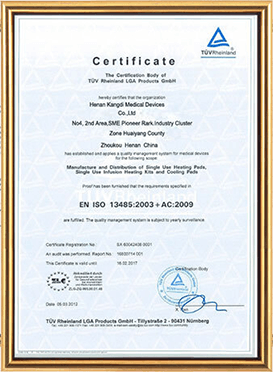
Henan Kongdy Medical Devices Co., LTD. (KONGDY) was founded in 1989 and has 37 years of production experience as of 2026 across pain relief patches, slimming patches, capsicum plasters, heat patches, cooling gel patches, detox foot patches, steam eye masks, mosquito repellent patches and nose strips. Headquartered in Henan, China, KONGDY operates a 100,000-class GMP workshop built in 2008 and obtained ISO 13485 medical device Quality Management System European Standard Certification in 2014. The company runs OEM and ODM services for international brands across multiple regulatory pathways.
For a 2026 procurement evaluation the qualification team can supply the ISO 13485 certificate, GMP workshop audit reports, stability programme documentation, and reference customer case studies upon request via our contact page.
Related Guides
Five further references from the KONGDY knowledge base:
- Pain Relief Patch OEM: six warning letters compared
- Heat Patch OEM: twelve record gates from material to release
- Frequently asked compliance questions
- KONGDY OEM and ODM manufacturing services
- Cooling Gel Patch OEM: the 24-point data integrity walkthrough


