-
 KONGDY
The 24-Point Data Integrity Walkthrough: What a Cooling Gel Patch OEM Record Has to Show in 2026
The 24-Point Data Integrity Walkthrough: What a Cooling Gel Patch OEM Record Has to Show in 2026

Data integrity is usually described as a system property. It is easier to test as a property of one record, and the test takes a minute: pick a batch, pick a result, and ask whether a stranger could reconstruct what happened from what is written down.
The twenty-four points below are that test, broken into its parts. They are organised as a walkthrough of a record rather than as a description of a system, because a system description cannot be checked and a record can.
Two clauses carry most of the weight. 21 CFR Part 11 governs electronic records and electronic signatures, and 21 CFR 211.194(a) governs the laboratory record specifically. The worked failures come from warning letter MARCS-CMS 724506, which documents a firm whose analytical reports lacked specifications, whose reports cited modified pharmacopeial methods without describing the modifications, and whose response to the agency supplied summary reports without supporting documentation.
That last detail is the reason this checklist is phrased as it is. The firm did produce documents. What it did not produce was a document from which the underlying work could be reconstructed, and the agency treated those as different things.
For a cooling gel patch OEM the twenty-four points are worth applying to one product before applying them to a system. A single batch walked end to end will find more than a policy review. A cooling gel patch OEM that has walked one batch knows more about its records than one that has read its own manual twice.
Why twenty-four points on a record, not a system
A system is described in a manual and a record is checked on a page, and the difference matters because only one of them can be falsified by a stranger.
| The question a buyer or an inspector asks | What answers it |
|---|---|
| Do you have a data integrity programme | A manual, which is true and unverifiable |
| Show me who made this measurement | Point one, on one record, in one minute |
| Show me what this result was judged against | Point six, on one report |
| Show me what changed in this value and who changed it | Point seventeen, on one audit trail |
| Show me that this batch could be recalled by lot | Points twelve to fifteen, on one batch record |
The second column is the whole argument of this article. Every question that actually gets asked in a procurement meeting or an inspection is answered by a record, and none of them is answered by a programme.
For a cooling gel patch OEM the practical consequence is that the twenty-four points can be applied before the programme exists. A firm that walks one batch and closes what it finds has more than a firm that writes a policy and closes nothing. A cooling gel patch OEM should apply the points to a product before applying them to a procedure.
Band one: how the record is made, points 1 to 5
The first band is about the physical and logical form of the entry, and it applies identically to paper and to a system.
| # | Check | What it has to show | What its absence looks like |
|---|---|---|---|
| 1 | Attributable | The name of the person who made the entry, at the time of the entry | A value with a date and no name, or a name added later by someone who did not make the measurement |
| 2 | Legible and permanent | An entry that can be read now and will be readable at the end of the retention period | Pencil, correction fluid, or a thermal print that has faded |
| 3 | Contemporaneous | Recorded when the step was performed rather than when the shift ended | A block of entries in the same handwriting and the same pen at intervals that match nothing |
| 4 | Original | The first record, with any later change visible as a change | A rewritten sheet that is the only version available |
| 5 | Accurate, with corrections traceable | A single-line strike-through, the reason, the initials and the date | A value overwritten, or a correction with no explanation |
Point five is the one that separates a correction from an alteration, and the distinction is the same in a paper record and in a database. In a system it becomes a question about the audit trail, which is band four. A cooling gel patch OEM that fixes point five has fixed the habit that produces most of the others.

Band two: how the laboratory result is recorded, points 6 to 11
The second band is the laboratory, and it is where the worked example failed most often.
| # | Check | What it has to show | What its absence looks like |
|---|---|---|---|
| 6 | The specification the result is judged against | The limit, stated on or with the report | A number with no limit, which is what the letter found: analytical reports lacking specifications |
| 7 | The method, with any modification described | The method identified, and a modification described rather than named | A report citing a modified pharmacopeial method, which is what the letter found |
| 8 | The raw data behind the reported number | The chromatograms, the weighings, the instrument output | A summary report with the raw data held elsewhere or not held |
| 9 | The calculation, reproducible by a second person | The formula, the dilution factors, the unit conversion | A final number that cannot be recomputed from the record |
| 10 | The conclusion and the scientific justification | Why the result means what the firm says it means | A finding of sub-potency reported without justification, which is what the letter found |
| 11 | The out-of-specification path taken when a result fails | The investigation record, not a second test | A result replaced by a repeat measurement with no investigation recorded |
Point seven is the one that surprises people because it concerns a permitted practice. A modified method is not a violation. A modified method whose modification is not described is a result that cannot be related to anything, and the agency asked specifically for the modification to be described and justified with validation data.
Point nine is the one most often missing in a small operation, and it costs nothing to fix. A second person who cannot reproduce the calculation from the record is being asked to trust rather than to verify. A cooling gel patch OEM should be able to hand one report to a second analyst and get the same number back.

Band three: how the batch is recorded, points 12 to 16
The third band moves from the result to the batch, and it is where a release decision draws its evidence.
| # | Check | What it has to show | What its absence looks like |
|---|---|---|---|
| 12 | The master batch record exists and is approved | An approved version, dated, with the quality unit named under 21 CFR 211.22(a) | An instruction sheet that has never been approved by the quality function |
| 13 | Every step has a recorded actual, not only a tick | The value obtained, beside the value required | Check marks beside specifications, with no measured value anywhere |
| 14 | Deviations are recorded where they happened | An entry at the step, with the action taken | A deviation described in a summary at the end of the month |
| 15 | Material reconciliation closes | The quantity issued, used and returned, with the difference explained | An issue quantity with no use and no return, and no explanation |
| 16 | The record was reviewed before release | A second signature with a date, from the quality function | A release decision with no review record behind it |
Point thirteen is the cheapest improvement in the whole list. A record that holds the actual value beside the required value can be reviewed by somebody who was not there, and a record of ticks cannot be reviewed at all.
Point fifteen is the one that catches a real problem rather than a formal one. Material that cannot be reconciled has either been lost, used off-record, or recorded wrongly, and all three are the kind of finding that a reviewer pursues. A cooling gel patch OEM that cannot reconcile a lot has an explanation to find before a reviewer finds it.

Band four: how the electronic record behaves, points 17 to 21
The fourth band is 21 CFR Part 11, and it applies wherever a record lives in a system, which is now almost everywhere.
| # | Check | What it has to show | What its absence looks like |
|---|---|---|---|
| 17 | An audit trail exists for creation and modification | A history of values, with who changed what and when | The current value only, with no history, which is what a plain spreadsheet gives |
| 18 | Access is limited to authorised persons | Named accounts with defined permissions | A shared login, which makes every entry unattributable |
| 19 | Electronic signatures are attributable | The signature identifies the signer, and the system records the meaning of the signature | A typed name in a cell, which is a statement rather than a signature |
| 20 | Backups exist and restore is tested | A backup schedule, and a record of a restore actually performed | A backup that has never been restored |
| 21 | Records are retained and retrievable for the required period | A retention period applied in practice, per 21 CFR 211.180 | An archive that nobody can open in the format used today |
Point seventeen is the whole of Part 11 in one line for most smaller firms. A record that is overwritten in place produces a current state and no history, so the batch from last year cannot be evidenced even though the procedure says it can.
Point eighteen is the one that quietly defeats the rest. If two people share a login, then every entry in the system is attributable to nobody, and points one, sixteen and nineteen collapse together. A cooling gel patch OEM can fix this in an afternoon and it is usually the highest-value afternoon available. A cooling gel patch OEM with named accounts has made every later point answerable.

Band five: how the organisation keeps it true, points 22 to 24
The fifth band is the smallest one and the one that decides whether the other twenty-one stay true after the first audit.
| # | Check | What it has to show | What its absence looks like |
|---|---|---|---|
| 22 | Changes to a record design go through change control | A change record naming what changed, why, and the review that approved it | A template edited on the floor and used the same afternoon |
| 23 | People are trained on the record they are asked to complete | A training record tied to the specific form or system, dated | A general induction record from three years ago |
| 24 | Someone looks at a sample of records on a stated cycle | A self-inspection record with findings, and what was done about them | A self-inspection that has never found anything |
Point twenty-four is the mirror of the third band. A self-inspection that has never produced a finding has not been performed against the twenty-three points above, because every programme examined against them finds something in the first year. A cooling gel patch OEM should expect three to eight findings on the first pass and treat the pattern as the result.
The reason the mirror works is a property of the checklist rather than of the firm. Most of the twenty-four points are phrased so that they can be answered by looking rather than by asking, which means a self-inspection built on them cannot be satisfied by reassurance. A cooling gel patch OEM that has run it once has replaced an opinion with a list.
Three failure patterns the points catch
Across the twenty-four points, three patterns account for most of what a walkthrough finds, and naming them makes the results easier to act on.
| Pattern | Which points catch it | What it looks like in practice |
|---|---|---|
| The record of a decision rather than of a measurement | Points 1, 3 and 13 | Values entered at the end of the shift, all in one hand, none of them traceable to an instrument |
| The result that cannot be recomputed | Points 7, 8 and 9 | A reported figure with a method name, no modification described, no raw data attached and no calculation shown |
| The current state presented as a history | Points 4, 17 and 21 | A file that contains the right number today and cannot show what it contained last year |
The third pattern is the one that has grown fastest, because the tools that make recording easy also make overwriting easy. A shared spreadsheet is a better record than a form in every respect except that it has no history.
For a cooling gel patch OEM the third pattern is usually the one that requires money rather than discipline. Points one, three and thirteen need an instruction. Point seventeen needs a system that appends rather than replaces, and that is a design decision to be made once.
A cooling gel patch OEM that has made that decision can answer the electronic points for years without further work. One that has not answers them once per audit. A cooling gel patch OEM that designs for append rather than replace has closed the fastest-growing pattern in one decision.

How to run this in one afternoon
Take one batch, one product, and one result. The exercise is not an audit and it should not become one.
| Step | What to do | What it tells you |
|---|---|---|
| Pick a shipped batch | A batch that has left the building and gone to a customer | Nothing about a batch still in the warehouse is as instructive |
| Produce points 12 to 16 | The batch record, the review and the reconciliation | Whether the production record can be read by a stranger |
| Produce points 6 to 11 | One analytical report with its specification, method and raw data | Whether the number can be reproduced, which is the question the agency asked in the worked example |
| Produce points 17 to 21 | The audit trail for one edited value, and one restored backup | Whether the electronic record is a record or a current state |
| Ask someone else to do steps two to four | A person who did not record the batch | Whether points 1 to 5 are satisfied, because they will tell you what they could not follow |
The fifth step is the one that makes the exercise worth doing. The twenty-four points are written from the outside, and the only honest test of a record is whether somebody from the outside can follow it. A cooling gel patch OEM that asks a colleague to follow the record is running the only test that cannot be gamed.
A cooling gel patch OEM that runs this once will find between three and eight points open, and the pattern of which ones are open is more useful than the count. A cooling gel patch OEM that finds all of its findings in band four has a tooling problem, and one that finds them in band one has a habits problem. The two call for different spending.

About KONGDY Medical

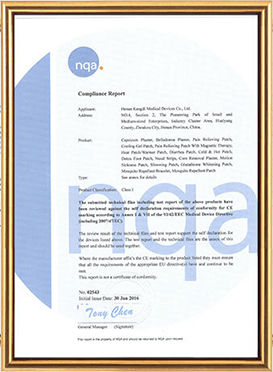
Henan Kongdy Medical Devices Co., LTD. (KONGDY) was founded in 1989 and has 37 years of production experience as of 2026 across pain relief patches, slimming patches, capsicum plasters, heat patches, cooling gel patches, detox foot patches, steam eye masks, mosquito repellent patches and nose strips. Headquartered in Henan, China, KONGDY operates a 100,000-class GMP workshop built in 2008 and obtained ISO 13485 medical device Quality Management System European Standard Certification in 2014. The company runs OEM and ODM services for international brands across multiple regulatory pathways.
For a 2026 procurement evaluation the qualification team can supply the ISO 13485 certificate, GMP workshop audit reports, stability programme documentation, and reference customer case studies upon request via our contact page.

Frequently asked questions
What does data integrity mean in practice?
It means a person who was not there can reconstruct what happened from what is written down, and can tell who did what and when. The twenty-four points in this article are that test broken into its parts, applied to one batch rather than to a system.
Which regulation governs electronic records?
21 CFR Part 11, for firms within the United States framework. It requires records to be trustworthy and reliable, audit trails for creation and modification, limited access, attributable electronic signatures, and retention that keeps the record retrievable. A record kept in a spreadsheet is not outside Part 11 because it is in a spreadsheet.
What specifically did warning letter 724506 find about laboratory records?
That the analytical reports lacked specifications, that the active ingredients were found below the labelled concentration without scientific justification, and that reports referenced modified pharmacopeial methods without describing the modifications. The agency also rejected a response that supplied summary reports without supporting documentation.
Is a modified test method a violation?
No. A modification is a permitted practice. What is not permitted is a result that cites a modification without describing it, because then the number cannot be related to the reference method or to anything else. The agency asked for the modification to be described and justified with validation data.
Why does a shared login defeat several checks at once?
Because it makes every entry unattributable. Point one requires a name at the time of the entry, point sixteen requires a review signature, and point nineteen requires an attributable signature. Shared credentials remove the basis for all three simultaneously, which is why it is usually the highest-value fix available.
How long must records be retained?
21 CFR 211.180 sets the retention requirements for records under the pharmaceutical framework, and a record that must be kept must also be retrievable. An archive in a format no current system can open is a retention claim rather than a retained record.
What is the single quickest improvement?
Recording the actual measured value beside the required value, rather than a check mark. Point thirteen costs nothing to change and turns a record that can only be reviewed by the person who made it into one that can be reviewed by anyone.
Does this checklist replace an audit?
No. It is a walkthrough of one record, and an audit examines a system across samples. What the walkthrough does better than an audit is finding out quickly whether the record you would produce in an inspection is a record or a document.
Related Guides
Five further references from the KONGDY knowledge base:
- Heat Patch OEM: twelve record gates from material to release
- Pain Relief Patch OEM: six warning letters compared
- Frequently asked compliance questions
- KONGDY OEM and ODM manufacturing services
- Capsicum Plaster OEM: substance family screen


