-
 KONGDY
Twelve Questions to Ask Before You Sign with a Capsicum Plaster OEM in 2026
Twelve Questions to Ask Before You Sign with a Capsicum Plaster OEM in 2026
A factory audit is the cheapest thing a buyer can do and the thing buyers most often skip, and the reason for skipping is usually the same one: the factory says it already passes everything.
A warning letter issued on 17 September 2025 shows what a factory that does not pass everything looks like from the inside. Three CGMP findings, and two of them carry a sentence that is worth reading twice: this is a repeat violation noted in previous inspections.
Repeat is the important word. It means a previous inspection had already found the same gap, and it was still open. The firm inspected from 5 to 11 March 2025 responded to the Form FDA 483 on 27 March 2025, and the letter arrived on 17 September 2025.
For a capsicum plaster OEM buyer, that is the case that argues for auditing a factory you have not yet signed, rather than a factory you are about to leave. The twelve questions below are the ones that would have found it.
1. What is the single question that tells me the most?
Ask what the last inspection found and what was closed out, because that one question covers the whole quality system.
In the case in this library, the answer was a sentence that appears twice in a single letter: the failure to perform process validation for over-the-counter aerosol products was a repeat violation noted in previous inspections, and the failure to test an adequate number of batches under its own written stability procedure was also a repeat violation noted in previous inspections.
| The two repeats | Why each one is a system failure |
|---|---|
| No process validation for the over-the-counter aerosol line | A validation gap is not a paperwork gap. It means the line has never been shown to do what it is supposed to do |
| Fewer batches on stability than the firm own written procedure requires | A firm that does not test what its own procedure says it will test cannot support the expiry dates on the product it already sold |
The second row is the one that matters most to a buyer, because the product is already on shelves somewhere and the expiry dates on it are what a buyer inherits.
A capsicum plaster OEM that answers this question with a document rather than a sentence has given you the single most useful piece of information available before signing.
2. What should the response to my audit questionnaire contain?
A timeline, an interim plan, and a named owner for each item, because a response without those three is the response the agency called inadequate.
The firm in this library said it would outline the control procedures to ensure that manufacturing processes are properly validated, and that it would follow its current standard operating procedure for data collection.
| What the reply promised | What the agency asked for instead |
|---|---|
| An outline of control procedures | A detailed summary of the validation program, including process performance qualification and ongoing monitoring of intra-batch and inter-batch variation |
| A commitment to follow the existing procedure for data collection | Process performance protocols and written procedures for qualification of equipment and facilities |
| Nothing about when | A timeline for performing appropriate process performance qualification for each marketed drug product |
| Nothing about what happens in the meantime | Details of interim plans while full validation is being completed |
The third and fourth rows are the same omission seen twice, and they are the reason the reply was judged inadequate. A commitment with no date is a sentiment, and an interim plan with no detail is a promise about a period during which the product is still on shelves.
For a capsicum plaster OEM the test is simple: if the answer to a question about a known gap does not contain a date, a named person and a description of what happens in the meantime, the answer is not a plan.

3. How many batches must be on stability, and who decides?
The firm decides, in its own written procedure, and then the procedure has to be followable by the firm.
The finding in this library was not that the stability data was poor. It was that the firm did not test an adequate number of drug product batches as defined by its own written stability procedure, and that this too was a repeat violation.
| The element of a stability programme | What a buyer should ask for |
|---|---|
| Stability-indicating methods | A written description of the methods, and evidence they indicate stability rather than merely measuring it |
| Studies in the marketed container-closure system | Confirmation that the studies were run in the pack the customer receives, not in a laboratory container |
| Before distribution is permitted | Confirmation that the study is complete before the batch ships, not after |
| Representative batches added each year | A calendar showing which products get a fresh batch each year and which do not |
The second row is the one a buyer has to verify rather than accept. A stability study in a different container tells the buyer nothing about the shelf life of the pack on the shelf, and this is the point at which a spice-based patch, with its own packaging interaction questions, is most often under-specified.
The fourth row is the one that catches a drift. A programme that adds batches for some products and not others is a programme that has stopped, and the letter asked for a complete picture of it rather than a sample.
4. Who signs off a batch, and what do they actually look at?
The quality unit, and it has to review records before the batch is released, not after it has shipped.
The third finding in this library was that the quality control unit failed to exercise its responsibility to ensure that drug products manufactured comply with CGMP and meet established specifications for identity, strength, quality and purity.
| What the quality unit was supposed to ensure | The finding |
|---|---|
| Adequate procedures for change controls, batch record release and CAPA | The procedures were not adequate |
| Adequate review of control records, meaning finished product testing, prior to release and distribution | The review before release and distribution was not adequate |
| Appropriate procedures established and followed for the cleaning and maintenance of drug manufacturing equipment | The procedures were not appropriate, or not followed |
The second row is the one with teeth. Review before release is a sequence, and a sequence is the first thing to break when a plant is running late.
The third row is the one that connects to a patch line directly. Capsicum paste is messy, the equipment that handles it is cleaned under time pressure, and a cleaning procedure that exists on paper and not on the floor produces the cross-contamination that a first-aid antiseptic claim cannot survive.
A capsicum plaster OEM whose release review happens after dispatch has moved the review, not removed it, and the buyer inherits the risk of finding out later.
5. Should I audit the factory or the trading company?
The factory, always, and if they are not the same company then you need both and the contract has to say which one is responsible for what.
A supply chain has at least three legal positions in it: the manufacturer who makes the product, the trading company who buys and resells it, and the brand owner whose name goes on the pack.
| Who you contract with | What they can actually give you | What you must still verify yourself |
|---|---|---|
| A factory | Batch records, process validation, stability data, quality unit release | That the records are theirs and not copied from a template |
| A trading company | Documentation, certificates, coordination | Everything about the plant, because they did not see it |
| A marketplace seller | A storefront and a shipping record | Everything, including whether a factory exists at all |
| A brand owner | A specification and an approval | Everything below it |
The second row is the one that goes wrong. A trading company can supply a certification document that is real and a plant that has never been audited, and the two facts do not contradict each other.
A capsicum plaster OEM that will not name the manufacturing site and the legal entity that owns it is not ready for an audit, and that is a perfectly good reason not to proceed.

6. How long should an audit take and who should be on it?
Two days on site with three people, and the third person is the one who is usually missing.
| The role | What they look at | Why they have to be there |
|---|---|---|
| A quality or regulatory person | Batch records, deviations, CAPA files, the change log | They can read a record for what it is supposed to prove |
| A production or engineering person | The line, the cleaning procedure, the in-process controls | They can tell whether the written procedure is what happens |
| A buyer or category lead | The pack, the claim, the label, the shipping documents | They can tell whether the thing made is the thing ordered |
The third row is the one worth insisting on. The first two people can confirm that a plant works, and the third person is the only one who can confirm that the plant is making the right product for the right market, which is a different question and the one the buyer is actually being paid to answer.
For a capsicum plaster OEM the label review belongs to the third person and takes an afternoon, and it is worth an afternoon because the claims on the pack are what turns a cosmetic into a drug.

7. What should I read before I go?
Four documents, and if any of them does not exist that is the finding.
| The document | What you are checking for | The red flag |
|---|---|---|
| The written process validation program | Process performance qualification plans, ongoing intra-batch and inter-batch monitoring | An outline, a promise, or a plan with no dates |
| The written stability program | Methods, container-closure, annual batch additions, attribute definitions per timepoint | A procedure the firm does not follow |
| The quality unit procedures | Change control, batch record release, CAPA, equipment cleaning and maintenance | Procedures that exist but are not signed or not dated |
| The last inspection or audit report | What was found, what was closed, what was not | A report that shows no findings at all, which usually means it was not a real audit |
The fourth row of the last column is the one that experienced auditors recognise instantly. A report with no findings on a manufacturing site is not a good sign, it is a sign that nobody looked.
A capsicum plaster OEM that hands over these four documents before you arrive has already done half the work, and a capsicum plaster OEM that cannot is telling you something useful about how its quality system runs.

8. What are the findings that should stop the deal immediately?
A repeat finding, a missing quality unit, or an expiry date with no data behind it, and any one of the three is enough.
| The finding | Why it stops a deal | What it looks like in practice |
|---|---|---|
| A repeat violation | It means a previous inspection found the same thing and it was not closed, which is a statement about the quality system rather than about the gap | The same gap appearing in a second report for the same site |
| No functioning quality unit | Everything downstream of it depends on it, including the release decision | The person who signs the release is the person who ran the line |
| Expiry dates with no supporting data | The buyer inherits product that cannot be defended on expiry | Batches on the market with a shelf life nobody can substantiate |
| A response with no dates | It means the firm does not manage to a deadline | Commitments phrased as intentions |
The first row is the one that closes the case in this library. A repeat violation is not a worse gap than a first-time gap. It is a different kind of finding, because it is evidence that the firm knows how to fix a gap and did not.
For a capsicum plaster OEM the practical effect is that a factory with a closed gap is a supplier and a factory with an open gap is a risk, and the difference is worth more than any discount.

9. How long do I give them to fix what I find?
Long enough to close it properly and short enough to see it happen, and the measure of the first is whether the fix is a document or a change.
| The finding | A reasonable response | Not a reasonable response |
|---|---|---|
| Process validation not performed | A schedule per product with process performance qualification, and an interim description of what is in place until then | A revised procedure with no run behind it |
| Stability programme short of batches | A catch-up plan and a calendar for the ongoing annual additions | Adding one batch and calling the programme current |
| Release review not adequate | A documented review step with a named reviewer before dispatch | A training record |
| Cleaning and maintenance procedures | A revised procedure, a training record, and a verification the auditor can see | A signed checklist with no verification step |
The third row of the middle column is the one that most factories will agree to and not do, which is why it should be the one the contract names a verification for.
A capsicum plaster OEM that is given a documented interim measure is not being asked to have a perfect plant next month, it is being asked to have an honest one, and the two are much easier to work with.
10. What has to go into the contract, not just the audit report?
The audit finding belongs in the contract, because an audit report is a snapshot and a contract is the thing that survives the snapshot.
| The clause | What it must say | Why it belongs there |
|---|---|---|
| Right to audit | Frequency, notice period, and the right to audit sub-suppliers and the trading entity as well as the factory | The plant can change and the contract can outlast it |
| Regulatory status | What the supplier is and is not authorised to do in each market, including the markets it does not currently supply | A product sold outside its status becomes an unapproved product |
| Documentation and record access | Batch records, validation and stability data, and access within a stated period | Access after the fact is the only version that helps |
| Change notification | Notice before changes to the process, the site, the formulation or the quality unit | The change is the event that invalidates the audit |
| Defect and recall | Notification, cooperation, cost responsibility, and a defined recall decision route | A recall is a commercial event and it happens on somebody clock |
The fourth row is the one that most contracts omit and most buyers wish they had not. An audit is a picture of a factory on one day, and a change of site, process, formulation or quality unit is what makes the picture wrong.
A capsicum plaster OEM that accepts a change notification clause is agreeing to be audited more often, and one that refuses is telling the buyer where the risk sits.
11. How often should I re-audit?
Every year for a stable site, every time something changes, and immediately when something goes wrong.
| The trigger | The response | The reason |
|---|---|---|
| The calendar | An annual audit at the same plant | The plant does not stay audited, it stays operated, and the two drift |
| A change of site, process, formulation or quality unit | An audit before the change takes effect, not after | The last audit result no longer describes the operation |
| A complaint, a returned batch or a market action | An audit within days | The event is the finding, and it will not be found on a schedule |
| A finding at the last audit | A closing audit, not a closing email | A repeat finding is the failure mode to design against |
The fourth row is the row that came out of the case in this library. Two of the three findings there were repeat violations, and both were in areas a closing email would have accepted.
For a capsicum plaster OEM the calendar is the easy part, and the trigger-driven part is the part that keeps a good supplier good.
12. What if the audit finds problems?
You have three options and only one of them is usually chosen, which is to walk away.
| The option | When it makes sense | What it requires of you |
|---|---|---|
| Walk away | A repeat finding, a non-functioning quality unit, or a regulatory status problem | Finding another supplier at short notice, which is why a second source is never optional |
| Fix it and continue | A documentation gap with a credible owner and a date | A closing audit, and the patience to enforce it |
| Fix it and reduce the scope | The gap affects one product or one line rather than the site | A written scope limit and a separate audit trail for what you stopped buying |
The third row is the option that is almost never written down, and it is the one that works when a good site has one bad product line.
A capsicum plaster OEM that a buyer reduced the scope on is still a supplier, and a capsicum plaster OEM that a buyer walked away from is still available to your competitor, which is worth remembering when the negotiating gets hard. A capsicum plaster OEM that is still in the supplier list after an audit has been through something, and that is a qualification in its own right.
About KONGDY Medical

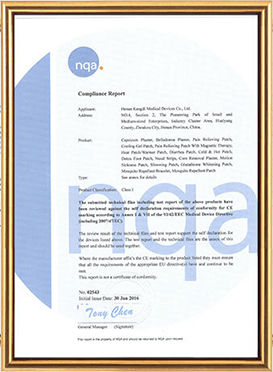
Henan Kongdy Medical Devices Co., LTD. (KONGDY) was founded in 1989 and has 37 years of production experience as of 2026 across pain relief patches, slimming patches, capsicum plasters, heat patches, cooling gel patches, detox foot patches, steam eye masks, mosquito repellent patches and nose strips. Headquartered in Henan, China, KONGDY operates a 100,000-class GMP workshop built in 2008 and obtained ISO 13485 medical device Quality Management System European Standard Certification in 2014. The company runs OEM and ODM services for international brands across multiple regulatory pathways.
For a 2026 procurement evaluation the qualification team can supply the ISO 13485 certificate, GMP workshop audit reports, stability programme documentation, and reference customer case studies upon request via our contact page.
Frequently asked questions
What is a repeat violation and why does it matter more than a first finding?
It is a finding that a previous inspection already made, which means the firm has had the information before and the gap is still open. In the case in this library two of the three CGMP findings were repeat violations, covering process validation for the over-the-counter aerosol line and the number of batches tested under the written stability procedure.
How many batches should be on stability?
The firm decides in its own written procedure, and the requirement that matters is that it follows it. The finding in this library was not that the data was weak, it was that an inadequate number of batches was tested as defined by the firm own written stability procedure, which left the expiry dates on the market without appropriate supporting data.
What does the agency require in place of a promise?
Specific timelines and interim plans. In this case the response was judged inadequate precisely because it lacked specific timelines and details of interim plans while the firm worked toward full process validation, and separately because it did not address the stability data needed to support the expiry dates of products already on the market.
Does the quality unit have to sign off before the batch ships?
Yes. The finding was that the quality unit failed to ensure adequate review of control records, meaning finished product testing, prior to release and distribution, as well as adequate procedures for change controls, batch record release and corrective and preventive action, and appropriate procedures for cleaning and maintenance of drug manufacturing equipment.
Should I audit a supplier or their trading company?
The factory, and both if they are different entities. A trading company can supply genuine documents about a plant it has never visited, and the audit has to reach the manufacturing site, the legal entity that owns it, and any sub-supplier in the chain.
What is the most useful question to ask a factory before visiting?
What did the last inspection find, and what was closed out. It surfaces repeat violations, gaps in the quality unit, and missing validation in one question, and it is the question a factory that passes everything can answer immediately.
How long should a capsicum plaster OEM audit take?
Two days on site with three people: a quality or regulatory person for the records, a production person for the line, and a buyer or category lead for the pack and the claims. The third person is the one most often left out and the only one who can confirm the plant is making the product and the claim that were ordered.
What has to be in the contract rather than the audit report?
The right to audit with a stated frequency and notice period, including sub-suppliers, the regulatory status in each market, access to batch records and validation and stability data, advance notification of changes to the process, the site, the formulation or the quality unit, and defect and recall notification with cost responsibility.
What if I find problems at the audit?
Three routes: walk away, fix it and continue with a closing audit, or fix it and reduce the scope to the product lines that are not affected. The third is the one that keeps a good supplier and stops a bad product, and it needs to be written down.
Related Guides
Five further references from the KONGDY knowledge base:
- Capsicum Plaster OEM services and manufacturing
- Pain Relief Patch OEM: how a contract is read
- Frequently asked compliance questions
- KONGDY OEM and ODM manufacturing services
- Cooling Gel Patch OEM: the glycerin and DEG questions


