
-
 KONGDY
The Case Where a Preservative Was the Wrong Answer: What FDA Warning Letter 721916 Shows a Pain Relief Patch OEM in 2026
The Case Where a Preservative Was the Wrong Answer: What FDA Warning Letter 721916 Shows a Pain Relief Patch OEM in 2026
On 9 April 2026 the Center for Drug Evaluation and Research issued warning letter MARCS-CMS 721916 to Medical Products Laboratories, Inc., of Philadelphia. The firm had been inspected from 29 September to 16 October 2025 and had answered the Form FDA 483 on 6 November 2025.
This is the first letter in this library about microbiology, and it is worth reading in full for the sequence it records, because the sequence is the finding.
A laboratory reported gross contamination on the plates of finished batches, with two lots too numerous to count. The firm treated the finished batches with an unvalidated protocol, resampled, and released the product on the resampling results. The corrective action included revising the formula to increase preservative content. The agency rejected that remedy in terms, and required five things instead, one of which is a system assessment listing seven physical characteristics.
For a pain relief patch OEM the case matters because the products are gels, and a gel is not sterile, and because the remedy the firm proposed is the one a cosmetic manufacturer is most likely to reach for.
1. The facts, exactly as the letter states them
The identification facts come first, and the inspection length is the notable one.
| Item | What the letter states |
|---|---|
| Letter | MARCS-CMS 721916, dated 9 April 2026 |
| Firm | Medical Products Laboratories, Inc. |
| Facility identifier | FEI 2513595 |
| Address | 9990 Global Road, Philadelphia |
| Recipient | Mr. Stone |
| Inspection | 29 September to 16 October 2025, eighteen days |
| Form FDA 483 response | 6 November 2025 |
| Route | The firm manufactures prescription and over-the-counter drug products for topical administration |
| Products found to be unapproved new drugs | Hydro-Q 4% Gel, several sodium sulfacetamide and sulfur suspensions, washes, shampoos, cleansers, lotions and creams at various strengths, a salicylic acid 28.5 percent solution, and Plexion shampoo, lotion and cream |
| CGMP findings | 21 CFR 211.113(a), plus production and process control, batch investigation and stability |
The sixth row is the longest inspection recorded in this library, and the reason it is worth noting is that the findings that came out of it are the kind that a short inspection tends to miss.
The seventh row is the one that makes the case readable for a patch manufacturer. Eleven or more topical products, most of them gels, suspensions and washes, sold into the prescription and over-the-counter channels, and the same set of clauses applied to every one of them.
2. Finding one, and the sequence that produced it
The first finding is 21 CFR 211.113(a), on written procedures designed to prevent objectionable microorganisms in drug products not required to be sterile, and the sequence recorded under it is the most instructive passage in this library.
| Step | What the letter records |
|---|---|
| The failure | The firm manufactured topical products and failed to establish and follow procedures to prevent contamination with objectionable microorganisms |
| The intervention | It used an unvalidated treatment protocol on filled drug product batches in an attempt to reduce microbiological content |
| The result | The laboratory reported gross contamination on plates for both the total aerobic count and the total yeast and mold count, with two lots too numerous to count for both counts |
| The release | The firm subsequently released drug products based on results from resampling after the treatment |
| The remedy | The corrective action included revising the drug product formulation to increase preservative content |
| The response | The agency rejected that remedy, and required five things instead |
The fourth step is the one a reader should stop at. A resample taken after an unvalidated treatment is not a repeat of the original test, and treating it as one converts a failing measurement into a passing one without anything having changed.
For a pain relief patch OEM the sequence is the whole argument. Every step in it is a decision that a manufacturer can make differently, and the first of them is not to treat a finished batch as something that can be processed back into compliance.
3. The remedy the agency rejected
The sentence is short and it is the one to quote: preservatives are not a substitute for a comprehensive approach to preventing objectionable microorganisms, and cannot be relied on to reduce in-process bioburden during manufacturing.
It matters because the rejected remedy looks like good practice. Increasing preservative content in a water-based formula is a reasonable thing to do for a shelf life, and the agency is not saying it is a bad idea.
| What the firm proposed | What the agency said about it |
|---|---|
| Revise the formula to increase preservative content | It is not a substitute for a comprehensive approach to preventing objectionable microorganisms from contaminating drug products |
| The implication | It cannot be relied on to reduce in-process bioburden during manufacturing |
| The direction of travel | Upstream, to the design and control of the manufacturing operations and to the water system |
The third row is the operative point, and it is the reason the case belongs in a series about patch manufacturing rather than only in a series about regulatory cases. The contamination arrived through the process and the water, so the remedy has to be in the process and the water.
A pain relief patch OEM that responds to a microbiological failure by changing the formula has made the same error, and the error is invisible because the formula change works on the next batch by making the next batch harder to grow in rather than by removing the source.
4. The investigation that did not include the system
The second half of the microbiological finding is about scope, and it is the part that a reader can apply to any investigation.
The investigation into the failing results concluded that the contamination was from a component, recovered from a mixture of that component with another. The letter records that the investigation failed to consider out-of-limit microbiological recoveries from the water system.
| What the investigation did | What it did not do |
|---|---|
| Identified a component from which the organism was recovered | Consider whether the water that went into the mixture was itself returning out-of-limit organisms |
| Explained the failing plates | Explained why the system was returning organisms in the first place |
| Closed the investigation on the batches it was asked about | Asked whether the same pathway existed for other products and other lots |
The third row is the one that connects to the requirements. The agency asked for complete investigations into all batches with potential objectionable microbiological contamination or a failing microbiological result, whether or not the result was later invalidated, and for a remediation plan for the design, control and maintenance of the water system.
A pain relief patch OEM whose investigation of a microbiological failure names only a material has not found the source, and a pain relief patch OEM whose investigation also asks what the water was doing that week has found it.

5. The seven characteristics of the water system
The letter lists them, and the list is a usable description of a distribution system for any firm that has one.
| The characteristic | What it tests |
|---|---|
| System temperature | Whether the temperature is one that does not support the organisms of concern |
| Materials of construction | Whether the surfaces in contact with the water support growth or resist it, and whether they degrade |
| Slope | Whether the drainable part of the system is actually drainable |
| Identified dead-legs | Where the pipework has no flow, and for how long |
| Stagnant locations | Where the water sits still, including inside the equipment it feeds |
| Unsanitary fittings | Which connections cannot be cleaned and were not designed to be |
| Flow velocity | Whether the velocity is high enough to stop the system becoming a culture vessel |
Every one of the seven is a physical question about the plant, and every one of them has a maintenance action attached to it. That is what distinguishes a system assessment from a programme.
The letter also asks for the total microbiological count limits used to monitor whether the system is producing water suitable for the intended uses of each product, which ties the plant to the formulation and not only to itself.
For a pain relief patch OEM the practical version is that this list is a document that can be produced once and used in every qualification conversation in either market, and it is the document that answers the question a customer asks when a micro result surprises them.
6. The consequences, and the one that was voluntary
The firm issued a voluntary recall of lots due to microbiological contamination, and the agency required a risk assessment for product within expiry with actions specified, naming customer notification and product recall.
| The consequence | Who carried it |
|---|---|
| A voluntary recall of lots due to microbiological contamination | The firm itself, before the letter required it |
| A risk assessment covering all drug products where the treatment was attempted | The firm, which had covered only the two failing lots |
| A requirement to state whether additional bacterial species were present | The firm, which had asserted that the growth on the yeast and mold plates was solely bacterial without evidence |
| The agency conclusion | Unresolved manufacturing and quality problems can pose a significant hazard to patients |
The first row is the one that distinguishes this case from the others in this library. Everywhere else the consequence is written in the closing paragraph of the letter. Here the firm acted before the letter, which is evidence that it knew the contamination was serious.
The third row is the mirror of it. The firm made an assertion about the microbiology that the evidence did not support, and the letter asked for the evidence. A pain relief patch OEM that makes an assertion about a microbiological result without the identification to support it has made the same one.
7. What the other three findings are about
They are the recurring ones, and their presence alongside a microbiological finding is worth reading as a pattern rather than as four separate problems.
| Finding | The clause area | How it connects to the microbiology |
|---|---|---|
| Adequate written production and process control procedures | The production and process control provisions | A written procedure is what 211.113(a) requires, and it is the document that would have specified the cleaning and the hold times |
| Thorough investigation of any unexplained discrepancy or failure of a batch or of its components to meet specification | The batch investigation provisions | This is the clause that the inadequate investigation was about |
| An adequate written stability testing programme | The stability provisions | A microbiological failure and a stability failure have the same consequence for product in expiry |
The first row is the connection that matters most. The four findings are not four separate matters; they are one matter seen from four directions, and a firm that fixes only the microbiology has fixed the visible symptom.
A pain relief patch OEM that has a written production and process control procedure with defined cleaning, hold times and in-process controls has the document that 211.113(a) asks for, and a pain relief patch OEM that does not has to write one after a finding.

8. Six questions a buyer can ask
Each question corresponds to something in this letter, and each one is answerable from a document.
- Show me the microbiological release specification for this product. It should include the identification requirement, not only the count.
- Show me the retain testing summary across failing, out-of-specification, out-of-limit and out-of-trend results. Four categories, and the fourth is the one that catches a drift.
- Show me the water system vulnerability assessment against the seven named characteristics.
- Show me the procedure that governs what happens to a batch when the microbiological result fails. It should not contain a treatment step followed by a resample.
- Show me the count limits and what they are monitored against. They should be set for the intended use of each product.
- Show me the investigations, including the ones whose results were later invalidated. The letter asks for those as well.
The fourth question is the one that separates this case from the ordinary one. A procedure that ends with a resample after a treatment has told the reader what the firm does when the answer is no, and a pain relief patch OEM that shows it can answer the same question without embarrassment.
A pain relief patch OEM that can answer all six has a microbiology programme, and a pain relief patch OEM that cannot has a count limit and a sanitation schedule, which is what this case shows is not the same thing.
9. Why this case belongs in a patch series
The findings in this letter sit in the drug framework, and a reader in the cosmetic route may reasonably ask what any of it means for a gel patch. Most of it does not apply directly. All of it applies commercially, and the reason is a question rather than a clause.
| The question | Where it appears | Why it applies to any route |
|---|---|---|
| What is the release specification for this product, and how was it measured | The release specification requirement, and the batch release provisions | It is the first question a customer asks about any gel product |
| What happens when the result fails | The investigation requirement, and the refusal to release on a resample after treatment | It is the question that reveals whether a quality system is real |
| Where did the contamination come from | The water system evaluation with its seven characteristics | It is a description of the plant, and a plant does not change with the route |
| What is still in the market | The risk assessment covering all lots currently within expiry | A recall is a commercial event under any route |
The third row is the one that survives the change of framework, and it survives for a simple reason. A water system does not know which regulation its output is sold under, and the seven characteristics the letter names are properties of the plant rather than of the paperwork.
For a pain relief patch OEM the practical conclusion is that the customer question and the regulatory question have the same answer, and a pain relief patch OEM that can answer it once has a document that works in both markets. A pain relief patch OEM that has only a count limit and a sanitation schedule has the two documents that this case shows are not the same thing.
The last row of the first table is the one that a customer actually asks, and it is the reason this letter is in this series rather than in a general regulatory collection. A pain relief patch OEM that has a written microbiology programme can answer it in a meeting, and a pain relief patch OEM that has only a certificate has to schedule a laboratory visit instead, which is a slower and a more expensive answer to the same question.
About KONGDY Medical

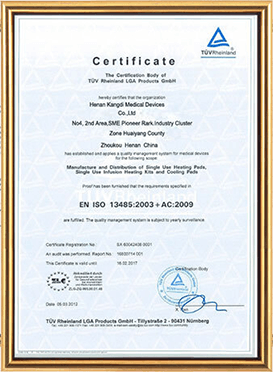
Henan Kongdy Medical Devices Co., LTD. (KONGDY) was founded in 1989 and has 37 years of production experience as of 2026 across pain relief patches, slimming patches, capsicum plasters, heat patches, cooling gel patches, detox foot patches, steam eye masks, mosquito repellent patches and nose strips. Headquartered in Henan, China, KONGDY operates a 100,000-class GMP workshop built in 2008 and obtained ISO 13485 medical device Quality Management System European Standard Certification in 2014. The company runs OEM and ODM services for international brands across multiple regulatory pathways.
For a 2026 procurement evaluation the qualification team can supply the ISO 13485 certificate, GMP workshop audit reports, stability programme documentation, and reference customer case studies upon request via our contact page.
Frequently asked questions
What is warning letter MARCS-CMS 721916?
A warning letter dated 9 April 2026 from the Center for Drug Evaluation and Research to Medical Products Laboratories, Inc., facility identifier FEI 2513595 at 9990 Global Road, Philadelphia, following an inspection from 29 September to 16 October 2025 and a Form FDA 483 response dated 6 November 2025. It contains four CGMP findings and concerns a topical gel, suspension, wash and lotion product range.
What was the central failure?
The firm used an unvalidated treatment protocol on filled drug product batches in an attempt to reduce microbiological content, after its laboratory had reported gross contamination with two lots too numerous to count for both the total aerobic count and the total yeast and mold count. The firm then released product on the basis of resampling after that treatment.
Why did the agency reject the corrective action?
The corrective action included revising the drug product formulation to increase preservative content. The agency states that preservatives are not a substitute for a comprehensive approach to preventing objectionable microorganisms from contaminating drug products, and cannot be relied on to reduce in-process bioburden during manufacturing.
What did the investigation miss?
It concluded that the contamination was from a component recovered from a mixture, but the letter records that the investigation failed to consider out-of-limit microbiological recoveries from the water system.
Did the firm recall product?
It issued a voluntary recall of lots due to microbiological contamination, and the agency separately required a risk assessment covering all drug product lots currently within expiry, with actions specified such as customer notification and product recall.
What does the letter require in place of a formula change?
A comprehensive independent assessment of the design and control of the manufacturing operations with a review of all microbiological hazards; a detailed risk assessment for distributed product; complete investigations into all batches with potential objectionable contamination or a failing result whether or not later invalidated; appropriate microbiological batch release specifications for each product meaning total counts and identification of bioburden; a summary of retain testing across the four result categories; and a remediation plan for the design, control and maintenance of the water system with an evaluation of the seven named characteristics.
Why does this matter to a patch manufacturer?
Because a gel patch is not a sterile product and 21 CFR 211.113(a) applies to it, and because the remedy the firm proposed is the one that is easiest to reach for and least effective. The letter is also the first in this library to treat microbiology as a primary subject rather than as an incidental one.
What does this letter add to the interval figures?
Eighteen days is the longest inspection recorded in this library, and the letter was issued 175 days after the inspection ended, which sits on the median of the inspection route.
Related Guides
Five further references from the KONGDY knowledge base:
- Detox Foot Patch OEM: twelve questions on microbiological control
- Heat Patch OEM: twelve questions on third-party release testing
- Frequently asked compliance questions
- KONGWY OEM and ODM manufacturing services
- Slimming Patch OEM: nine stages of an FDA site inspection


