-
 KONGDY
Twelve Questions About the External Analgesic Monograph: How a Capsicum Plaster OEM Should Read M017 in 2026
Twelve Questions About the External Analgesic Monograph: How a Capsicum Plaster OEM Should Read M017 in 2026
The external analgesic monograph is the instrument that decides whether a topical pain product can be sold in the United States without an approved application, and it is routinely read as a list. It is not a list. It is at least three different rules in one document, and the published letters in this library fail products on each of them separately.
Three letters provide the worked examples. One fails a product on its intended uses, one fails a product on its active ingredients, and one fails a product on both while also holding that a labelling tradition does not change the framework.
The twelve questions below are ordered the way the document has to be read: what the instrument is, how it is numbered, what it permits, what it forbids, and what happens outside it.
For a capsicum plaster OEM the exercise is worth an hour because it converts a general instruction to be compliant into a specific set of checks with published examples behind each one.
One note on precision before the questions. The two instruments in play have different names and both are cited in practice: the regulation text at 21 CFR Part 348, and the monograph order referenced as M017. Where a letter cites a paragraph number, this article quotes the paragraph number rather than paraphrasing it.
1. What exactly is the external analgesic monograph?
It is the set of conditions a topical pain product must meet to be marketed without an approved application, and meeting it is what makes the product generally recognised as safe and effective.
The mechanism runs through section 505G of the Food, Drug, and Cosmetic Act, which allows certain nonprescription drugs to be marketed without an approved application if they meet the applicable requirements. For external analgesics, that requirement is conformance to the conditions of the monograph.
| The question | The answer |
|---|---|
| What it permits | Marketing without an approved application, if the conditions are met |
| What it controls | The permitted intended uses, and the permitted active ingredients |
| What happens if a condition fails | The product is a new drug and needs an approved application |
| Where the CFR text sits | 21 CFR Part 348, external analgesic drug products for over-the-counter human use |
| How letters cite it | As M017, with paragraph numbers such as M017.2, M017.12 and M017.50(b) |
The fifth row is the one that matters operationally. A capsicum plaster OEM that has read only the CFR text has read one version of the rules, and the letters cite the monograph paragraphs.
2. Why do the letters cite M017.2 in one case and M017.12 in another?
Because both are cited in the published letters as the paragraph governing permitted active ingredients, and the honest answer is that this library records both rather than resolving which numbering controls.
| Letter | Paragraph cited | What the letter finds |
|---|---|---|
| MACRS-CMS 724506 | M017.2 | Natural herbs are not permitted as active ingredients in M017, in combination or as sole ingredients |
| MACRS-CMS 718720 | M017.12 | Zinc oxide and mentha oil, and separately chlorpheniramine maleate and thymol, are not permitted active ingredients, in combination or as sole ingredients |
| MACRS-CMS 724506 | M017.50(b) | The permitted general intended uses, which claims to promote healing, improve circulation and reduce inflammation go beyond |
The practical reading is that the paragraph numbers are stable enough to quote and the substance of the rule is consistent: there is a paragraph listing permitted active ingredients, and there is a paragraph listing permitted intended uses.
A capsicum plaster OEM should therefore check both paragraphs rather than treating one as the whole rule. The third row is the one most often missed, because a permitted ingredient can sit inside an impermissible claim.
3. What are the permitted intended uses?
They are stated in the letters more precisely than in most summaries, and one of them is not a pain indication at all.
A footnote in one letter in this library lists the permitted indications under M017 as the treatment of pain, itching and minor skin irritation generally, and the prevention of premature ejaculation.
| Permitted indication | What it covers | What it does not cover |
|---|---|---|
| Treatment of pain, generally | Minor aches and pains of muscles and joints | A named condition that is not a minor ache |
| Treatment of itching, generally | Itch as a symptom | An itch attributed to a disease the product is said to treat |
| Treatment of minor skin irritation, generally | Irritation as a symptom | A condition the product is said to heal |
| Prevention of premature ejaculation | A specific permitted use that is unrelated to pain | Nothing beyond itself |
The fourth row is real and it is worth knowing for a reason beyond completeness. It shows that the permitted uses are a closed list rather than a description of what an analgesic does, and a closed list has edges.
The edges are where products fail. One letter finds that claims to promote healing, improve circulation and reduce inflammation go beyond the allowed general intended uses, and another finds that a product intended for genital sores goes beyond them. Neither product failed on an ingredient.
4. Which active ingredients are permitted?
The monograph names a specific set, and this library records three of them with their concentration ranges from the CFR text.
| Active ingredient | Recorded range | Source in this library |
|---|---|---|
| Menthol | 3 to 16 percent | 21 CFR 348.10, the external analgesic OTC monograph entry |
| Methyl salicylate | 10 to 30 percent | 21 CFR 348.10 |
| Camphor | 3 to 11 percent | 21 CFR 348.10 |
| Every other ingredient | Not recorded here as permitted | A product formulated with anything else needs its own determination |
The fourth row is deliberate. This article lists what the library has registered with a concentration range and does not extend the list by inference, because the letters show what happens to products whose ingredients were assumed to be acceptable.
A capsicum plaster OEM should treat the three rows as a starting point and not as the membership test. The test is the paragraph in the monograph in force on the date of the screening.
5. What happened to the ingredients that are not on the list?
They failed, and the wording of the failure is consistent across two cases in this library.
| Product | Active ingredients as labelled | The finding |
|---|---|---|
| SINSINPAS AREX INSTANT PAIN RELIEF | Zinc oxide and mentha oil | Not permitted active ingredients under the monograph, whether used in combination or as sole ingredients |
| SINSINPAS Pain Relieving Liquid MULPAS | Chlorpheniramine maleate and thymol | Same finding, and the thymol element carries a separate determination |
| A product claiming natural herbs | Natural herbs, claimed to promote healing, improve circulation and reduce inflammation | Not permitted as active ingredients in the monograph, in combination or as sole ingredients |
The phrase that repeats is the one to keep. In combination or as sole ingredients means the route cannot be recovered by reducing the concentration of the unlisted ingredient, because a lower level is still an unlisted active ingredient.
The third row is the one with the widest reach for a capsicum plaster OEM, because natural herbs are exactly what a botanical formulation contains. The finding was not that the herbs were harmful; it was that they are not on the list.
6. What is different about thymol?
It is the only ingredient in this library with a separate regulatory determination cited against it, which makes it a stronger finding than simply being unlisted.
One letter states that the agency has also determined that over-the-counter external analgesic and anesthetic drug products with the active ingredient thymol are not generally recognised as safe and effective under a final determination issued under 21 CFR Part 330.
| The two kinds of finding | What each means |
|---|---|
| Not on the permitted list | The ingredient is not among those the monograph allows, so the product does not conform |
| Not generally recognised as safe and effective by determination | The agency has reached a conclusion about the ingredient itself, which does not depend on which product it is in |
The distinction matters because it changes what a manufacturer can do. An unlisted ingredient might be added to a monograph through the ordinary route. An ingredient with an adverse determination faces a different problem.
A capsicum plaster OEM reading the monograph for the first time should look for both kinds of finding rather than only the first.
7. Does the Drug Facts panel decide the question?
No, and one case in this library shows the panel being bypassed by a claim elsewhere on the label.
21 CFR 201.66 governs the Drug Facts format, and the letters quote purpose and uses from that panel. In one case the panel did not list the herbs as active ingredients, and the agency held that a claim that the products are formulated with natural herbs to promote healing, improve circulation and reduce inflammation purports that the herbs furnish pharmacological activity, which makes them active ingredients.
| Where the evidence came from | What it established |
|---|---|
| The Drug Facts purpose line | That the product is presented as a topical analgesic |
| The Drug Facts uses line | Which symptoms the product claims to address |
| A marketing claim outside the panel | That an ingredient supplemented the pharmacological activity, and therefore became an active ingredient |
| A website and two social accounts | That the labels were being presented to consumers in a specific channel |
The third row is the one to carry into a capsicum plaster OEM marketing review. The panel is a format, and the claim set is the substance, and the second is what determines the first.
8. Can the cosmetic route avoid the monograph?
It can avoid the monograph and it cannot avoid a framework, and the trade is not free.
| Route | What governs it | What it costs |
|---|---|---|
| US OTC monograph | Conformance to the permitted uses and active ingredients | The claim set is narrow and fixed |
| US cosmetic | Cosmetic requirements, with no drug claims permitted | The product cannot claim to treat anything |
| EU cosmetic | Regulation (EC) No 1223/2009, with a responsible person, a product information file and a substance annex | A different file, and a substance annex that also changes |
The second row is the trap. Moving to the cosmetic route does not preserve the claims; it removes them, and a product whose value is the claim has lost the value.
A capsicum plaster OEM should decide the route from the claim it intends to make, rather than choosing the route and then testing which claims survive.

9. What does a claim outside the permitted uses actually trigger?
Two findings at once in the cases in this library, not one.
One letter makes the chain explicit. Because the product is a nonprescription drug subject to section 505G but does not comply with the requirements for marketing under that section, and is not the subject of an approved application, it is misbranded under the provision that governs that situation. The introduction of a misbranded drug into interstate commerce is separately prohibited.
| The finding | What produced it |
|---|---|
| Unapproved new drug | The product does not conform to the monograph, so it is not generally recognised as safe and effective, and no application is in effect |
| Misbranded | The same non-conformance, expressed through the provision that covers nonprescription drugs marketed without an application |
| Prohibited introduction | Each of the above carries its own prohibition on interstate commerce |
The second row is the one manufacturers underrate. A single failure of conformance produces a labelling finding as well as a drug-approval finding, which is why the same letter carries both.
10. What does the route failure mean for the product commercially?
It moves the product from a list to an application, and an application is a different order of work.
| The position before | The position after |
|---|---|
| Marketing permitted if the monograph conditions are met | Marketing requires an approved application |
| Evidence is the conformance itself | Evidence is the application file and its data |
| The claim set is bounded by permitted uses | The claim set is bounded by the approved labelling |
The third row changes what a marketing function can do. Under the monograph the claim set is fixed by the instrument; under an application it is fixed by what was approved, and neither is something marketing can adjust.
For a capsicum plaster OEM the operational consequence is that the claim set belongs under change control, because a single sentence can move the product between the two columns.

11. How long does it take to find out?
Longer than the usual summary suggests, and this library now has three review-based cases that span about three months to about seven.
| Case | Start | Letter | Interval |
|---|---|---|---|
| 735346 | Website and storefront review, July 2026 | 2026-10-01 | About 2.5 to 3 months |
| 736006 | Products purchased, July 2026 | 2026-10-01 | About 2.5 to 3 months |
| 718720 | Labelling review, 2025-04-15 | 2025-11-12 | About 6.9 months |
The third row is a correction to a convenient generalisation. It is tempting to say that review-based cases move faster than inspection-based ones, and the first two rows support it while the third does not.
The defensible statement is narrower: inspection-based letters in this library run about five and a half to six and a half months, and review-based cases range from about three to about seven. A capsicum plaster OEM should plan on the range rather than on the fast end of it.
12. What is the shortest defensible self-check?
Five steps, in this order, and the order matters because each one can close the question before the next.
- Name the intended use in the words the label will use. Then read the permitted uses and check whether the wording sits inside one of them, including the edges.
- List every active ingredient, including the ones the panel does not list. A claim about an ingredient makes it an active ingredient, so the list is longer than the panel.
- Check each ingredient against the permitted list, and check the combination. The finding in one case applies to ingredients used in combination, which is a second test after the individual check.
- Check whether any ingredient carries an adverse determination. The thymol finding is not about the list; it is a determination that the ingredient is not generally recognised as safe and effective.
- Date the screening and name the version screened against. Both are needed, because a monograph changes and a screen without a version cannot be related to a later restriction.
The fifth step is the one that costs nothing and is missing most often. A capsicum plaster OEM that can produce a dated screening naming the version has answered the question before it is asked, and one that cannot has a conclusion without a record.
13. What the screening record should look like
The twelve questions produce a conclusion, and the conclusion is worth nothing without a record that can be read a year later by somebody who was not present.
| Field | What it has to contain | Why |
|---|---|---|
| The product and the formula revision | A specific revision, not a product family | A screening that covers a family cannot be related to the batch that shipped |
| The intended use, in the words the label will use | The actual claim wording | The edges of the permitted uses are decided by the exact wording |
| Every active ingredient, including unlisted ones | The panel list plus the ingredients any claim refers to | A claim makes an ingredient an active ingredient |
| Each ingredient checked individually and as a combination | Two results per ingredient | The published finding applies to ingredients used in combination |
| Any adverse determination found | Named separately from the list check | A determination is a different kind of finding and needs its own row |
| The version screened against, and the date | Both, on one line | A screen without a version cannot be related to a later restriction |
The sixth row is the whole reason a screening is worth recording. A capsicum plaster OEM that has a dated record naming the version can answer the only question that ever gets asked about a screen, which is what it was run against.
The fifth row is the one most often missing, and the thymol case is why it matters. A screening that checks only whether an ingredient is on the list will pass an ingredient that has a separate adverse determination, because the two tests are different tests.
There is one further feature worth adding, and it costs a sentence. A capsicum plaster OEM should record which permitted indication each claim was mapped to, rather than recording only that the claim set was approved. The mapping is what shows the reasoning, and the reasoning is what a reviewer checks when the wording later changes.
A capsicum plaster OEM that has the mapping can re-run the decision after a wording change in minutes, and one that has only an approval stamp has to reconstruct it. A capsicum plaster OEM in that position usually reconstructs it by deciding again, which is not the same thing as reviewing it.
That is the practical argument for all thirteen sections of this article. The monograph is short, the questions are twelve, and the record is one page. A capsicum plaster OEM that has all three has closed a route question that otherwise reappears at every product change. Everything in this article reduces to that one page, and the page is cheaper to write once than to reconstruct a second time under a deadline.
About KONGDY Medical

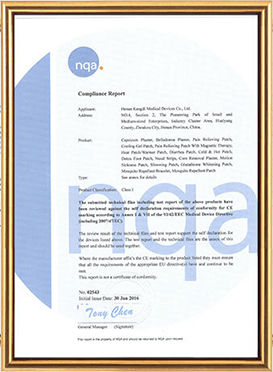
Henan Kongdy Medical Devices Co., LTD. (KONGDY) was founded in 1989 and has 37 years of production experience as of 2026 across pain relief patches, slimming patches, capsicum plasters, heat patches, cooling gel patches, detox foot patches, steam eye masks, mosquito repellent patches and nose strips. Headquartered in Henan, China, KONGDY operates a 100,000-class GMP workshop built in 2008 and obtained ISO 13485 medical device Quality Management System European Standard Certification in 2014. The company runs OEM and ODM services for international brands across multiple regulatory pathways.
For a 2026 procurement evaluation the qualification team can supply the ISO 13485 certificate, GMP workshop audit reports, stability programme documentation, and reference customer case studies upon request via our contact page.
Related Guides
Five further references from the KONGDY knowledge base:
- Pain Relief Patch OEM: six warning letters compared
- Capsicum Plaster OEM: export certificates and withheld approvals
- Frequently asked compliance questions
- KONGDY OEM and ODM manufacturing services
- Cooling Gel Patch OEM: the 24-point data integrity walkthrough


