
-
 KONGDY
The 20-Point Change Control Checklist: The One Record That Connects Every Other File for a Detox Foot Patch OEM in 2026
The 20-Point Change Control Checklist: The One Record That Connects Every Other File for a Detox Foot Patch OEM in 2026
Every article in this series has argued the same thing from a different direction: the file has to match the product. Change control is the mechanism that keeps that true, and it is the only record that connects the others.
The reason is structural. A formula, a laminate, a label and a claim each have a document. A change is the event that makes all four documents wrong at once, and it is the only event that does.
It is also the one failure that an inspection cannot reliably produce. A missing release specification can be requested. A blank cleaning step can be seen in a batch record. A change made without review is only visible by comparing the current state with a previous one, which requires a log that was already being kept.
For a detox foot patch OEM the twenty points below are organised in four bands: what counts as a change, how it is requested and assessed, who approves it and in what record, and what has to be redone afterwards.
One warning about the register itself. An empty change log is not a clean sheet. A manufacturing operation produces changes in the ordinary course of business, and a year with none recorded is a year without records rather than a year without changes.
Band one: what counts as a change, points 1 to 5
The first band defines the scope, and most failures of change control are failures to recognise that something was a change.
| # | Check | What it has to show | What its absence looks like |
|---|---|---|---|
| 1 | Any change to the formula or an ingredient level | A change record naming the ingredient, the before and after values, and the reason | A formula that differs from the one in the product information file, with no record of when it changed |
| 2 | Any change of supplier or material source | The supplier change recorded with the qualification of the new source | The same specification satisfied by a material from a different source, on the assumption that the specification is sufficient |
| 3 | Any change to the pack or laminate | A dated laminate specification, with a record of any revision | A packaging change made for cost, with the test reports left describing the previous laminate |
| 4 | Any change to the label or the claims | The label revision and the claim determination it relied on, both dated | Live listings carrying wording that no approved claim block contains |
| 5 | Any change to a process parameter or to equipment | The parameter, the previous value, the new value, and the qualification or validation that covers it | A line running to a different setting because that is what worked on the day |
The third row is the one that catches programmes most often, because a laminate change looks like procurement rather than like a product change. In a self-heating or gelling product the pack controls the performance, which makes a laminate substitution a formulation change wearing a different name.
A detox foot patch OEM should read the fifth row as covering settings as well as machines. A parameter adjusted on a shift is a change whether or not anybody wrote it down.
Band two: how a change is requested and assessed, points 6 to 10
The second band is the assessment, and its purpose is to establish what becomes untrue when the change takes effect.
| # | Check | What it has to show | What its absence looks like |
|---|---|---|---|
| 6 | A written request naming what changes and why | A dated request with the requester identified | An instruction given verbally and implemented the same shift |
| 7 | An impact assessment listing every document affected | The documents named individually, with the action for each | A general statement that relevant documents will be updated |
| 8 | A substance screening against the annex version in force | A dated screening for the changed material, naming the annex version | A substitution made under an annex read two years earlier |
| 9 | A decision on whether stability data are required | A written decision, with the reasoning, either way | An assumption that a minor change cannot affect the expiry date |
| 10 | A decision on whether cleaning validation needs review | A written decision covering shared equipment and worst case | A product added to a shared line with the cleaning validation unexamined |
The eighth row has a worked example in this library that makes it concrete. TPO was banned during 2025 and nail polish alerts containing it were notified for the first time that year, which means a formula written before the ban can still contain it. A change made under an annex read two years earlier is a change made against a document that no longer governs.
The tenth row matters more for a detox foot patch OEM than for a dedicated line. One case in this library records a firm manufacturing OTC drug products on the same non-dedicated equipment used for non-drug products, which turns every new product introduction into a cleaning question.

Band three: who approves it, and in what record, points 11 to 15
The third band is the approval, and the clause that governs it is specific about who and not about how.
| # | Check | What it has to show | What its absence looks like |
|---|---|---|---|
| 11 | Written approval by the quality function before implementation | A signature, a role and a date preceding the first batch made to the change | A change approved after the fact, by somebody reconstructing the record |
| 12 | A written statement of who has that authority | The quality unit responsibility and authority recorded, per 21 CFR 211.22(d) | A quality function that has never refused a change, because nothing says it may |
| 13 | An effective date and a batch break point | The first batch made to the new version, identifiable | Two versions in the market with no way to say which batch is which |
| 14 | An audit trail where the record is electronic | A history of the change to the change record, per 21 CFR Part 11 | A spreadsheet overwritten in place, showing the current version only |
| 15 | Any notification the change requires | Customer or authority notification, where a contractual or regulatory obligation exists | A customer buying a product they believe is the one described in the brochure |
The twelfth row is the one that separates authority from practice. A quality function whose own responsibilities are not written down has no documented basis to refuse anything, which means the approval in the eleventh row may be a formality performed by whoever is available.
The thirteenth row is the one a buyer should ask about, because it is answerable from a batch number. A detox foot patch OEM that can name the first batch made to a changed version has operational control. One that cannot has a log without a break point.
Band four: what has to be redone afterwards, points 16 to 20
The fourth band is the completion, and it is where most change control quietly stops halfway.
| # | Check | What it has to show | What its absence looks like |
|---|---|---|---|
| 16 | Every affected document revised and the previous version withdrawn | A revision number per document and a record that the old one is out of use | Two versions in circulation, with the older one still on a line |
| 17 | A release criterion for the first batches made to the change | The additional checks applied, and the basis for them | The first batches released against the unchanged specification |
| 18 | The changed product entered into the stability programme | The batch added, with the timepoints planned | A stability programme still describing the pre-change product |
| 19 | The log itself retrievable by product and by date | A log that can be searched, not only read in order | A log that exists and cannot be produced for a specific product |
| 20 | Every change reviewed in the periodic product review | A review record naming the changes of the period and their outcomes | A review that summarises the year without mentioning what changed in it |
The eighteenth row connects change control to the expiry claim. The regulation requires the labelled expiry date to be supported by stability testing, so a product change that never reaches the stability programme leaves the expiry date supported by evidence for a product that is no longer made.
A detox foot patch OEM that checks only points 1 to 15 has controlled the paperwork. Points 16 to 20 are what make the product match it. A detox foot patch OEM should check that for itself.

How to run this in half a day
Take one product, one year, and one question. The exercise is not an audit.
| Step | What to do | What it tells you |
|---|---|---|
| Pick a product shipped in the last twelve months | One that has been in the market and had time to change | Nothing about a product still in development is as instructive |
| Ask three people what changed | Production, purchasing and regulatory, asked separately | Whether the log is the record of change or one person memory |
| Produce the change records for that product | Every point from 1 to 15 for each change found | Whether the changes were recognised and approved |
| Check points 16 to 20 for one change | The document revisions, the release criterion and the stability entry | Whether the file was actually updated or only the log |
| Count the changes against the batch count | A plausible number, not a precise one | A product with hundreds of batches and no changes is a log that is not in use |
The fifth step is the one that produces the answer, and it produces it in a minute. Change frequency and batch frequency are not the same number, but they are related, and a ratio of zero is not a sign of stability.
A detox foot patch OEM that runs this exercise will find either a short log or a gap, and the second finding is the more valuable one because it can still be closed.

The three ways change control fails
Twenty points is a long list, and in practice the failures cluster into three patterns that are worth naming separately from the points.
| The pattern | Which points catch it | What it looks like |
|---|---|---|
| The change was not recognised | Points 1 to 5 | A laminate substitution, a supplier switch or a parameter adjustment treated as procurement or as a line decision rather than as a product change |
| The change was recognised and not assessed | Points 6 to 10 | A record exists, the impact assessment is a sentence, and no annex version is named |
| The change was assessed and not completed | Points 16 to 20 | The log is correct, the documents were not revised, and the stability programme still describes the previous product |
The third pattern is the most expensive and the least visible, because the evidence of it is an absence. A file with a complete log and unrevised documents looks like a programme from the outside and is a filing exercise from the inside.
A detox foot patch OEM can tell the three apart with one question per pattern: was this change identified, was it assessed, and was it finished. The third question is the one that most firms cannot answer quickly. A detox foot patch OEM should check that for itself.

What a buyer asks about change, in four questions
A procurement conversation about change control reduces to four questions, and each one is answerable from a document rather than from a description.
| The question | The document that answers it | What a weak answer sounds like |
|---|---|---|
| What changed in this product in the last twelve months | The log, filtered by product and by date, with every entry listed | A statement that nothing material changed |
| Which batch first carried each change | The batch break point recorded per change | A range of batches, or a month, rather than a batch number |
| What additional evidence was generated for the changed version | The release criterion, the stability entry and any retest | A statement that the specification was unchanged |
| Who approved it, and what gives them the authority | The approval record and the written quality unit responsibilities | A name without a role, or a role without a document |
The first question is the one that separates a programme from a claim. A supplier that can produce a filtered list has a log; a supplier that answers from memory has a recollection.
A detox foot patch OEM that has answered all four for its own file before a buyer asks has done something a certificate cannot do, which is to describe a specific product at a specific time.
The log entry that does the work
One entry, written properly, contains seven fields. A log that has all seven is searchable, and a log missing any of them is a diary.
| The field | Why it is there |
|---|---|
| What changed, described specifically | A category such as packaging change cannot be acted on later |
| The reason | It is what distinguishes a cost decision from a correction |
| The documents affected | Named individually, because the log has to drive the revisions |
| The assessment conclusion, including the annex version screened against | A screening without a version cannot be related to a restriction introduced later |
| The approver, the role and the date | The date must precede the first batch made to the change |
| The batch break point | It is the only way to tell two versions apart once both are in circulation |
| The completion record | The date each affected document was revised, so an open entry is visible as open |
The seventh field is the one that turns a log into a management instrument. Without it, an unfinished change looks identical to a finished one, and the third failure pattern in the previous section is invisible until an inspection finds it.
For a detox foot patch OEM the practical test is whether the log can show an open entry. A log where every row is complete has either a very disciplined operation or a habit of closing rows before the work is done, and the second is more common.
There is one further property worth stating, because it is what makes the whole checklist usable rather than theoretical. The log is the only record that a detox foot patch OEM writes before anybody asks for it. Every other document in this series is produced on request, and the log is produced in the ordinary course because the operation needs it.
That is why an empty log is such a strong signal. A detox foot patch OEM with a thin file can produce documents when asked and cannot invent a year of entries, so the log is the one place where a buyer sees the unedited record of how the product was actually managed. A detox foot patch OEM that has kept it well has kept the only evidence that cannot be assembled retrospectively.
A detox foot patch OEM should start with one entry rather than with a template. A detox foot patch OEM that records the next change it makes, with all seven fields, has started a log. One that designs a form and files it empty has started a document.
That distinction is the whole of this checklist in one sentence, and a detox foot patch OEM can test itself against it before an auditor does.
About KONGDY Medical

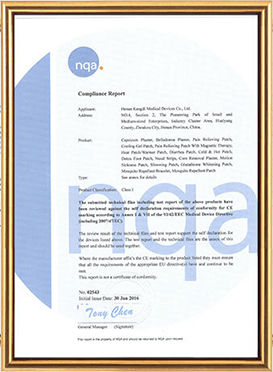
Henan Kongdy Medical Devices Co., LTD. (KONGDY) was founded in 1989 and has 37 years of production experience as of 2026 across pain relief patches, slimming patches, capsicum plasters, heat patches, cooling gel patches, detox foot patches, steam eye masks, mosquito repellent patches and nose strips. Headquartered in Henan, China, KONGDY operates a 100,000-class GMP workshop built in 2008 and obtained ISO 13485 medical device Quality Management System European Standard Certification in 2014. The company runs OEM and ODM services for international brands across multiple regulatory pathways.
For a 2026 procurement evaluation the qualification team can supply the ISO 13485 certificate, GMP workshop audit reports, stability programme documentation, and reference customer case studies upon request via our contact page.
Frequently asked questions
Why is change control the record that connects the others?
Because a change is the event that makes several documents wrong at once. A formula, a laminate, a label and a claim each have a document, and a change to any one of them invalidates the others until they are revised together. No other single event does that.
Is an empty change log a good sign?
No. A manufacturing operation produces changes in the ordinary course of business: a supplier substitution, a laminate revision, a specification correction, a claim rewording. A year with none recorded is a year without records rather than a year without changes.
What does the regulation say about who approves a change?
21 CFR 211.100(a) requires the quality control unit to review and approve the procedures for production and process control and any changes to them, and 21 CFR 211.22(d) requires the quality unit responsibilities and procedures to be in writing. One case in this library was cited because the quality unit had not approved the process documents.
Does a laminate change count as a product change?
Yes, and it is the one most often missed because it looks like procurement. In a gelling or self-heating product the pack controls performance, so a laminate substitution changes the product while leaving the formula unchanged.
Why does a change need a substance screening?
Because a restriction can be introduced after a formula is written. TPO was banned during 2025 and nail polish alerts containing it were notified for the first time that year, and a January 2026 case withdrew a skin care oil containing delta-9-THC and delta-9-THCA. A screening that does not name the annex version cannot show which version it was run against.
What is the batch break point and why does a buyer care?
It is the first batch made to the changed version, and it is the only way to tell two versions apart once both are in circulation. A buyer who is purchasing a product can ask which batch introduced the change, and the answer is checkable from a lot number.
Does a change affect the expiry date?
It can. 21 CFR 211.137(a) requires the labelled expiry date to be supported by appropriate stability testing, so a change that is never entered into the stability programme leaves the expiry date supported by evidence for a product that is no longer manufactured. Point 18 is the one that closes this.
How does this connect to a European file?
Through the product information file under Article 11 of Regulation (EC) No 1223/2009 and the technical documentation under Article 9(2) of Regulation (EU) 2023/988, which must be kept for ten years. A change that is not reflected in either means the document and the product have separated, and only the change log records when that happened.
Related Guides
Five further references from the KONGDY knowledge base:
- Slimming Patch OEM: nine stages of an FDA site inspection
- Cooling Gel Patch OEM: the 24-point data integrity walkthrough
- Frequently asked compliance questions
- KONGDY OEM and ODM manufacturing services
- Heat Patch OEM: twelve record gates from material to release


