
-
 KONGDY
Twelve Determinations Behind One Release: What a Slimming Patch OEM Should Be Able to Show for Every Batch in 2026
Twelve Determinations Behind One Release: What a Slimming Patch OEM Should Be Able to Show for Every Batch in 2026
Releasing a batch is one signature. It is the end of twelve determinations, and each of the twelve can be answered by a document or cannot be answered at all.
The reason this is worth twelve questions is a specific finding in the public record. In one case a firm told the agency in writing that it tested every batch before release. The agency then asked for the test data. The firm could not produce any records showing that it tested its finished products before release, and the letter concluded that the firm did not appear to be performing release testing on finished products at all.
Nothing in that exchange required an inspector to be on site. The agency had asked for records under section 704(a)(4) of the Federal Food, Drug, and Cosmetic Act in September 2024, the letter followed in August 2025, and the conclusion was reached entirely from documents that did or did not exist.
For a slimming patch OEM the twelve questions below are the twelve determinations that have to be answerable on request, in the order they are made. They are written as questions because the answer to each one is either a document or an absence, and an absence is what the record will eventually record.
1. What exactly does the release determination require?
A laboratory determination of satisfactory conformance to final specifications, including the identity and strength of each active ingredient, before release.
That is the text of 21 CFR 211.165(a), and the wording is narrow in two ways that matter.
| What the clause says | What it rules out | The consequence |
|---|---|---|
| A laboratory determination | A visual check and a weight | Two of the letters in this library record a firm offering exactly those two as its finished product testing evidence |
| Conformance to final specifications | Conformance to a general description of the product | The specifications have to exist, with limits, before the determination means anything |
| The identity of each active ingredient | A single assay covering a blend | Each active has to be identified, not inferred from the blend |
| The strength of each active ingredient | A pass against a range | A number without a limit is not a determination |
| Before release | After release, as part of a later review | The determination is the last act before the goods move |
The fifth row is the one that gets argued about, and the case law in this library settles it. One letter recorded the absence of an adequate stability programme as meaning that there was no scientific evidence that the product retained its quality attributes throughout the labelled expiry period, which is the same logic applied to the shelf life rather than to a batch.
A slimming patch OEM should treat the first two rows as the difference between a determination and a record of one. The determination is a conclusion against a limit; the record is evidence that the conclusion was reached.
2. Do the final specifications exist in writing?
They have to, because a determination against a specification that does not exist is not a determination.
One letter in this library asked the firm for a list of chemical and microbial specifications with adequate test methods used to analyse each batch before a batch disposition decision. Another recorded that the analytical reports it received lacked specifications and showed active ingredients below the labelled concentration without scientific justification.
| What the specification has to contain | Why each field is there |
|---|---|
| The attribute | Identity, strength, impurities, and the microbiological attributes where the product requires them |
| The limit | Without a number there is nothing to conform to |
| The method | So that the result can be related to something |
| The reference where one exists | So that a result can be compared with a published method |
| The date and the revision | So that a batch can be related to the specification it was released against |
The fifth row is the one that quietly stops mattering. A specification without a revision can be updated silently, and then a batch released last year was released against a limit that no longer exists.
3. Is the method the method that was written?
A modified method is permitted and an undescribed modification is not, and the distinction is worth stating precisely.
One letter in this library records that the microbiological reports referenced modified pharmacopeial methods without describing the modifications, and required complete results per the chapters as written together with justification and validation data for any change.
| The state of the method | What it means |
|---|---|
| The method as written | The result is comparable with the reference and with other laboratories |
| The method modified and the modification described and validated | The result is comparable and the change is a controlled one |
| The method modified and not described | The number cannot be related to the reference method or to anything else |
The third row is a result with no meaning rather than a wrong result, and that is the distinction that matters when an agency asks for the method. A slimming patch OEM that has a modified method should expect to produce the modification description and its validation without being asked, because the description is what makes the number usable. A slimming patch OEM should check that one first.

4. Can the raw data be produced?
Yes, because without it the reported result is a claim rather than a determination.
The letters in this library ask for the underlying documentation repeatedly. One requires an action plan and timelines for testing retain samples of all distributed batches within expiry, and a summary of all results obtained. Another asks for a comprehensive independent assessment of laboratory practices, procedures, methods, equipment, documentation and analyst competencies.
| What a number looks like | What it is |
|---|---|
| A result with the raw data behind it | A determination |
| A result with the calculation but no raw data | A reproduction that cannot be checked at the source |
| A summary table with neither | A number to repeat |
The third row is the one that ends a letter. When the agency asked one firm for its test data, the answer it received was that no records demonstrating release testing could be provided, and that became the finding itself.
5. Is the calculation reproducible?
By a second person, from the record, without asking the person who made it.
This is not a regulatory requirement written anywhere in the clauses in this library, and it is the cheapest quality control a laboratory has. It is also the question that separates a report from a number.
A slimming patch OEM that can hand the same report to a second analyst and get the same answer has a determination. One that cannot has a result, and the difference shows up on the first day somebody needs to defend it.
The reason this belongs in a list of twelve is that the failure is invisible internally. A calculation that only the analyst who wrote it can follow is not a calculation in any operational sense, and nothing in the routine reveals it. A slimming patch OEM should check that one first.

6. Where does the microbiological result sit?
Beside the chemical one, with the method stated, because the requirement for microbiological testing is conditional on the product and the condition has to be met explicitly.
21 CFR 211.165(b) requires appropriate laboratory testing for each batch of drug product that is required to be free of objectionable microorganisms. The reference methods are USP general chapters 61 and 62.
| The product | What the determination has to include |
|---|---|
| A product required to be free of objectionable microorganisms | The microbiological result, the method, and the limit |
| A product not so required | A written statement of why the requirement does not apply, and who decided |
The second row is the one that gets skipped, and skipping it leaves an absence rather than a decision. A slimming patch OEM that has decided the requirement does not apply has answered the question. One that has not looked has an open item. A slimming patch OEM should check that one first.

7. What happens when the result fails?
An investigation happens, and the investigation extends to other batches that may be affected.
21 CFR 211.192 requires a thorough investigation of the failure, an extension of the investigation to other batches, and a written conclusion with follow-up. The letters in this library are pointed at the same distinction from the other side, and one of them stated it plainly.
| What the record shows | What it means |
|---|---|
| A failed result and a second test that passes | A retest, not an investigation |
| A failed result, an investigation and a written conclusion | The investigation the clause requires |
| A failed result with no record of anything | An unresolved question that will be asked |
The first row is the trap, and it is common enough to be worth naming. A second test answers a different question from an investigation, because an investigation is about why the batch failed and whether anything else did.
8. What supports the expiry date on the pack?
A stability programme, run in the pack the product ships in, with the attributes and the timepoints defined.
The letters in this library state the consequence in the plainest terms available: without the appropriate stability studies there is no adequate scientific evidence that the drug product retains its quality attributes throughout the labelled expiry period. One letter required a written stability testing programme to be established and followed.
| The element | What it has to show |
|---|---|
| Stability-indicating methods | A method that detects change rather than one that confirms the sample is still present |
| The container-closure system | The pack the product ships in, because the pack is part of the test article |
| The attributes at each timepoint | A written definition of what is measured and when |
| An ongoing programme | Representative batches added each year, so the shelf life claim stays current |
| A link to the released batch | The batch that was tested and the batch that was sold |
The fifth row is the one that connects stability to release. A stability programme that does not reference the released batches is a programme about a different product, and the two have to be the same product.
9. Did the raw material get identified before it was used?
Yes, chemically and for every incoming batch, and the requirement is separate from anything the supplier says.
21 CFR 211.84(d)(1) requires at least one test to verify the identity of each component. The letters in this library describe what happens without it in detail.
One firm stated that it identified all items through its receiving practices and supplied the receiving procedure. The letter records that the procedure did not specify chemical identity testing, and that the incoming component testing data for the most recent batches shipped to the United States was not provided when it was asked for.
| The claim | What was missing from it |
|---|---|
| We identify all items at receiving | No chemical identity test was named in the procedure |
| We rely on supplier certificates | A commitment to at least one specific identity test per incoming lot was required |
| We have data for recent batches | The data for the most recent batches shipped was requested and not provided |
The third row is a documentation point with a serious edge, because a firm that cannot produce recent data has not necessarily got a filing problem. A slimming patch OEM should check that one first. A slimming patch OEM that has never been asked has no way of knowing which of the two it is.
10. Is the batch record complete, including the steps that were not ticked?
It has to be, and the step that is designed and left blank is the finding.
One letter in this library records that the batch records contained a designated step for documenting equipment cleaning and that this step was not completed for multiple drug product lots, and that no cleaning or sanitization logs existed at all.
| What the record shows | What it means |
|---|---|
| A step designed and completed | A control that was used |
| A step designed and blank | A control that everybody treats as a formality |
| No step and no log | A procedure that exists and produces nothing |
The second row is the one to ask about, and it is invisible in a procedure review because the procedure is there. The way to find it is to open three batch records and look at the same cell in each.

11. Where does the electronic record keep its history?
21 CFR Part 11 governs the record where the record is electronic, and the requirement that matters here is the audit trail.
An overwritten value produces a current state and no history, which means a batch released last year cannot be evidenced. That is the same problem as a missing log, arrived at by a different route.
| Where the record lives | What the evidence looks like |
|---|---|
| On paper | A signed entry with a date, and corrections made in a way that shows what changed |
| In a system with an audit trail | A value with its history, and the identity of whoever changed it |
| In a spreadsheet | A current value, and nothing about what it was before |
The third row is the one that appears in more files than any other, because a spreadsheet is easy to start and hard to retire. A slimming patch OEM whose batch records are electronic should be able to show what a value was last year, and if it cannot, the electronic record is a document rather than a record.
12. Who signed the release, and can they still be asked?
A named person with a role, a date, and the record that gives them the authority to sign.
The requirement that the quality control unit has the responsibility and the authority to approve or reject is the one that makes the signature meaningful, and one letter in this library found that the quality unit had not reviewed and approved the process documents at all.
| The element | What it establishes |
|---|---|
| A name and a role | Who decided |
| A date | When, and therefore which version of the file applied |
| The record covered | What was in front of the person signing |
| The written authority | That the person was entitled to decide |
The fourth row is the one that converts a signature into a decision. A slimming patch OEM whose quality function has no written authority to release a batch has a signature that carries no information, and a reviewer who asks who accepted the result will find that the question has no documented answer.
What the twelve determinations have in common
The twelve look like a list of laboratory questions and they are not. They are a single question asked twelve times, and the question is whether the release can be reconstructed.
| Determination | What it reconstructs |
|---|---|
| 1 and 2: the specification | What the batch was supposed to be |
| 3, 4 and 5: the method, the data and the calculation | How the number was produced and whether it can be repeated |
| 6 and 7: microbiology and the failure path | What else was checked and what happens when something fails |
| 8: stability | Whether the batch may still be sold at the date it is sold |
| 9 and 10: incoming material and the batch record | What went into the batch and what was done to it |
| 11 and 12: the electronic trail and the signature | Who decided, and whether the decision can still be explained |
That is why the case in this library with the most severe finding did not need an inspection. The agency asked for records, the firm could not produce records, and the finding followed from the absence. The same twelve questions would have answered it, one batch at a time, before it was ever asked.
That is the strongest argument for running the twelve on yourself. A slimming patch OEM that answers eleven of them has a gap it can close this week, and a slimming patch OEM that has never run them has an unknown number of gaps that will be found at a time of the agency choosing. The quantity of the number matters less than its existence, because a firm that has measured its own gaps can plan the work and a firm that has not is waiting to find out.
One further point belongs with these twelve, and it decides whether the exercise is worth doing at all. A determination is a conclusion, and a conclusion is only as good as the evidence behind it. The twelve questions are the shortest route from a claim that the work was done to a record that shows it, batch by batch.
For a slimming patch OEM the practical version of this is a single afternoon with a batch in front of you and a second person asking the questions. A slimming patch OEM that can answer all twelve from the folder has a determination. A slimming patch OEM that answers eleven has a gap, and a gap found in that afternoon is worth a great deal more than a gap found by an agency eleven months later.
About KONGDY Medical

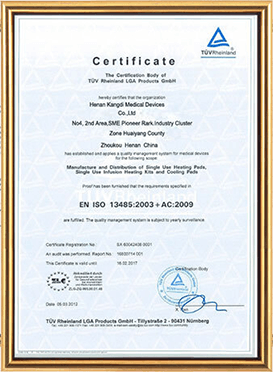
Henan Kongdy Medical Devices Co., LTD. (KONGDY) was founded in 1989 and has 37 years of production experience as of 2026 across pain relief patches, slimming patches, capsicum plasters, heat patches, cooling gel patches, detox foot patches, steam eye masks, mosquito repellent patches and nose strips. Headquartered in Henan, China, KONGDY operates a 100,000-class GMP workshop built in 2008 and obtained ISO 13485 medical device Quality Management System European Standard Certification in 2014. The company runs OEM and ODM services for international brands across multiple regulatory pathways.
For a 2026 procurement evaluation the qualification team can supply the ISO 13485 certificate, GMP workshop audit reports, stability programme documentation, and reference customer case studies upon request via our contact page.
Related Guides
Five further references from the KONGDY knowledge base:
- Pain Relief Patch OEM: six warning letters compared
- Cooling Gel Patch OEM: four working days at the border
- Frequently asked compliance questions
- KONGDY OEM and ODM manufacturing services
- Detox Foot Patch OEM: the 20-point claim approval register


