
-
 KONGDY
Three Letters on One Day: What FDA Warning Letter 736557 Shows a Heat Patch OEM in 2026
Three Letters on One Day: What FDA Warning Letter 736557 Shows a Heat Patch OEM in 2026

On 1 October 2026 the Center for Drug Evaluation and Research issued three warning letters on the same day, signed by the same person in the same office, about products that overlap.
One of them went to a platform. That is the part that makes this case worth reading carefully, because it is the first time this library has been able to see a single enforcement action laid across a manufacturer and two marketplaces at the same time.
Warning letter MARCS-CMS 736557 was issued to Walmart, Inc., addressed to John Furner, President and CEO, at 702 SW 8th Street, Bentonville, Arkansas. The agency had found the products by buying them from www.walmart.com in July 2026 and reviewing their labelling.
For a heat patch OEM the case is not about heat patches. It is about what it means when the person who moves the product to the customer is not the person who made it, and both of them get a letter on the same day.
1. The facts
Everything in this section is identification and procedure, and it is worth reading exactly because the case is about the chain rather than about a plant.
| Item | What the letter states |
|---|---|
| Letter | MARCS-CMS 736557, issued 2026-10-01 |
| Recipient | John Furner, President and CEO |
| Company | Walmart, Inc. |
| Address | 702 SW 8th Street, Bentonville, AR 72716-6299 |
| Contact | HWSCSAFETY@wal-mart.com |
| Office and signer | CDER, signed by Tina Smith, M.S., Captain, U.S. Public Health Service, Director, Office of Unapproved Drugs and Labeling Compliance, Office of Compliance |
| Delivery | By electronic mail, with read and delivery receipt requested |
| Response period | 15 working days, to FDAAdvisory@fda.hhs.gov, with the reference number in the subject line |
| The three products | HClear for him, Herstat GST and Terragen HG Formula |
| How they were found | Purchased from www.walmart.com in July 2026, with the labelling reviewed |
| What the letter characterises them as | Unapproved new drugs, and misbranded products |
The tenth row is the one that explains the speed. Nobody had to arrange an inspection, nobody had to request records, and nobody had to wait for a voluntary disclosure. The agency bought the product, read the label and wrote the letter.
The eighth row is worth reading twice, because it shows the mechanism working the way it is designed to. Fifteen working days, one email address, and the reference number in the subject line.
2. The three-party chain, which is the real content of the letter
The letter itself names three products. What it establishes, read together with the other two letters of that day, is a chain with three links.
| The product | A manufacturer letter | Both platform letters | What the chain shows |
|---|---|---|---|
| Herstat GST | Yes, 718720 to Sinsin Pharmaceutical | Appears in both 736006 and 736557 | Three parties were each told about the same product |
| Terragen HG Formula | Yes, 735346 to Aidance Scientific | Appears in both 736006 and 736557 | The same three-party chain, for a different product |
| HClear for him | No manufacturer letter in this library | Appears in both 736006 and 736557 | Two parties were told, and the manufacturer is the one absent from this library |
The first row is the one to hold on to. One product, three letters, three separate recipients, and each of them was asked to answer for their own part of it.
The third row is the one to be careful with, because it is a fact about this library and not a fact about the world. The absence of a manufacturer letter for that product does not mean no letter was issued.
A heat patch OEM reading this table should notice what it does not contain, which is a claim on the label being made by the person who owns the brand, with no manufacturing question asked.
3. What it means that a platform was written to
The role of a platform in this chain is narrow and specific, and the letter defines it by what it asks for.
| The question | The role it defines |
|---|---|
| Why is this product on your website | The listing itself is evidence that the product reaches consumers |
| What is the labelling you are distributing | The label in the listing is the label the customer receives |
| What is your response within 15 working days | The platform has an obligation of its own, separate from the manufacturer |
The third row is the one that matters for a supplier conversation. A platform that has received a letter of this kind has an obligation to respond, and that obligation is not the manufacturer obligation, and it does not discharge it.
This is the same structure as the three-party chain in section two, seen from the other side. The manufacturer answers for the product, the platform answers for the distribution, and neither answer covers the other.
For a heat patch OEM the practical consequence is that the channel is not a passive outlet. It is a party in the chain, and it can receive a letter of its own.
4. One enforcement action, three letters, one day
The single most useful thing in this library is not any one letter. It is the date.
| The letter | The party | The route that started it | The start |
|---|---|---|---|
| 735346 | Aidance Scientific, Inc., the manufacturer | Review of the company website and its Amazon storefront | July 2026 |
| 736006 | Amazon.com, Inc., the first platform | Purchase from www.amazon.com and review of the labelling | July 2026 |
| 736557 | Walmart, Inc., the second platform | Purchase from www.walmart.com and review of the labelling | July 2026 |
All three started in July 2026 and all three were issued on 1 October 2026, and the same office and the same signer produced all of them.
The risk did not arrive three times. It arrived once, in July, and it was applied three times in October.
A heat patch OEM that audits only its own factory has audited one third of what that single action examined, and the two thirds it did not examine are the two thirds that carry the distribution question.
5. The route that needed nothing from the company
The cheapest enforcement route in this library, and the reason the timing in section four is what it is.
The products were bought at retail price with a credit card, and the labelling was read. There was no inspection to arrange, no records to request and no company to cooperate.
| What the route needed | The cost of it | What it could reach |
|---|---|---|
| A purchase | The price of the product and the shipping | The label exactly as the customer receives it |
| A reading | An hour of somebody with a document | The intended use as the label states it |
| A letter | A template and a signature | The party that distributed the product |
The third column is the limit and the strength at the same time. A route that starts with a purchase cannot find a process problem, and it can find a claim problem in a way that no inspection timetable can.
A heat patch OEM whose label makes a claim outside what the route permits is exposed by a mechanism that costs the agency almost nothing to run.
6. The reference number in the subject line
A small detail that says something about how the letters are produced.
The letter closes by asking the recipient to identify its response with reference number 760557 in the subject line, while the letter itself is numbered 736557.
That is how the letter reads, and this library records it as it reads. The error is not corrected here, because a source that is quoted accurately is worth more than a source that is tidied.
| The detail | Why it is worth noting |
|---|---|
| The number in the subject line differs from the number on the letter | A responder following the instruction literally would file a response against a number that does not exist |
| The instruction is still clear in practice | The recipient has the letter, and the letter carries the correct number in its own header |
| It is not evidence of anything else | It is a typographical slip in a template, and it does not change the substance of the letter |
The third row of the second column is the one that matters for how this case is used. A reader who spots the slip and reports it as evidence of something beyond a slip damages their own credibility.
A heat patch OEM that cites this case should cite it for the chain and the route, and mention the slip only if the reference number is the point being made.
7. The channel funnel, which the manufacturer case showed
The related manufacturer letter in this chain is the first case in the library in which three channels were reviewed in a single action.
In the case of 718720 to Sinsin Pharmaceutical the agency reviewed the official website, Facebook and Instagram, and all three led to the same Amazon storefront.
| The channel | What a review of it reaches | Why it is separate from the label |
|---|---|---|
| The official website | The claims in the company own voice | Written for persuasion rather than for compliance |
| A social media account | The claims in a promotional voice | Usually written faster and more loosely than any label |
| The marketplace storefront | The listing, the images and the price | This is where a company without a shop still reaches the customer |
The second row is the one to watch, and the reason the first case in this library is remembered. Promotional copy is not a regulated document, and it is frequently the place where a claim travels further than the label allows.
For a heat patch OEM the three channels should be reviewed as one set of claims, because that is how they were reviewed.

8. What this letter establishes and what it does not
An honest boundary, because the letter is about a distribution chain and it is easy to read too much into it.
| It establishes | It does not establish |
|---|---|
| That a platform can be the direct recipient of a warning letter | That a platform was found to have manufactured or misbranded anything |
| That one action reached a manufacturer and two platforms at once | That every action has that reach |
| That the products were found by purchase and label review | That the underlying manufacturing was examined in this action |
| That the agency treats the listing as a distribution event | That a listing decision is the same as a labelling decision |
| That three products were involved | That the products were removed from sale |
The third row of the first column is the one that keeps the case honest. The action in this letter was a look at a label on a shelf, and a look at a label cannot see a plant.
The fifth row of the second column is the one that stops a headline. A warning letter is a letter, and it states what it states.
For a heat patch OEM the case is strongest as evidence about the chain and about the route, and weakest as evidence about any particular factory.

9. What happens after a platform is named
The first movement is not made by the agency. It is made by the platform, and it reaches you before any deadline in the letter does.
A platform that has received a letter of this kind has an obligation to respond within fifteen working days, and the cheapest way for it to respond is to ask every seller of a similar product to supply evidence about theirs.
| The step | What happens | Who feels it first |
|---|---|---|
| The letter is issued | The platform is a direct recipient with its own response obligation | The platform, on the day of issue |
| The platform starts its own review | It asks sellers of the same or similar products for labelling, test summaries and supplier information | Every seller of a similar product, within days |
| Sellers respond | Some provide evidence, some do not have it, and some did not know the product was listed at all | The seller who did not know, first and hardest |
| The platform decides what to do with the listing | It acts on what it has, and it acts faster than any agency timetable | The seller whose evidence is incomplete |
The second row is the one that matters for a supplier, because it converts a regulatory action against a marketplace into a request for evidence from every seller on that marketplace.
The fourth row is the one that surprises a manufacturer who thinks this is somebody else problem. The platform acts on what it holds, and it holds listings, and the decision to delist or to require evidence is taken by a commercial party on a commercial timetable.
For a heat patch OEM the practical consequence is that the fastest route to a bad week is not an inspection. It is a product that is listed on a marketplace by somebody who does not think of you as the party who has to answer. A heat patch OEM that keeps a current list of where its product is listed is a heat patch OEM that hears about it from its own file.
A heat patch OEM that sells through distributors should ask which of those distributors list the product independently, and a heat patch OEM that sells on a marketplace should hold the labelling, the test summaries and the supplier information in a file that can be produced in a day rather than a week.
10. The five questions this case leaves you with
Five, and each one is answerable this week without waiting for anything.
| The question | Where the answer comes from | Why it is worth asking |
|---|---|---|
| Which of my products are listed on a marketplace I did not put them on | A search of the platform for the brand and the product name | The chain in this case started with a listing, and the listing is the thing a brand owner can check |
| Do I hold the labelling, the test summaries and the supplier information in one file | The suppliers own records | The platform asked for exactly this, and it asked for it in days |
| Does my label state any claim the route does not permit | A review of the drug facts and the marketing copy against the route | A missing required direction or warning is a misbranding finding in the market that requires it |
| Are the website, the social accounts and the storefront telling the same story | One review of the three channels together | They were reviewed together in the related manufacturer case |
| Who at my company answers a regulatory enquiry in five working days | A name, not a department | The response period in this letter is fifteen working days, and the first clock that starts is often a distributor asking you for evidence |
The second row of the third column is the one that decides how the week goes. A file that already exists turns a regulatory enquiry into a morning, and a file that has to be assembled turns it into a fortnight.
For a heat patch OEM the fifth row is the one that is usually missing, and a heat patch OEM that has no name against the five working day question will find that somebody else answers it. A heat patch OEM that has a name and a file behind it can answer a distributor the same week.
A heat patch OEM that answers all five this week has closed the gaps that the July 2026 review opened in three months.
About KONGDY Medical

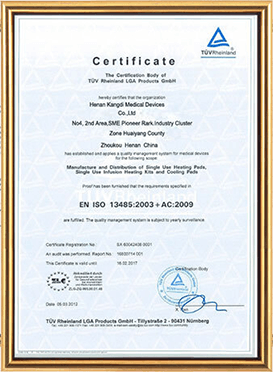
Henan Kongdy Medical Devices Co., LTD. (KONGDY) was founded in 1989 and has 37 years of production experience as of 2026 across pain relief patches, slimming patches, capsicum plasters, heat patches, cooling gel patches, detox foot patches, steam eye masks, mosquito repellent patches and nose strips. Headquartered in Henan, China, KONGDY operates a 100,000-class GMP workshop built in 2008 and obtained ISO 13485 medical device Quality Management System European Standard Certification in 2014. The company runs OEM and ODM services for international brands across multiple regulatory pathways.
For a 2026 procurement evaluation the qualification team can supply the ISO 13485 certificate, GMP workshop audit reports, stability programme documentation, and reference customer case studies upon request via our contact page.
Frequently asked questions
What is warning letter MARCS-CMS 736557?
A warning letter dated 1 October 2026 from the Center for Drug Evaluation and Research to Walmart, Inc., addressed to John Furner, President and CEO, at 702 SW 8th Street, Bentonville, Arkansas, delivered by electronic mail with read and delivery receipt requested, requiring a written response within 15 working days to FDAAdvisory@fda.hhs.gov. It concerns three products, HClear for him, Herstat GST and Terragen HG Formula.
How did the agency find these products?
By purchasing them from www.walmart.com in July 2026 and reviewing their labelling. No inspection was arranged, no records were requested and no company cooperation was needed, which is what makes this the cheapest route to a letter in the library.
Why were three letters issued on the same day?
They were the same action applied along one product chain. 735346 went to the manufacturer after a review of its website and Amazon storefront, 736006 went to Amazon after purchases from amazon.com, and 736557 went to Walmart after purchases from walmart.com. All three started in July 2026 and all three were issued on 1 October 2026 by the same office and the same signer.
What is the three-party chain?
Herstat GST appears in the manufacturer letter 718720 to Sinsin Pharmaceutical and in both platform letters, and Terragen HG Formula appears in the manufacturer letter 735346 to Aidance and in both platform letters, while HClear for him appears in both platform letters with no manufacturer letter in this library.
What does it mean that a platform received a warning letter?
It means the platform has an obligation of its own to respond within the stated period, and that obligation is separate from the manufacturer obligation and does not discharge it. A listing is a distribution event that the agency treats as evidence that the product reaches consumers.
What was the response deadline?
Fifteen working days, to FDAAdvisory@fda.hhs.gov, with the reference number in the subject line. The letter itself asks for 760557 in the subject line while its own number is 736557, and that slip is recorded as written rather than corrected.
Did the products come off the shelf?
The letter does not say that, and this library does not infer it. What the letter states is the characterisation of the products as unapproved new drugs and as misbranded, and the requirement to respond within fifteen working days.
What should a supplier do with this case?
Three things. Review the label, the product page and the social accounts as one set of claims. Ask whether the product is listed on any channel the manufacturer did not put it on, because the platform link is a link in the chain. And accept that a route that starts with a purchase can reach a claim that no inspection timetable would have reached.
Is a warning letter the same as a penalty?
No. This library records these letters as warnings with a response period, and it does not record them as fines, judgements or removals, because the letters do not state any of those things.
Related Guides
Five further references from the KONGDY knowledge base:
- Heat Patch OEM services and manufacturing
- Pain Relief Patch OEM: what an FDA site inspection looks like
- Capsicum Plaster OEM: twelve questions to ask before you sign
- Frequently asked compliance questions
- KONGDY OEM and ODM manufacturing services


