-
 KONGDY
Three Channels, Two Products, One Determination: What FDA Warning Letter 718720 Shows a Pain Relief Patch OEM in 2026
Three Channels, Two Products, One Determination: What FDA Warning Letter 718720 Shows a Pain Relief Patch OEM in 2026
On 12 November 2025 the Center for Drug Evaluation and Research issued warning letter MARCS-CMS 718720 to Sinsin Pharmaceutical Co., Ltd., a company in Sejong, South Korea. The finding arose from a labelling review on 15 April 2025.
Three things about this letter are unusual and each one is transferable.
The first is the evidence base. The agency reviewed the company website and two social media accounts, and all three directed consumers to the same online storefront. The subject of the review was therefore a route to purchase rather than a document.
The second is the ingredient detail. Two products failed on four named active ingredients between them, and one of those ingredients carries a separate regulatory determination that goes beyond simply being absent from the permitted list.
The third is the interval. The review was in April 2025 and the letter was in November 2025, which is about seven months, and that figure corrects a convenient generalisation this knowledge base has been carrying.
For a pain relief patch OEM the letter is worth reading in full because both products are topical analgesics, which is the same category as any pain relief patch sold into the United States.
1. The facts, exactly as the letter states them
The identification facts are worth having in one place, because every one of them is checkable and two of them are easily assumed wrong.
| Item | What the letter states |
|---|---|
| Letter | MARCS-CMS 718720, dated 12 November 2025 |
| Firm | Sinsin Pharmaceutical Co., Ltd., South Korea |
| Address | 9 Sojeongsandandong-Ro, Sojeong-myeon, Sejong 30002 |
| Recipient | Hyun Kwang Dan, Senior Managing Director |
| Contact given | hktan@sinsin.com |
| Issuing office | Center for Drug Evaluation and Research |
| Delivery | By email |
| Review date | 15 April 2025, a review of product labelling |
| Products | SINSINPAS AREX INSTANT PAIN RELIEF and SINSINPAS Pain Relieving Liquid MULPAS |
| Both classified as | Topical analgesics, external analgesic drug products |
| Statutory findings | Unapproved new drugs and misbranded |
The fourth row is the one a manufacturer should notice. The recipient is a managing director rather than a chief executive, and the correspondence address is an email rather than a postal address, which is consistent with the review having been conducted entirely from published material.
A pain relief patch OEM reading this should recognise the pattern: where the evidence is a website, the letter goes to whoever the website names as the responsible party.
2. The three channels and why they matter
The letter names three places it looked, and all three pointed at the same storefront, which is the detail worth understanding.
In the letter own words, the review covered the product labelling including the website at www.sinsinpas.us, which directs consumers to the Amazon storefront where the products are available for purchase in the United States without a prescription, and it also covered the social media on Facebook and Instagram, which also direct consumers to your Amazon storefront.
| Channel reviewed | What it contributed to the finding |
|---|---|
| The company website | A destination carrying labelling, and a route onward to the point of sale |
| A Facebook presence | Further labelling, and the same route onward |
| An Instagram presence | Further labelling, and the same route onward |
| The storefront itself | The place where the products were available for purchase without a prescription |
The fourth row is what the other three were reviewed for. A website and two social accounts were not reviewed as separate publications; they were reviewed as parts of a path that ends at a purchase.
That has a practical consequence for a pain relief patch OEM that runs its own channels. A claim approval that covers only the printed label leaves three published surfaces unmanaged, and each of them is a place where the claim can appear in a form nobody approved.

3. The first product: two ingredients, neither permitted
SINSINPAS AREX INSTANT PAIN RELIEF failed on its active ingredients, and the wording of the finding is precise about the combination question.
According to the labelling, the product is formulated with the active ingredients zinc oxide and mentha oil. The letter states that neither is a permitted active ingredient under the monograph when used in combination, or as a sole ingredient, for any over-the-counter external analgesic drug product.
| The product | Active ingredients as labelled | The finding |
|---|---|---|
| SINSINPAS AREX INSTANT PAIN RELIEF | Zinc oxide and mentha oil | Neither permitted, in combination or as sole ingredients |
| Its stated purpose | Topical analgesic | Establishes that it is presented as an external analgesic, which is what makes the monograph the applicable framework |
| Its stated uses | Temporary relief of minor aches and pains of muscles and joints associated with arthritis, simple backache, strains, bruises, sprains | The uses sit inside the permitted indications, so the failure was not the claim |
The third row is the most useful row in the table, because it isolates the cause. This product did not fail on what it said it would do. It failed on what it was made of, and the uses quoted are the ordinary permitted ones.
A pain relief patch OEM should draw the operational lesson directly. A claim set that is entirely correct can sit on a formula that is not.

4. The second product: an antihistamine and a determined ingredient
SINSINPAS Pain Relieving Liquid MULPAS failed twice over, and the second failure is different in kind from the first.
The labelling states the active ingredients as chlorpheniramine maleate and thymol. Neither is a permitted active ingredient under the monograph, in combination or as a sole ingredient. The letter then adds that the agency has also determined that over-the-counter external analgesic and anesthetic drug products with the active ingredient thymol are not generally recognised as safe and effective under a final determination issued under 21 CFR Part 330.
| The ingredient | The first finding | The second finding |
|---|---|---|
| Chlorpheniramine maleate | Not a permitted active ingredient | No separate determination recorded in this letter |
| Thymol | Not a permitted active ingredient | Also the subject of a final determination that such products are not generally recognised as safe and effective |
| The combination | Not permitted in combination | Not relevant to the determination, which concerns the ingredient |
The second column of the second row is the point of difference. Being absent from a list is a statement about the list. A final determination under 21 CFR Part 330 is a statement about the ingredient, and it does not depend on which product contains it.
A pain relief patch OEM screening a formula should therefore run two tests rather than one: is the ingredient on the permitted list, and does the ingredient carry an adverse determination.

5. The misbranding chain, written out
This letter states the reasoning for the misbranding finding more completely than the others in this library, and the completeness is the useful part.
The letter states that the products are misbranded because they are nonprescription drugs subject to the provision governing marketing without an application, but do not comply with the requirements for marketing under that provision and are not the subject of an approved application. It then states that the introduction of a misbranded drug into interstate commerce is separately prohibited.
| Step | What it establishes |
|---|---|
| The products are drugs | Intended to treat disease or affect the structure or function of the body |
| The applicable route is the monograph | They are marketed as nonprescription external analgesics |
| The route conditions are not met | The ingredients are not permitted |
| No approved application exists | The alternative route is not in use either |
| Therefore misbranded | A nonprescription drug subject to the provision but not complying with it |
| Therefore introduction is prohibited | A separate statutory prohibition |
The fifth row is the one that surprises people. The same non-conformance that produces the unapproved drug finding also produces the misbranding finding, so a single ingredient decision creates two statutory problems rather than one.
For a pain relief patch OEM that means a formulation review is a labelling review as well. The two are not independent, and a product cannot be misbranded in a way that leaves the approval question untouched.

6. The interval, and a correction
The review was on 15 April 2025 and the letter is dated 12 November 2025, which is about six point nine months, and that figure does not fit a generalisation this knowledge base has been using.
| Case | What started it | Letter date | Interval |
|---|---|---|---|
| 735346 | Website and storefront review, July 2026 | 2026-10-01 | About 2.5 to 3 months |
| 736006 | Products purchased on a website, July 2026 | 2026-10-01 | About 2.5 to 3 months |
| 718720 | Labelling review, 15 April 2025 | 2025-11-12 | About 6.9 months |
| Inspection-based cases | Site inspections ending December 2025 to January 2026 | Letters May to July 2026 | About 5.4 to 6.4 months |
The honest reading is narrower than the one that was previously stated. It is not established that review-based cases move faster than inspection-based ones, because the third row is a review-based case that took longer than any inspection-based case in this library.
What is established is that inspection-based cases cluster in a range, and review-based cases do not. A pain relief patch OEM planning on the basis of these figures should plan on three to seven months for a review-based finding and not on the fast end of it.
This article states the correction explicitly rather than quietly dropping the earlier claim, because a supplier that quotes a range it has not tested will be caught by the first counter-example.

7. What this letter does and does not establish
An honest boundary, because the document is specific and the conclusions drawn from it are often broader than it supports.
| The letter establishes | The letter does not establish |
|---|---|
| Four named active ingredients are not permitted under the monograph | That those ingredients are unsafe in every context |
| Thymol carries a separate adverse determination for these product categories | That every unlisted ingredient carries one |
| Three published channels directed consumers to one storefront | That the manufacturer controlled the storefront content |
| The products were available without a prescription | That any consumer was harmed |
| The review to letter interval was about six point nine months | That this interval is typical, since only three review cases exist here |
The second row of the second column is the one most often overstated. One ingredient with a determination does not make every unlisted ingredient equivalent, and treating them as equivalent produces a screening programme that cannot prioritise.
A pain relief patch OEM should use the letter to build a checklist, not a fear response. The checklist is finite and the fear is not.
8. Six questions a buyer can ask after reading this
Each question corresponds to a finding above and each one is answerable from a document.
- Which channels carry your claims? If the answer is the pack, ask again. This letter reviewed a website and two social accounts, all of which carried labelling.
- List every active ingredient, including any the panel does not show. A claim that an ingredient does something makes it an active ingredient.
- For each ingredient, is it on the permitted list, and separately, does it carry an adverse determination? Those are two tests and the thymol finding is the reason.
- Was the ingredient screened as a combination or only individually? The finding in this letter applies to ingredients used in combination, which is a second test after the first.
- Where does the purchase route end? A website that leads to a storefront is one route, and the storefront is where the labelling was found to be available without a prescription.
- Who received the letter, and what does that tell you about who the agency treats as responsible? A managing director and an email address, chosen from published material rather than from a facility record.
The sixth question is unusual and it is diagnostic. A supplier that has thought about which named person the outside world would write to has thought about responsibility, and a pain relief patch OEM that cannot name that person has not.

9. What to build from this case rather than what to fear
One letter can generate either a checklist or an anxiety, and only one of them is useful. This section is the checklist.
A pain relief patch OEM reading this case should end up with four artefacts rather than four concerns. Each one is a page, and each one answers a question the letter raises.
| The artefact | What it contains | The question it answers |
|---|---|---|
| A channel register | Every surface that carries a claim: the pack, the website, each social account, each marketplace listing, and who owns each one | Where can the claim appear in a form nobody approved |
| An ingredient register | Every active ingredient, including ingredients a claim refers to, with the permitted list result and the determination result recorded separately | Is this ingredient permitted, and is it determined |
| A combination screen | Each pair of ingredients that appear together, with the result | Does the product fail on the combination rather than on any single ingredient |
| A route record | Where the purchase route ends, and who the responsible party is at that end | Who would the outside world write to, and does that party know it |
The second row is where this case is most specific. A pain relief patch OEM that records only the permitted list result will pass an ingredient that carries a determination, because the two tests look similar and produce different answers.
The third row is the one most programmes skip, and the letter is explicit about it. The finding applies to ingredients used in combination or as sole ingredients, which means a product can pass every individual check and fail the combination. A pain relief patch OEM with a combination screen has covered a test that an ingredient-level screen cannot reach.
The fourth row is the one that is genuinely new in this case. Previous letters in this library concerned a manufacturer site or a marketplace. This one concerned a website and two social accounts that all led to one storefront, which means the route to purchase was the subject.
A pain relief patch OEM that maps its own route has answered a question the letter raises before a buyer does, and one that has never looked has assumed its route is the pack.
A pain relief patch OEM that builds all four artefacts has learned the right lesson from a case about two products it does not make. A pain relief patch OEM that remembers only the ingredient names has remembered an anecdote. A pain relief patch OEM that has built the registers can answer a new case, and the new case is the one that matters. That is the whole argument for reading a letter about somebody else product. A pain relief patch OEM that does this once has a habit.
About KONGDY Medical

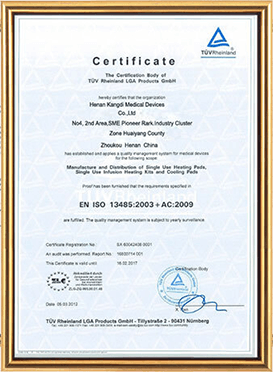
Henan Kongdy Medical Devices Co., LTD. (KONGDY) was founded in 1989 and has 37 years of production experience as of 2026 across pain relief patches, slimming patches, capsicum plasters, heat patches, cooling gel patches, detox foot patches, steam eye masks, mosquito repellent patches and nose strips. Headquartered in Henan, China, KONGDY operates a 100,000-class GMP workshop built in 2008 and obtained ISO 13485 medical device Quality Management System European Standard Certification in 2014. The company runs OEM and ODM services for international brands across multiple regulatory pathways.
For a 2026 procurement evaluation the qualification team can supply the ISO 13485 certificate, GMP workshop audit reports, stability programme documentation, and reference customer case studies upon request via our contact page.

Frequently asked questions
What is warning letter MARCS-CMS 718720 about?
It is a warning letter dated 12 November 2025 from the Center for Drug Evaluation and Research to Sinsin Pharmaceutical Co., Ltd. in South Korea, following a labelling review on 15 April 2025. It concerns two topical analgesic products found to be unapproved new drugs and misbranded.
Which products were named?
SINSINPAS AREX INSTANT PAIN RELIEF, formulated with zinc oxide and mentha oil, and SINSINPAS Pain Relieving Liquid MULPAS, formulated with chlorpheniramine maleate and thymol. Neither product conformed to the external analgesic monograph.
What made this case unusual?
Three things. The agency reviewed a website and two social media accounts that all directed consumers to the same online storefront, so the evidence base was a purchase route rather than a single document. One ingredient, thymol, carried a separate adverse determination under 21 CFR Part 330. And the interval from review to letter was about six point nine months.
Why does the thymol finding matter more than the other three?
Because being absent from a permitted list is a statement about the list, and a final determination that products containing an ingredient are not generally recognised as safe and effective is a statement about the ingredient. The second does not depend on which product contains it.
Did the products fail on their claims?
Not in the way that suggests the claims were wrong. The uses quoted for one product are the ordinary permitted ones for a topical analgesic. The failure was the formulation, which is why a claim set can be entirely correct and still sit inside a product that does not conform.
What is the misbranding reasoning?
The products are nonprescription drugs subject to the provision governing marketing without an application, they do not comply with the requirements for marketing under that provision, and they are not the subject of an approved application. The same non-conformance therefore produces both the unapproved drug finding and the misbranding finding, and each carries its own prohibition on interstate commerce.
How long did the letter take to arrive?
About six point nine months after the review. That is longer than two other review-based cases in this library, which ran about two and a half to three months, and it means the generalisation that reviews move faster than inspections is not supported.
What should a manufacturer take from it?
Four things. Manage every channel that carries a claim rather than only the pack. Test each ingredient against the permitted list and separately against adverse determinations. Test the combination and not only the individual ingredients. And plan on a range of months for a review-based finding rather than on the shortest case in the file.
Related Guides
Five further references from the KONGDY knowledge base:
- Capsicum Plaster OEM: twelve questions on reading the monograph
- Cooling Gel Patch OEM: warning letter 736006 and marketplace responsibility
- Frequently asked compliance questions
- KONGDY OEM and ODM manufacturing services
- Heat Patch OEM: twelve record gates from material to release


