-
 KONGDY
Thirty Clauses That Belong in a Supply Contract with a Detox Foot Patch OEM in 2026
Thirty Clauses That Belong in a Supply Contract with a Detox Foot Patch OEM in 2026
A contract is the only document in the supply chain that is still in force after the audit ends, the visit ends and the sample goes back to the laboratory.
This is a list of thirty clauses, in six bands, with the reason each one is there and the case it comes from. It is built on six warning letters in this library and on one uncomfortable pattern running through them: the failures that recurred were not failures of knowledge. They were failures of record, of scope and of timing. A buyer working with a detox foot patch OEM keeps a copy of this list with the audit report.
The clearest example is a firm that had never performed process validation for one product line and had tested fewer stability batches than its own written procedure required. Both were repeat violations noted in previous inspections. Neither of them would have been visible to a buyer who looked at a certificate. For a detox foot patch OEM this is the point at which the visit stops being a tour.
For a detox foot patch OEM the clauses below are written to be lifted into a template, and every one of them has a case behind it that says what happens when the clause is missing.
Band one: what the contract says about the product, points 1 to 5
Five clauses, and they cover what is being bought and what the buyer owns. A detox foot patch OEM that has not seen this before will usually miss it.
- The specification, attached as an annex and versioned. Formula, materials, pack, artwork and the drug facts or label content, each with a version number and a date. A specification that exists in an email is not a specification.
- Who owns the formulation and the artwork. Assignment on payment, with the right to transfer both to a second manufacturer on notice. A trader that developed the formula and claims to own it can prevent you from moving production.
- The route the product is sold on, per market. Cosmetic, over-the-counter drug, device or food, named for each destination country, with the evidence that supports it. A product sold outside its status becomes an unapproved product.
- The shelf life, and the evidence behind it. The expiry period stated and the studies that support it, in the container-closure system that is actually sold, with the annual batch additions the supplier is committed to running.
- The batch and serial definition. How a batch is identified, what a batch record covers, and how a buyer identifies a batch in a recall. This is the clause that makes every other clause in band five executable.
The third row of the second point is the one that has caused real disputes. A formulation that belongs to the supplier is a formulation you cannot take to a second supplier, and that is a commercial trap rather than a legal one. The detox foot patch OEM reading of this item is not the obvious one.
The fourth point exists because a firm was found that could not support the expiry dates of the products already on the market, and the agency required stability studies in the marketed container-closure system before distribution is permitted. A detox foot patch OEM should treat this as a question with a required answer.
A detox foot patch OEM with clauses one to five in place can change supplier, and one without them is locked in.
Band two: what it says about the site and the chain, points 6 to 10
Five clauses about where the product is made and who stands behind it. This is the detox foot patch OEM version of the same point.
- The manufacturing site, named. Legal entity, facility identifier, physical address, and the specific line or building within it. A company name is not a site.
- No transfer of production without consent. The site cannot change without written agreement, and if it does the buyer holds the right to suspend shipments until a new audit is done.
- Sub-suppliers and the trading entity. If any part of the chain is a trading company, the contract reaches it and reaches the plant beneath it. One enforcement action in this library reached a manufacturer and two platforms at once.
- Audit right, with frequency, notice and scope. Including sub-suppliers, the documents to be made available, and a stated response time after the report.
- Inspection history disclosure. The supplier discloses regulatory inspections, findings and correspondence for the site, with a duty to notify within a stated period. Repeat findings are the clearest quality signal a buyer can obtain, and they are usually not volunteered.
The third point is the one that decides whether the audit right has any teeth. An audit right that stops at the trading company audits an office. A buyer working with a detox foot patch OEM keeps a copy of this list with the audit report.
The fifth point is the clause most often left out and the one with the highest return. A supplier that has been found twice will usually not volunteer the second finding, and a buyer that has to find it in a public record is running the risk that a five-minute search would have closed. For a detox foot patch OEM this is the point at which the visit stops being a tour.
For a detox foot patch OEM the fifth point is the cheapest risk reduction in the whole list.
Band three: what it says about quality and release, points 11 to 15
Five clauses, and all five come from findings in the same library.
- Release testing on every batch, with named tests. Identity, strength, quality and purity for each batch, with the microbiological specification for non-sterile products including total counts and identification of bioburden. A firm was found whose only finished product evidence was appearance and weight.
- The release decision sits before dispatch. A named reviewer, a signed record and a date, and no dispatch before the signature. A quality control unit was found not to have ensured review of control records prior to release and distribution.
- Third-party laboratories are permitted and disclosed. The name, the address and the supplier qualification report for any external laboratory used for release testing. One firm in this library answered an inspection by engaging an external laboratory and was asked for exactly those three things.
- Supplier certificates are not a substitute for testing. Incoming materials are identified and tested, and the reliability of the supplier testing results is verified at appropriate intervals rather than assumed.
- Retain samples and their test results. Retained for the shelf life, available for the buyer, with the summary of results across failing, out-of-specification, out-of-limit and out-of-trend results.
The first point is the one with the longest reach, because release testing is the control that sits underneath every other finding in this library.
The fourth point exists because a firm was found relying on supplier certificates of analysis without verifying the reliability of the supplier testing results at appropriate intervals, which is a chain-of-trust failure rather than a laboratory failure.
The fifth point carries the out-of-trend category, and that category is the only one in the list that a system shows while it is drifting, before any batch fails.
A detox foot patch OEM that writes points eleven to fifteen as a single sentence about quality will have written none of them.
Band four: what it says about change, points 16 to 20
Five clauses, and this band is the one most likely to be missing from a template that was written for a different product.
- Advance notice of process change. Before, not after. Process, site, formulation, equipment, software, key personnel and the quality unit.
- Advance notice of the commercial chain. The trading entity, the sub-supplier and the sub-supplier of the sub-supplier, on the same footing as the site.
- Re-validation triggers. Which changes require process performance qualification to be repeated and which require only an assessment, and who decides.
- The change log is a contract deliverable. On request, within a stated period, with what was changed, who approved it and whether validation was triggered. A quality control unit was found not to have ensured adequate procedures for change controls.
- Interim arrangements are written down. If a change is implemented before validation is complete, what the interim controls are and how long that state may last. A regulator found one response inadequate because it lacked specific timelines including details of interim plans.
The fifth point is the clause this library argues for most strongly, and the argument is that a buyer who knows what the interim control is can manage the risk, while a buyer who has been told that validation is coming has nothing.
The fourth point turns a quality system into a document the buyer can read, and it is the point at which a supplier that does not have a change log shows itself.
For a detox foot patch OEM points sixteen to twenty are what stop an audit from being a photograph of one day.

Band five: what it says about failure, points 21 to 25
Five clauses, and this band is what the contract is actually for.
- Defect notification, with a deadline. Within a stated number of days of the buyer raising it, with what the notification contains and what the supplier provides to support it.
- Investigation of every affected batch. Complete investigations, not only the batches that failed, and not only the ones the buyer noticed. A regulator required complete investigations into all batches with potential contamination or a failing result, whether or not the result was later invalidated.
- Recall execution. Who decides, who executes, who notifies the channel, who pays, and the timescale. The party that holds the batch records is the one that can execute a targeted recall, and a contract cannot substitute for those records.
- Customer notification. That the supplier will notify the buyers it sold to, and provide them with the information needed to notify their own customers. This was an explicit requirement in the case that also produced a voluntary recall.
- Regulatory cooperation and record retention. Access for an inspector, production of records on request, and a retention period that survives the end of the commercial relationship.
The third point is the one that decides whether a recall is possible. A recall is executed by tracing batches, and the trace lives in the batch records, and no clause can create a trace that does not exist.
The fourth point matters because the chain in this library runs through a manufacturer and two platforms at once, and each of them was told separately. A contract that names only the immediate supplier leaves the other links in the chain to find out on their own.
For a detox foot patch OEM band five is the part that is only worth writing if it is specific, because a vague clause here is worse than no clause, since it creates the impression of a remedy.
Band six: what it says about documents and access, points 26 to 30
Five clauses, and these are the ones that make the other twenty-five enforceable.
- Records access on request. Batch records, validation files, stability files, change logs, deviations and release records, within a stated period and at the buyers cost.
- Format and language. Readable, in a language the buyer can use, and not only summaries. A test summary is a document about a product and a batch record is a document about a batch.
- Audit reports and third-party audit rights. The buyer may appoint its own auditor, the auditor may work to the buyers criteria, and the supplier may not substitute its own certificate for the result.
- Translation and document control. Which language governs, and a requirement that the label content supplied to the buyer matches the label content approved for the destination market.
- Survival. Which clauses continue after the last order, and for how long, in particular the record access, the recall cooperation and the confidentiality terms.
The second point is the one that decides whether an audit right produces evidence or produces paperwork. A supplier that sends a certificate where a record was asked for has answered the request in form and not in substance.
The fourth point is the one that catches the misbranding findings in this library, where the product was made correctly and the label omitted a required direction and a required warning. A label is a regulatory document and it has to be controlled like one.
A detox foot patch OEM that writes the thirty clauses as a checklist and puts them in the template has a contract that a supplier can sign.

How to run the clause review in half a day
The list is not a document to be drafted. It is a set of questions to be asked, and half a day is enough if the order is right.
| The block | The time | What you produce |
|---|---|---|
| Bands one and two, the product and the chain | The first ninety minutes | A list of the clauses that are missing and the ones that are already covered by an existing quality agreement |
| Bands three and four, quality and change | The second ninety minutes | The specific questions that need an answer in writing rather than an agreement in principle |
| Band five, failure | Sixty minutes, with the business owner in the room | The four clauses that decide who pays and who acts, which are commercial decisions and not quality decisions |
| Band six, documents and access | The last ninety minutes | The drafting instructions, and the confirmation that the supplier will sign rather than merely read |
The third row is the one that needs a different set of people in the room. The recall cost and the decision route are not quality decisions, and a quality agreement written by a quality team and a commercial team is a quality agreement that nobody signs.
The second row of the third column is the trap. An agreement in principle is how a clause ends up with no date in it, and a clause with no date in it is the thing a regulator called inadequate when it lacked specific timelines and details of interim plans.
For a detox foot patch OEM the half day is spent asking which five of the thirty clauses the supplier will not sign, because those five are the ones that decide how much of the rest is worth having.

The three ways a contract fails
Not three ways a clause is drafted badly. Three ways a contract that was signed stops working.
| The way it fails | What it looks like | The clause that prevents it |
|---|---|---|
| The clause exists but the document does not | An audit right that produces summaries instead of records | Points 26 and 27, on records access and format |
| The clause exists but the scope is wrong | An audit right that stops at a trading company, or a notice clause that covers only the site | Points 7 and 18, on sub-suppliers and on the change in the chain |
| The clause exists but nobody owns it | A recall clause with no decision route, or a change clause with no notification period | Points 20 and 22, on interim arrangements and on the notification deadline |
The second row of the first column is the one that surprises buyers, because the clause is present and the supplier believes it has been complied with.
The third row is the failure that the letters in this library show in their plainest form. Two findings were repeat violations, which means the same gap was known and not closed, and a contract without an owner is a gap with a signature on it.
A detox foot patch OEM that names an owner for each of the thirty clauses has already closed the third of these three failure modes.

The thirty clauses in one table
Six bands, five clauses each, and the single question that decides whether the band is in place.
| The band | What it covers | The number | The single question to ask |
|---|---|---|---|
| One, the product | Specification and version, ownership of formula and artwork, the route per market, the shelf life and its evidence, and the batch definition | Five | Which version governs, and who owns it |
| Two, the site and the chain | The named site and facility identifier, no transfer of production, sub-suppliers and the trading entity, the audit right, and inspection history disclosure | Five | Can the audit right reach the plant |
| Three, quality and release | Release testing on every batch, the release decision before dispatch, third-party laboratories, supplier certificates, and retain samples and their results | Five | What is actually in the release packet |
| Four, change | Advance notice of process change, the same for the commercial chain, re-validation triggers, the change log as a deliverable, and interim arrangements | Five | What happens between the change and the validation |
| Five, failure | Defect notification, investigation of every affected batch, recall execution, customer notification, and regulatory cooperation with record retention | Five | Who decides, who acts, and who pays |
| Six, documents and access | Records access, format and language, third-party audit rights, translation and document control, and survival | Five | Does the clause produce evidence or paperwork |
The second column of the fourth row is the band that most often does not exist in a contract, and it is the one that decides whether a contract written in year one still describes the operation in year three.
The second column of the fifth row is the band that carries the money, and it is the band that a quality team cannot write on its own.
For a detox foot patch OEM the table is the thing to print, and the six questions are the six questions to ask in the first meeting.
About KONGDY Medical

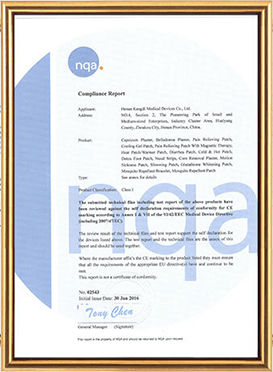
Henan Kongdy Medical Devices Co., LTD. (KONGDY) was founded in 1989 and has 37 years of production experience as of 2026 across pain relief patches, slimming patches, capsicum plasters, heat patches, cooling gel patches, detox foot patches, steam eye masks, mosquito repellent patches and nose strips. Headquartered in Henan, China, KONGDY operates a 100,000-class GMP workshop built in 2008 and obtained ISO 13485 medical device Quality Management System European Standard Certification in 2014. The company runs OEM and ODM services for international brands across multiple regulatory pathways.
For a 2026 procurement evaluation the qualification team can supply the ISO 13485 certificate, GMP workshop audit reports, stability programme documentation, and reference customer case studies upon request via our contact page.
Frequently asked questions
How many clauses does a supply contract actually need?
Thirty, in six bands: the product, the site and the chain, quality and release, change, failure, and documents and access. The number is less important than the band structure, because the bands are what stop a clause from being argued about in isolation.
Which single clause has the highest return?
Disclosure of regulatory inspection history for the site, with a duty to notify. It is a single question, it is answered in writing, and it surfaces the one signal that a certificate cannot carry, which is whether the same finding has been made twice.
Why does release testing need to be named clause by clause?
Because the failure in this library was not a missing test but a missing record. One firm had only appearance and weight as finished product evidence, and another released product on the results of resampling after an unvalidated treatment, and both are failures of specification rather than of intent.
What is the interim arrangements clause for?
For the period between a change and the completion of validation. It says what controls apply in the meantime and how long that state may last. A regulator found a response inadequate precisely because it lacked specific timelines and details of interim plans.
How do I write a recall clause that can actually be executed?
Start from the trace rather than from the word recall. Name who holds the batch records, require that the batch record definition in point 5 match the records that are held, name the decision route, and put a deadline on customer notification.
Do I need all thirty if the supplier has a quality agreement?
The quality agreement typically covers the middle of band three. It rarely covers bands two, four and five, which are the site and the chain, the change notification and the failure routes, and those are the bands where the evidence in this library is concentrated.
What if the supplier refuses the audit right entirely?
That refusal is itself the answer, and it should be recorded as such rather than negotiated away. An alternative is a third-party audit to the buyers criteria with a named right to receive the batch records for the first three orders, which tests the same thing by a different route.
How long should these clauses survive the last order?
Record access, recall cooperation and confidentiality need to survive, and the retention period has to be long enough to cover the shelf life of the product plus the period in which a lot can still be in the market. Point 30 exists because the clauses that matter most are the ones needed after the relationship has ended.
Related Guides
Five further references from the KONGDY knowledge base:
- Detox Foot Patch OEM services and manufacturing
- Pain Relief Patch OEM: how to run a factory audit as a buyer
- Capsicum Plaster OEM: twelve questions to ask before you sign
- Frequently asked compliance questions
- KONGDY OEM and ODM manufacturing services


