-
 KONGDY
How to Run a Factory Audit as a Buyer: A Ten-Stage Plan for a Pain Relief Patch OEM in 2026
head>
How to Run a Factory Audit as a Buyer: A Ten-Stage Plan for a Pain Relief Patch OEM in 2026
A buyer audit is not a regulatory inspection, and the difference matters in a way that costs money when it is forgotten. An inspector arrives with a legal power to require records. A buyer arrives with a contract.
What a buyer can do is look at the same things an inspector looks at, in the same places, and write down what was seen. What a buyer cannot do is compel an answer, and what a buyer should never claim is that the visit substitutes for an inspection.
This is a ten-stage plan built around what three real warning letters show. The first found that a firm had never performed process validation for one product line and had tested fewer stability batches than its own written procedure required, both of which had been found on previous inspections. The second found a firm that had treated filled batches with an unvalidated protocol to reduce microbial content and had then released product on the resampling results. The third found a firm whose only finished product evidence was appearance and weight.
For a pain relief patch OEM buyer all three of those are visible on a two-day visit, and all three of them are the reason to do it.
Stage one: decide what the visit is for before you book anything
The visit has one purpose, and writing it down before you travel prevents the most common failure, which is a two-day tour.
The purpose is written as a single sentence that names a decision. Not improve the relationship, not build confidence, and not see the factory.
| The purpose, badly written | The purpose, well written | What the difference produces |
|---|---|---|
| To check the supplier | To confirm that the pain relief patch line is validated and released before dispatch, before we sign the second order | The second version tells the factory what to prepare and tells the audit team what to look for |
| To look at quality | To find out whether finished product identity, strength and purity are tested on every batch before release | The second version is a question with an answer, and the answer can be documented |
| To satisfy the audit clause | To satisfy the audit clause and to leave with the batch release record of one real batch | The second version produces evidence the buyer keeps |
The third row is the one that separates an audit from a visit. A factory can host a visitor and show a clean line all day, and the only artefact that proves anything is a record.
A pain relief patch OEM that arrives with one sentence and one document to obtain has a two-day plan. A pain relief patch OEM that arrives with five objectives has a two-day visit and no findings.
Stage two: the questionnaire, sent two weeks ahead
The questionnaire is not homework for the factory. It is the map for the audit, and the answers decide where the two days go. A buyer working with a pain relief patch OEM keeps a copy of this list with the audit report.
| The question | The answer you want | What it tells you about the visit |
|---|---|---|
| Which lines have completed process performance qualification, and which have not | A named list, not a yes or a no | Where to spend the two hours that matter |
| How many batches go on stability per product per year, against your own written procedure | The number, and a copy of the procedure | Whether the stability question is settled or is a finding |
| Who signs the batch release, and what do they review before signing | A title, a procedure and the last three release records | Where to stand on the floor for the first hour |
| Do you use a third-party laboratory, and if so which one | The name, the address and the supplier qualification report | Whether the laboratory needs its own check |
| What does a release packet contain, from sampling to dispatch | The document list | The document room order for the first morning |
The first row is the one that saves the most time. A firm that answers it with a list will tell you in writing that two lines are not validated, and the two days then go where they should. For a pain relief patch OEM this is the point at which the visit stops being a tour.
The second row is the one from a real case. A firm was found to have tested fewer batches than its own written stability procedure required, and it was found to be a repeat violation. That is a question the buyer can ask and the answer is a number. A pain relief patch OEM that has not seen this before will usually miss it.
For a pain relief patch OEM the questionnaire is also the first evidence of how a firm handles a request it could have avoided.
Stage three: the document room, and the four sets that must be there
The first morning is documents, and four sets decide whether the rest of the visit is worth anything. The pain relief patch OEM reading of this item is not the obvious one.
| The document set | What to look for | The case it comes from |
|---|---|---|
| Process validation files, per line | Process performance qualification protocols and reports, the ongoing intra-batch and inter-batch monitoring, and the equipment and facility qualification files | The case in which a line had never been validated and the reply gave no timeline and no interim plan |
| The stability programme and the batch records | The written procedure, the annual batch additions, the container-closure used, and the retain results for failing, out-of-specification, out-of-limit and out-of-trend results | The case in which fewer batches were tested than the procedure required, leaving the expiry dates on the market unsupported |
| The release records for three real batches | The identity, strength and purity results, the microbiology results, the release signature and the date of dispatch | The case in which the only finished product evidence was appearance and weight |
| The change log and the deviation log | The last ten entries, with what was changed, who approved it and whether a validation was triggered | The case in which the quality unit was found not to have ensured adequate procedures for change controls, batch record release and corrective and preventive action |
The third row is the one to insist on, and it is the one most factories offer without being asked for. A clean file room is evidence of nothing; a real batch record shows what actually happened on a real batch. A pain relief patch OEM should treat this as a question with a required answer.
The fourth row is where a buyer learns something that no questionnaire answers, which is how a factory actually handles change.
A pain relief patch OEM that is shown a release record with a signature and a date has been shown the control that every other finding depends on.
Stage four: the walkthrough, in one direction
One direction, no backtracking, and the reason is that a plant that is walked twice shows the buyer the good end twice.
| The sequence | What you are looking for | The trap |
|---|---|---|
| Goods in and the warehouse | Segregation of quarantined, released and rejected material | A tidy floor with no visible status marking |
| Raw material sampling and the incoming store | Identity testing on incoming API and components, and how often supplier certificates are verified | Accepting a supplier certificate as a substitute for testing |
| The compounding or filling line | Whether the in-process controls are recorded, and whether the operator writes at the time | A demonstration performed for you rather than performed for the shift |
| Cleaning and changeover | The procedure, the record, and whether the verification is signed | A signed checklist with no verification step |
| The warehouse and dispatch | FEFO, the release status, and whether dispatch happens after release | Release review that happens after the truck has loaded |
The third row of the first column is the one most worth the hour. A line demonstrated for a visitor has not been demonstrated for the shift, and the difference shows in the records rather than in the room.
The last row of the second column is the finding that appears in real warning letters, and it is the one a buyer can see in ten minutes by asking what time the trucks leave.
A pain relief patch OEM that walks the floor in one direction and asks about the last three dispatches learns more than one that takes a guided tour.
Stage five: the three stops that carry the most weight
If the visit has to be cut short, these three are the ones to keep.
| The stop | What you check | The case that makes it a stop |
|---|---|---|
| The release desk | Pick one batch, read the release packet from the first page to the signature, and note who signs and what they read | A quality control unit found not to have exercised its responsibility, including review of control records before release and distribution |
| The water and utility system | Temperature, materials of construction, slope, dead-legs, stagnant locations, unsanitary fittings and flow velocity, plus the count limits and what they are monitored against | A firm that treated filled batches with an unvalidated protocol, whose investigation never considered out-of-limit recoveries from the water system |
| The stability room and the retain store | How many batches are on stability per product per year, whether retain samples exist, and whether the container-closure is the one that is sold | A firm that tested fewer batches than its own written procedure required and could not support the expiry dates already on the market |
The second row is a list of seven physical questions about a plant, and every one of them can be answered by looking. A pain relief patch OEM that has time for two stops and not three should keep the release desk and the utility area, because those are the two that no paperwork substitutes for.
A pain relief patch OEM that only has time for one stop should make it the release desk, because the release decision is the one control that sits under all three findings in this library.
Stage six: sampling, and what a sample cannot tell you
Take samples, because a buyer who takes none has no independent evidence at all, and know what they are worth.
| The sample | What it can establish | What it cannot establish |
|---|---|---|
| Finished product from the warehouse | Identity, strength and purity on one batch, and whether release testing was done at all | Whether the next batch will pass |
| A retain sample from an older batch | Whether the product held its specifications through its shelf life | Whether the stability programme is running |
| A raw material component | Whether identity and purity were tested on incoming material | Whether the supplier certificate was ever verified |
| A swab or a water sample | The condition at one point in one place | The state of the system as a whole |
The second column of the first row is the one that decides whether the sample is worth anything. A finished product with only appearance and weight behind it has not been tested, and that is exactly what one warning letter found.
The fourth row is the honest limit. A water sample is one point in one place, and the seven characteristics of the system are what a walk around the plant tells you.
For a pain relief patch OEM the rule is simple: sample the release packet and the retain store, and treat a single finished-product result as the start of the file rather than the end of it.
Stage seven: the closing meeting, in a specific order
The order of the closing meeting decides how much of the visit survives the flight home.
| The order | What is said | Why it comes there |
|---|---|---|
| Findings first, with evidence | What was observed, with the document or the record that shows it | A finding without evidence is an opinion and will be argued |
| Observations second, without judgement | Things seen that are not yet findings | Keeping them apart is what makes the finding credible |
| The supplier response third | Agreement, disagreement, or a promise of a date | The supplier speaks before the buyer explains the conclusion |
| The action list last, with owners and dates | What happens, who does it and by when | This is the only part that is still true in six months |
The third row is the one that carries the most weight in the case of a firm whose response to a regulator lacked specific timelines and details of interim plans. A reply with no date is not a commitment.
The fourth row is the one that decides whether the visit produced anything. An action list with no owner and no date is a list of things that will be raised again at the next visit, which is the failure mode this kind of audit has.
A pain relief patch OEM that closes with a dated action list has an audit, and one that closes with agreement has a meeting.
Stage eight: the report, and how it differs from a certificate
The report is the artefact. A certificate is a summary of somebody else audit, and the difference is who looked.
| The document | Who looked | How long it lasts | How it is used |
|---|---|---|---|
| A certificate of conformance or a quality certificate | The supplier, or an agency hired by the supplier | Until the next audit date | A precondition to the purchase, and nothing more |
| A buyer audit report | Your own team, on your own criteria | Until the next buyer audit | The basis for the second order, the price and the scope limit |
| A regulatory record | The agency | Indefinitely | Something you learn from, and cannot produce yourself |
The second row is the one that matters. A buyer report is the only one of the three that your own organisation can rely on when something goes wrong, because it is the only one that reflects your criteria and your questions.
The third row is the one to keep in mind. Nothing a buyer produces reaches the agency, and nothing a buyer produces can satisfy the agency, and the three rows are not alternatives to each other.
For a pain relief patch OEM the honest framing in any supplier conversation is that the buyer audit reduces uncertainty, and the regulatory record is out of both sides hands.

Stage nine: the closing audit, which is not a closing email
The gap between a finding and a closed finding is where the repeat violations in this library were born.
Two of the three findings in one case were repeat violations noted in previous inspections. A closure that consists of a document being filed is not a closure.
| The way a finding is closed | What it means | Whether it holds |
|---|---|---|
| By email, with the corrective document attached | The procedure now exists | Only until the next time the line runs at full rate |
| By a verification visit to the line | The procedure is being followed | For a while, and it is the strongest of the three |
| By a batch of evidence from production | The control produced a conforming result under real conditions | Indefinitely, and it is the only one that does |
The third row is the one that distinguishes a repeat violation from a closed gap, and it is the reason a closing audit is scheduled rather than assumed.
A pain relief patch OEM that asks for production evidence rather than a document is asking the only question that separates the two cases in the letters.
About KONGDY Medical

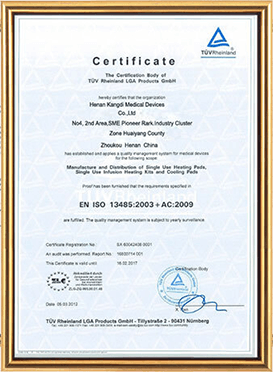
Henan Kongdy Medical Devices Co., LTD. (KONGDY) was founded in 1989 and has 37 years of production experience as of 2026 across pain relief patches, slimming patches, capsicum plasters, heat patches, cooling gel patches, detox foot patches, steam eye masks, mosquito repellent patches and nose strips. Headquartered in Henan, China, KONGDY operates a 100,000-class GMP workshop built in 2008 and obtained ISO 13485 medical device Quality Management System European Standard Certification in 2014. The company runs OEM and ODM services for international brands across multiple regulatory pathways.
For a 2026 procurement evaluation the qualification team can supply the ISO 13485 certificate, GMP workshop audit reports, stability programme documentation, and reference customer case studies upon request via our contact page.
Frequently asked questions
How is a buyer audit different from an FDA inspection?
An inspector arrives with legal power to require records. A buyer arrives with a contract. A buyer audit looks at the same areas and produces the same kind of observations, but it cannot compel an answer and it cannot substitute for an inspection, and a report from a buyer audit is not a regulatory record.
How long should a buyer audit take?
Two days on site for a single plant, with the first morning for documents and the second for the floor. Three people cover it well: a quality or regulatory person for the records, a production person for the line, and a buyer or category lead for the pack and the claims.
What is the single most useful question for the questionnaire?
Which lines have completed process performance qualification and which have not. It is answered with a list, it decides where the two days go, and it surfaces the gap that one warning letter found in a firm that had never validated its over-the-counter aerosol line.
What should I ask to see at the release desk?
One real batch, from the first page of the release packet to the signature, and the identity, strength and purity results on it. A quality control unit was found not to have ensured adequate review of control records, including finished product testing, prior to release and distribution, and the release decision is the control that sits underneath the other findings.
What should I look at in the utility area?
Seven physical characteristics of the water system: temperature, materials of construction, slope, identified dead-legs, stagnant locations, unsanitary fittings and flow velocity, plus the total microbiological count limits and what they are monitored against. These are the characteristics the agency asked to be evaluated in the case where an investigation failed to consider out-of-limit recoveries from the water system.
Is a sample worth taking?
Yes, but read it narrowly. A finished product sample establishes identity, strength and purity on one batch and whether release testing was done at all. A retain sample speaks to the shelf life of that batch and says nothing about whether the stability programme is running. A single water sample is one point in one place.
How should I close a finding?
By production evidence rather than by a filed document. Two of the three findings in one case were repeat violations noted in previous inspections, and a document that was filed and never followed is what a repeat violation looks like from the inside.
What should the closing meeting contain, in what order?
Findings with evidence first, observations without judgement second, the supplier response third, and a dated action list with named owners last. A reply without a date is not a commitment, which is exactly why a regulator found one response in this library inadequate.
What do I do when the site refuses?
Read which kind of refusal it is. A refusal of the visit but an offer of a certificate is a negotiation. A refusal of the line you needed to see is a finding. And a refusal of the release records is the finding itself, and the report should say so plainly.
Related Guides
Five further references from the KONGDY knowledge base:
- Pain Relief Patch OEM: what an FDA site inspection looks like
- Capsicum Plaster OEM: twelve questions to ask before you sign
- Cooling Gel Patch OEM: the glycerin and DEG questions
- Frequently asked compliance questions
- KONGDY OEM and ODM manufacturing services


