-
 KONGDY
The Inspection That Found the Same Thing Twice: What FDA Warning Letter 710087 Shows a Mosquito Repellent Patch OEM in 2026
The Inspection That Found the Same Thing Twice: What FDA Warning Letter 710087 Shows a Mosquito Repellent Patch OEM in 2026
There is a phrase in FDA warning letters that carries more information than any other, and it appears twice in the letter this article is about: this is a repeat violation noted in previous inspections.
Warning letter MARCS-CMS 710087 was issued on 17 September 2025 to Dixon Investments Inc. dba ARI, of Orchard Hill. The firm had been inspected from 5 to 11 March 2025 and had answered the Form FDA 483 on 27 March 2025.
Three CGMP findings, two of them repeats. The firm had not performed process validation for its over-the-counter aerosol products, and had not tested an adequate number of batches under its own written stability procedure. Both had been found before.
For a mosquito repellent patch OEM buyer this is the case that separates two things that are usually confused. A factory with a gap is a supplier with a plan. A factory with a repeat finding is a factory that knows how to fix a gap and did not.
1. The facts
Nothing in the identifying information is unusual, and that is part of the point.
| Item | What the letter states |
|---|---|
| Letter | MARCS-CMS 710087, dated 17 September 2025 |
| Firm | Dixon Investments Inc. dba ARI |
| Facility identifier | FEI 1037559 |
| Address | 2523 South McDonough Road, Orchard Hill |
| Recipient | Mr. Dixon |
| Inspection | 5 to 11 March 2025, seven days |
| Form FDA 483 response | 27 March 2025 |
| Letter after inspection | 190 days |
| Product route | Over-the-counter aerosol drug products |
| CGMP findings | 21 CFR 211.100(a), 211.166(a) and 211.22 |
The seventh row places this letter on the long side of the range in this library, and the eighth row is the one that makes it interesting. A repeat violation means the information was already delivered once.
The ninth row is why the case reaches a mosquito repellent patch OEM at all. An aerosol and a patch are different formats of the same regulatory question, and the question is whether the product is a drug, and if it is, whether it is lawfully marketed.
2. What kind of product this was, and how it was characterised
Three separate characterisations, and a reader who understands only one of them will miss most of the letter.
| The characterisation | The provision | What it means |
|---|---|---|
| Unapproved new drug | Sections 505(a) and 301(d) | The products were drugs and there was no approved application in effect, so they could not lawfully be introduced into interstate commerce |
| Misbranded | Section 502(f)(1) and 502(f)(2) | The labelling lacked required directions for use and required warnings |
| Misbranded | Section 502(ee) | The products were sold as over-the-counter monograph drugs while not meeting the conditions of the applicable monograph |
The third row is the one that is most often misunderstood. Selling a product under a monograph is lawful and common, and it is lawful only if the product meets the conditions of that monograph in every particular.
A mosquito repellent patch OEM that is working to the monograph route is making a lawful product, and the letter shows how narrow the distance is between that and an unlawful one.
3. The monograph conditions that were not met
Two monographs, and the letter names the specific sections that were missed.
The products were combination topical first aid antiseptic and external analgesic drug products, and they had to conform to the conditions in OTC monograph M003, First Aid Antiseptic Drug Products for Over-the-Counter Human Use, and M017, External Analgesic Drug Products for Over-the-Counter Human Use.
| The condition | The section cited | What was wrong |
|---|---|---|
| Permitted combinations of active ingredients | M003.20 and M017.20 | The specific combination of active ingredients in the formulation is not permitted under either monograph |
| Permitted external analgesic active ingredients | M017.10(a) | An ingredient labelled as a topical anesthetic in the Drug Facts is not a permitted external analgesic active ingredient |
| Permitted concentration | M003.10(d) | The concentration of an active ingredient is more than the allowed concentration for a first aid antiseptic product |
| Required directions for use | M003.50(d)(4), (5) and (6) | The directions section did not include the direction to apply a small amount of the product to the area one to three times daily, nor the direction that the area may be covered with a sterile dressing, nor the direction to let it dry first |
| Required warning | M003.50(c)(1)(ii) | The labelling omitted the warning to stop use and ask a doctor if the condition persists or gets worse, and not to use longer than one week unless directed by a doctor |
The fourth and fifth rows are the two that surprise people, because they are not chemistry problems. They are label problems, and they are the reason a product can be made correctly and still be unlawful.
The fifth row is the one to note for anyone selling in the United States. A warning that a monograph requires and a label does not carry is a misbranding violation on its own, regardless of how good the product is.
For a mosquito repellent patch OEM the practical version is that the label is not a translation exercise done after the formula is fixed. It is a regulatory document that has to be built alongside the formula.
4. Finding one: the process validation that never happened
The first finding is 21 CFR 211.100(a), and the sentence about repeats is in the middle of it.
The firm failed to establish adequate written procedures for production and process control designed to assure that the drug products manufactured have the identity, strength, quality and purity they purport or are represented to possess, and it had not performed process validation for its over-the-counter aerosol drug products. This is a repeat violation noted in previous inspections.
| What the response said | What the agency asked for instead |
|---|---|
| It will outline the control procedures to ensure that manufacturing processes are properly validated | A detailed summary of the validation program for ensuring a state of control throughout the product lifecycle, with associated procedures |
| It will follow its current standard operating procedure for data collection on the drug products it manufactures | Process performance protocols and written procedures for qualification of equipment and facilities |
| Nothing about timing | A timeline for performing appropriate process performance qualification for each of its marketed drug products |
| Nothing about the period in between | A detailed program for designing, validating, maintaining, controlling and monitoring each of its manufacturing processes, with vigilant monitoring of intra-batch and inter-batch variation to ensure an ongoing state of control |
The third and fourth rows are why the response was called inadequate. A firm that cannot say when it will validate a product, and cannot say what it is doing until it does, has not answered the question.
A mosquito repellent patch OEM that has never validated a line is running a line whose behaviour it does not know, and the second repeat finding in the letter is about a related kind of not knowing.

5. Finding two: a stability programme the firm did not follow
The second finding is 21 CFR 211.166(a), and the failure is not a weak programme but a programme not followed.
The firm failed to follow an adequate written testing program designed to assess the stability characteristics of drug products and to use the results of stability testing to determine appropriate storage conditions and expiration dates. It failed to test an adequate number of drug product batches as defined by its own written stability procedure. This is a repeat violation noted in previous inspections.
| The element | What the agency required |
|---|---|
| Stability-indicating methods | Methods that indicate stability rather than merely measure a number |
| Studies in the marketed container-closure system | Stability studies for each drug product in the container-closure system it is actually sold in, completed before distribution is permitted |
| An ongoing program | Representative batches of each product added each year to determine whether the shelf-life claim remains valid |
| Defined attributes at each timepoint | A detailed definition of the specific attributes to be tested at each timepoint |
| The procedures themselves | All procedures that describe these and the other elements of the remediated stability program |
The second row is the one that closes the case for a buyer. A study in a laboratory container says nothing about the pack on a shelf, and the agency asked for the studies to be in the marketed container-closure system before distribution is permitted.
The third row is the one that turns a stability programme into a living programme rather than an archive, and it is the row that most suppliers cannot produce on request.
For a mosquito repellent patch OEM the sentence that matters most is the agency conclusion: without appropriate stability studies, there is no scientific evidence to support whether the drug products meet established specifications and retain their quality attributes through their labeled expiry.

6. Finding three: a quality unit that did not do its job
The third finding is 21 CFR 211.22, and this is the one that connects the letter to the other two.
The quality control unit failed to exercise its responsibility to ensure that drug products manufactured are in compliance with CGMP and meet established specifications for identity, strength, quality and purity. The letter sets out three things the quality unit failed to ensure.
| What the quality unit had to ensure | The finding |
|---|---|
| Adequate procedures for change controls, batch record release and CAPA | The procedures were not adequate |
| Adequate review of control records, meaning finished product testing, prior to release and distribution | The review before release was not adequate |
| Appropriate procedures established and followed for the cleaning and maintenance of drug manufacturing equipment | The procedures were not appropriate, or were not followed |
The agency stated it plainly: the firm quality systems are inadequate.
The second row is the finding that would have caught the other two. A batch that never went through process validation and a batch with an unsupported expiry date both pass through a release decision, and a release decision that does not look hard enough will pass both.
A mosquito repellent patch OEM whose quality unit does not review the release record before dispatch has a control that exists on the organisation chart and nowhere else.

7. The whole letter in one table
This is the structure of the case, and it is the part a supplier conversation should start from.
| Finding | The clause | Repeat | The request |
|---|---|---|---|
| Process validation not performed for the over-the-counter aerosol line | 21 CFR 211.100(a) | Yes | A validation program, process performance qualification, a timeline per marketed product, protocols for equipment and facility qualification |
| Fewer stability batches tested than its own written procedure requires | 21 CFR 211.166(a) | Yes | Stability-indicating methods, studies in the marketed container-closure system before distribution, annual representative batches, defined attributes per timepoint |
| The quality unit did not exercise its responsibility | 21 CFR 211.22) | Not stated | An assessment and remediation plan giving the quality unit the authority and resources to function, with a complete and final review of each batch before the disposition decision |
| Products sold without an approved application | 505(a) and 301(d) | Not stated | Not applicable, this is a characterisation rather than a programme gap |
| Labels missing required directions and warnings | 502(f)(1) and 502(f)(2) | Not stated | Conforming to the conditions of M003 and M017 |
The third row of the first column is where the three findings meet. The agency required a complete and final review of each batch and its related information before the quality unit disposition decision, and that requirement is the answer to the two repeats above it.
A mosquito repellent patch OEM that has a batch review that is complete, final and before dispatch has closed the loop that this letter found open.

8. What to ask for, in the order that finds problems fastest
Six questions, each of which comes directly out of a finding.
- Which lines have completed process performance qualification, and which have not. The answer is a list, and the list is usually short.
- Show me the timeline. A commitment without a date is the exact reason the response in this case was judged inadequate.
- What are you doing on each unvalidated line until validation is complete. This is the interim plan the agency asked for and did not get.
- How many batches are on stability per product per year, against your own written procedure. If the number is lower than the procedure, that is the second finding in this letter.
- Who signs the batch release, and what do they review. If the answer does not include the review happening before dispatch, that is the third finding.
- Show me the cleaning and maintenance procedures for the filling line, and the last three records that they were followed.
The fourth question is the sharpest one in the list, because it needs no trust. The firm wrote the procedure, so the firm knows the number, and a buyer can compare it with the number of batches actually on stability in one question.
The sixth question is the one that catches a plant that passes a paper audit and fails a real one. Records exist in both cases, and only one of them is signed at the time of the clean.
A mosquito repellent patch OEM that answers all six in writing before a visit has shown the buyer something it could not have got from a certificate, and a mosquito repellent patch OEM that answers them only in the room has shown the buyer that the answers exist. A mosquito repellent patch OEM that produces the six answers and the closing record for the last inspection in advance has made the audit a formality, which is what a good mosquito repellent patch OEM should make it.

9. Why a repeat finding is the most useful signal a buyer has
Most of the findings in this letter are things a buyer cannot see. A supplier will tell you its quality system is adequate, and there is no way to know from outside whether that is true until something fails.
A repeat finding is different, because it is a piece of evidence that has already been produced about a specific site, and it is the one piece of quality evidence that a supplier cannot produce on request.
| The signal | What it tells a buyer | Why it is different from a certificate |
|---|---|---|
| A gap that has been open across two inspections | The corrective action system at that site does not work | A certificate states that a system exists; a repeat states that it did not close a gap it already knew about |
| A gap in the release review before dispatch | The batch record review is where the factory will pass a failing batch | The gap sits on the one control every product depends on |
| A gap in the stability programme | The expiry dates on product already sold cannot be substantiated | It reaches past the factory and into the market, and it is inherited by whoever buys the product |
The third row is the reason a repeat finding is worth more than a discount. A supplier that closes a documentation gap after one conversation is a supplier that manages a gap, and a supplier that carries the same gap across two inspections is a supplier whose system does not.
For a mosquito repellent patch OEM the practical consequence is that the cheapest quality signal available is a search of the public warning letter record for the site, and it takes five minutes. A mosquito repellent patch OEM that has never had a letter has one kind of risk, and a mosquito repellent patch OEM that has had one and closed it has a smaller one than a supplier that has never been inspected at all.
A mosquito repellent patch OEM that answers the six questions in the previous section and produces a closing record for the last inspection is a supplier a buyer can reason about, and a mosquito repellent patch OEM that cannot is a supplier a buyer can only price.
About KONGDY Medical

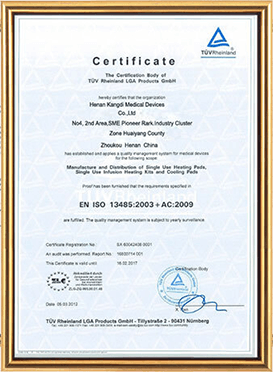
Henan Kongdy Medical Devices Co., LTD. (KONGDY) was founded in 1989 and has 37 years of production experience as of 2026 across pain relief patches, slimming patches, capsicum plasters, heat patches, cooling gel patches, detox foot patches, steam eye masks, mosquito repellent patches and nose strips. Headquartered in Henan, China, KONGDY operates a 100,000-class GMP workshop built in 2008 and obtained ISO 13485 medical device Quality Management System European Standard Certification in 2014. The company runs OEM and ODM services for international brands across multiple regulatory pathways.
For a 2026 procurement evaluation the qualification team can supply the ISO 13485 certificate, GMP workshop audit reports, stability programme documentation, and reference customer case studies upon request via our contact page.
Frequently asked questions
What is warning letter MARCS-CMS 710087?
A warning letter dated 17 September 2025 to Dixon Investments Inc. dba ARI, facility identifier FEI 1037559 at 2523 South McDonough Road, Orchard Hill, following an inspection from 5 to 11 March 2025 and a Form FDA 483 response dated 27 March 2025. It contains three CGMP findings and characterises the products as unapproved new drugs and as misbranded.
What does a repeat violation mean?
That a previous inspection found the same gap and it was still open. In this letter the phrase appears twice: for the failure to perform process validation for the over-the-counter aerosol products, and for the failure to test an adequate number of batches under the firm own written stability procedure.
Why does a repeat finding matter more than a first finding?
Because it is evidence about the quality system rather than about the gap. A firm that receives a finding and does not close it has shown that its corrective action procedure does not work, which is a different problem from the original one and a larger one.
What did the firm fail to do about stability?
Test an adequate number of drug product batches as defined by its own written stability procedure. The consequence the agency drew was that the expiry dates of the products currently on the market were not supported by appropriate stability data, and that without appropriate stability studies there is no scientific evidence that the products meet their specifications through their labeled expiry.
Why was the firm response inadequate?
In the first finding, because it lacked specific timelines and details of interim plans while the firm worked toward full process validation. In the second, because it did not address the stability data needed to support the expiry dates of products already on the market and did not give sufficient detail on interim measures to maintain critical quality attributes through the shelf life.
What is the significance of the two monographs in the letter?
M003 is the First Aid Antiseptic Drug Products monograph and M017 is the External Analgesic Drug Products monograph. A product sold under a monograph is lawful only if it meets the conditions of that monograph, and the letter cites specific sections: M003.20 and M017.20 on permitted combinations of active ingredients, M017.10(a) on permitted external analgesic active ingredients, M003.10(d) on concentration, and M003.50(d) and M003.50(c)(1)(ii) on labelling.
Can a product be made correctly and still be misbranded?
Yes, and this case is the proof. The misbranding findings are about missing directions for use under M003.50(d)(4), (5) and (6) and a missing warning under M003.50(c)(1)(ii), not about the formulation or the manufacturing. A label that omits a required monograph warning is a misbranding violation on its own.
What should a buyer ask a supplier first?
Which lines have completed process performance qualification and which have not, then the timeline for the rest, then the interim plan for the lines that are not yet validated, then the number of stability batches per product per year against the firm own written procedure, then who signs the batch release and what they review.
Related Guides
Five further references from the KONGDY knowledge base:
- Mosquito Repellent Patch OEM services and manufacturing
- Capsicum Plaster OEM: twelve questions to ask before you sign
- Pain Relief Patch OEM: what an FDA site inspection looks like
- Frequently asked compliance questions
- KONGDY OEM and ODM manufacturing services


