
-
 KONGDY
Six Ways One Alert Can Reach You: Reading the EU Safety Gate 2025 Report as a Detox Foot Patch OEM Enforcement Matrix
Six Ways One Alert Can Reach You: Reading the EU Safety Gate 2025 Report as a Detox Foot Patch OEM Enforcement Matrix

In 2025 the EU Safety Gate system validated 4,671 alerts on dangerous non-food products, the highest number since it was launched in 2003, and national authorities took 5,794 follow-up actions, the highest on record and 35 percent up on the year before.
Those two numbers do not match, and the gap between them is the most useful thing in the report for anybody who exports a product into Europe.
An alert is a notification. A follow-up action is a decision that a national authority has taken because of it. Four thousand six hundred and seventy-one notifications produced five thousand seven hundred and ninety-four decisions, because one notification can trigger a withdrawal in one country, a stop at a border in a second, a listing removal from a platform in a third and a recall in a fourth. A manufacturer reading only the alert count is reading the smaller number.
A detox foot patch OEM that plans on the alert count alone is planning on the number of incidents rather than the number of consequences, and the second number is the one that reaches a balance sheet.
The report was published by the European Commission on 5 March 2026, and the categories behind those numbers are stable enough to compare directly. Cosmetics accounted for 36 percent of all alerts, which is the third consecutive year they have come first, with toys at 16 percent and electrical appliances and equipment at 11 percent. On the risk side, chemical risk accounted for 53 percent of all notifications, more than half, ahead of injuries at 14 percent and choking at 9 percent.
For a detox foot patch OEM the practical question is narrower than the report and more answerable. When one of your products is named in one of these alerts, which of the six things can actually happen to it, who carries out each one, and which of them can be shown to a buyer before it happens rather than after. That is the grid this article is built around.
A detox foot patch OEM reading the same report sees a second question underneath the first, which is how much of the exposure sits in a product file nobody has revisited since the formula was written.
1. The six measures, side by side
The report names the follow-up measures that national authorities take to get dangerous products off the market. They are not variations of one action. They are six different things, they happen in different places, and they reach the manufacturer in different ways.
| Measure | Who carries it out | What it reaches | What it means for the exporter |
|---|---|---|---|
| Withdrawal from the market | The national authority of the country where the product was found | The national market it was sold in | The product is pulled from that market; other markets are not affected yet |
| Stop at the border | Customs in the country of destination | Shipments that have not entered the market yet | Future consignments are held, so the problem stops before it reaches a shelf |
| Removal of the online listing | The online marketplace, on instruction from the authority | The product page, not the physical product | A listing can disappear while the same product is still in a warehouse |
| Recall | The national authority, with the importer or the brand | Consumers who already bought the product | The most expensive measure, and the one that creates a consumer remedy obligation |
| Destruction or prohibition of sale | The national authority | The stock already inside the market | The goods are destroyed rather than returned, and the cost is usually not recovered |
| Not specified | Not stated in the alert | Unknown | The alert is public and the action is not, so the exposure cannot be bounded from outside |
The last row is the one a buyer cannot price, and it is common enough to matter. The report separates the alerts from the actions, and in a substantial share of cases the measure taken is not stated. A reader who assumes the worst case is not wrong, but a reader who treats the measure as unknown cannot build a reliable picture of the risk either.
2. Why the action count is larger than the alert count
Four thousand six hundred and seventy-one alerts produced 5,794 follow-up actions. The 1,123 action gap is not a rounding difference and it is not a change of year.
| What drives the gap | The number behind it | What it means |
|---|---|---|
| One alert, several countries | The system covers the 27 EU member states plus Norway, Iceland and Liechtenstein, so one finding can be acted on in more than one market | A single non-conforming batch can generate several actions from one alert |
| One alert, several action types | An authority may withdraw the product and separately order a platform to remove the listing | The same alert can produce actions of different kinds, which are counted separately |
| Follow-up on an earlier alert | An authority can act again on the same product after the original action | The action count is not a one-to-one mirror of the alert count and should not be read as one |
| The 35 percent rise | Follow-up actions grew 35 percent while alerts grew 13 percent | Authorities are not only finding more problems, they are acting on what they find at a higher rate |
The third row of that grid is the one that catches most readers. The 35 percent rise in actions against a 13 percent rise in alerts is the single most important sentence in the report for a manufacturer, because it says the enforcement response is deepening faster than the violation rate.
A detox foot patch OEM planning for 2027 should read the two growth rates as different things. A 13 percent rise in alerts says more bad products are being found. A 35 percent rise in actions says that when a bad product is found, more happens to it. The second number is the one that determines whether a single finding becomes one incident or five.

3. Which measure actually threatens an export business
Not all six measures carry the same weight, and ranking them by how much commercial damage they do is the useful next step.
| Rank | Measure | Why it ranks here | The damage a manufacturer absorbs |
|---|---|---|---|
| 1 | Stop at the border | It is the only measure that happens before the product is sold, so it converts a quality problem into a logistics and demurrage problem | Held stock, delayed consignments, and a buyer who has already paid for goods that cannot clear |
| 2 | Destruction or prohibition of sale | The goods cannot be sold or returned anywhere, so the loss is total | The full production cost of the affected batches, with no route to salvage |
| 3 | Recall | It is the only measure that creates a legal obligation to the end consumer | A consumer remedy obligation under the General Product Safety Regulation, on top of the cost of the recall itself |
| 4 | Withdrawal from the market | It removes the product from one market at a time and is usually the first step rather than the last | The sales in that market, and a signal that other authorities are watching |
| 5 | Removal of the online listing | It is fast and cheap to order and easy to execute, and it is also easy to reappear under a new listing | The listing itself, and the visibility loss; the physical stock is usually untouched |
| 6 | Not specified | It is the cheapest measure for the authority to take and the most expensive for the manufacturer to absorb | An unbounded exposure that cannot be planned for because the scope is not public |
The order is not the order of frequency. Most alerts end in a withdrawal, and a withdrawal is survivable. A border stop is less common and more expensive, because it lands on consignments that have already been paid for.
For a detox foot patch OEM the rank that matters most is the first one. A cosmetic patch sold into Europe moves by container, and a container held at the border is a problem that exists before the product has ever reached a customer. The measures further down the list damage a brand. The border stop damages a cash flow.
A detox foot patch OEM that quotes on the basis of a withdrawal being the worst case is quoting on the basis of the mildest of the six. The number that matters is the one on a container sitting in a port, and it is the one that is hardest to absorb without a plan for it.

4. The chemical category against your own formulation
Chemical risk accounted for 53 percent of all 2025 notifications, more than half of every alert in the system, and the two named substances in the report are both formulation substances rather than packaging or labelling failures.
| Substance | Status in the report | What it is | Why a patch maker should read it |
|---|---|---|---|
| BMHCA | Almost eight in ten cosmetics alerts in 2025 | A banned synthetic fragrance, Lilial, which can harm the reproductive system and irritate skin | A single fragrance failure can account for most of the cosmetics alerts in the whole system, so it dominates the statistics |
| TPO | Banned in 2025, with nail polish alerts reported for the first time | Diphenyl(2,4,6-trimethylbenzoyl)phosphine oxide, which can pose risks to prenatal health and provoke allergic reactions | A substance that was legal until a recent date and is now a finding, which means a supplier can be using a banned ingredient without knowing it |
| The chemical share itself | 53 percent of all notifications | The category that includes both substances above | The dominant failure mode in the EU system is a chemical in the product, not a label or a manual |
The middle row is the one with the longest tail for an exporter, and the reason is not that TPO is common. It is that TPO was legal until 2025, which means every supplier who formulated against an older annex is a candidate for the same finding.
A detox foot patch OEM that has not re-screened its own raw material against the current annexes is carrying a risk that was created by a regulatory change rather than by anything it did wrong. The supplier of the substance is not the party that gets named in the alert, and the change was made after the formula was written. That is the hardest kind of finding to defend against.
A detox foot patch OEM that can answer the question simply, by naming the annex version its screening was done against and the date of that screening, has closed the longest tail in the whole category with one line in a file.
For the record, the register this comparison sits in is the General Product Safety Regulation, Regulation (EU) 2023/988, and the substance list for cosmetic products sits in Regulation (EC) No 1223/2009, where Article 10 names the responsible person, Article 11 the product information file, Article 19 the labelling, and Article 22 and its annex the restricted substances. A detox foot patch OEM on the cosmetic route is inside all four of them at once.
The same file structure is used by a slimming patch OEM programme and by a cooling gel patch OEM programme, because both are cosmetic routes governed by the same annexes, and both meet the same six measures when something goes wrong.

5. The online channel, which changed the arithmetic
The report describes a mechanism that did not exist in this form before, and it changes what an alert is able to reach.
| The 2025 development | The number | What it does |
|---|---|---|
| The eSurveillance Webcrawler | It scanned more than 1.6 million websites in 2025 and found more than 20,800 products already listed in Safety Gate still being offered online | It makes the listing itself the enforcement surface, so a product that was never physically in the EU can still be pulled |
| Safety Gate Portal registration for marketplaces | More than 1,200 online marketplaces had registered by the end of 2025 | Every major platform now has a single point of contact, which makes a removal instruction fast to execute |
| The consumer reporting channel | Consumers can report safety issues through the Consumer Safety Gateway | A product complaint can now start an alert without any authority having inspected anything first |
| Recall remedies | The General Product Safety Regulation requires businesses to offer remedies to consumers for recalled products | A recall is now a service obligation rather than only a withdrawal, which raises its cost |
The first row is the one that changes what a 4,671 alert count means. An alert issued years ago is not a historical record if the product is still on sale. The crawler found more than 20,800 such products in a single year of scanning, which means the live exposure is larger than the historical count suggests.
For a detox foot patch OEM the practical consequence is narrow and immediate. A listing that carries a claim the file does not support is not a marketing problem, because the crawler gives the authority a direct route to it. The version of the product that a buyer will find is the version that gets checked.
A detox foot patch OEM that has built a file for the physical product but has never checked the listing copy against it has built half a file, and the half that is easiest for an authority to find.
6. What 2026 is going to do
The report names three things already in preparation, and each of them changes the timing of a finding rather than its nature.
| What is coming | What it is | What it changes for a manufacturer |
|---|---|---|
| The 2026 product safety sweep | The Commission is preparing it with national market surveillance authorities, a set of online checks carried out simultaneously in one sector | A sector can be checked all at once, so a gap in one product does not stay unexamined while others are looked at |
| Coordinated Actions for the Safety of Products | National authorities test the same products together and exchange best practice | Testing methods converge, which means a method that passes in one country is more likely to be accepted as the reference method elsewhere |
| The Product Safety Act | The Commission will update the market surveillance and compliance rules later in 2026, under the Single Market Strategy 2025 and the 2030 Consumer Agenda | The rules themselves are still moving, which is an argument for building a file that can be updated rather than one built around a fixed reading |
The second row is the one with the commercial bite for a detox foot patch OEM. Coordinated testing means the method that a European authority accepts becomes the method that other authorities use, and a supplier whose file was built on a method that later diverges has a file that has to be redone.
The Commissioner for Democracy, Justice, Rule of Law and Consumer Protection, Michael McGrath, put the direction of travel plainly: the record number of reports recorded in 2025 shows the European product safety framework is becoming more robust and more effective, and that national authorities are identifying dangerous products more quickly and withdrawing them faster.

7. How the six measures look inside your own quality file
A measure that appears in an alert appears in a file first. This is the grid that maps each of the six measures back to the document that would have prevented it.
| Measure | The document that stands in front of it | Who owns it at a detox foot patch OEM |
|---|---|---|
| Withdrawal from the market | A product information file under Article 11 of Regulation (EC) No 1223/2009 that shows the formula was screened against the annex in force | The regulatory function, with the quality function holding the screening record |
| Stop at the border | A bill of materials that names the raw material and its supplier, so the consignment can be traced and assessed | The production function for the bill, the regulatory function for the assessment |
| Removal of the online listing | An approved claim set that the marketing copy is checked against before it goes live | The quality function approves, and the commercial function is bound by it |
| Recall | A lot traceability record and a complaint file, because a recall needs to reach specific batches and specific buyers | The production function holds the lot record, the customer service function holds the complaints |
| Destruction or prohibition of sale | The same lot record, read in reverse: it has to establish which stock cannot leave the warehouse | The production function, with the commercial function holding the release authority |
| Not specified | A change log, because the most common cause of an unspecified measure is a change that nobody re-screened | The quality function, as the only function that sees a change before it ships |
That last row is the one worth dwelling on, because it converts an absence into a cause. When an alert does not state the measure, the usual explanation is not that the authority was hiding something. It is that the authority did not yet know how bad it was, and stopped at the first step.
A change log is the cheapest of the six documents and the one most often missing, and for a detox foot patch OEM it is the document that turns six different enforcement risks into one reviewable event. Every change to a raw material, a supplier, a label or a claim goes through the same question: does this change require the formula to be screened again, and if so, against which annex version.
That question is the whole of the answer to how a company ends up on a list without anyone having decided to put it there.
A detox foot patch OEM that keeps a change log for formulation, supplier, label and claim together has a single document that answers the only question a buyer really needs answered, which is whether the product in front of them is the product that was screened.
8. What this matrix settles and what it does not
The grid settles the shape of the response. It does not settle the probability of any particular measure for any particular product, and a reader who treats it as a risk table will over-read it.
| This matrix does settle | This matrix does not settle |
|---|---|
| Which six measures exist and who carries out each one | How likely your specific product is to be named in an alert |
| Why the action count exceeds the alert count | Which measure will be taken in your case, since that is not always stated |
| Where the enforcement surface is, including online listings | The chemical breakdown of the alerts in the category you sell into |
| Which measures create a consumer remedy obligation | Whether a given substance will be restricted in the next annex revision |
| What is already scheduled for 2026 | The outcome of the 2026 sweep, which has not been carried out yet |
The second column matters, and the first row of it is the one a reader is most likely to get wrong. The report is a statement about the enforcement system, not a statement about your product, and the categories in it describe the system rather than a forecast.
A detox foot patch OEM that treats the 2025 report as a forecast of its own risk will make two mistakes: it will assume the measure is one of the six when a large share of alerts state none, and it will assume the exposure is a year old when the crawler shows that a 2022 listing is still being found in 2025.
What the matrix does give a buyer is a way to test a supplier. A detox foot patch OEM that has thought about withdrawal, border stop, listing removal, recall, destruction and unspecified measures separately has a file, and a supplier that has only thought about the first one has a marketing response. That difference is visible in a single meeting.
The same is true in the other direction. A buyer who knows the six measures can ask a specific question about each one, and a supplier who answers all six with a document has demonstrated something that a general quality certificate does not cover. The certificate says the system exists. The six answers say the system was applied to this product.
About KONGDY Medical

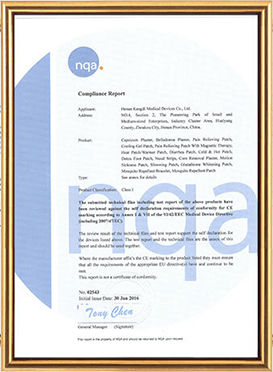
Henan Kongdy Medical Devices Co., LTD. (KONGDY) was founded in 1989 and has 37 years of production experience as of 2026 across pain relief patches, slimming patches, capsicum plasters, heat patches, cooling gel patches, detox foot patches, steam eye masks, mosquito repellent patches and nose strips. Headquartered in Henan, China, KONGDY operates a 100,000-class GMP workshop built in 2008 and obtained ISO 13485 medical device Quality Management System European Standard Certification in 2014. The company runs OEM and ODM services for international brands across multiple regulatory pathways.
For a 2026 procurement evaluation the qualification team can supply the ISO 13485 certificate, GMP workshop audit reports, stability programme documentation, and reference customer case studies upon request via our contact page.
Frequently asked questions
How many Safety Gate alerts were there in 2025?
National authorities validated 4,671, the highest number since the system was launched in 2003, a 13 percent increase on 2024 and more than double the figure reported in 2022. That works out to almost 100 notifications a week.
Why are there more follow-up actions than alerts?
Because one alert can trigger several actions in several countries. The system covers the 27 member states plus Norway, Iceland and Liechtenstein, and an authority may withdraw a product and separately order a platform to remove the listing. Actions grew 35 percent while alerts grew 13 percent, which says the response is deepening faster than the violation rate.
Which product categories were most notified in 2025?
Cosmetics at 36 percent, which is the third consecutive year they have come first, then toys at 16 percent and electrical appliances and equipment at 11 percent. On the risk side, chemical risk accounted for 53 percent of all notifications, with injuries at 14 percent and choking at 9 percent.
What is BMHCA and why does it matter so much?
It is a banned synthetic fragrance, Lilial, which can harm the reproductive system and irritate skin. Almost eight in ten of the cosmetics alerts in 2025 related to its presence. Because one substance accounts for so large a share, it dominates the cosmetics statistics and tells a manufacturer more about the category than a category-wide percentage does.
What changed with TPO?
TPO, Diphenyl(2,4,6-trimethylbenzoyl)phosphine oxide, was banned in 2025, and national authorities notified cases of nail polish containing it for the first time that year. It can pose risks to prenatal health and provoke allergic reactions. Because the ban is recent, a supplier may still be using a substance that has become prohibited since its formula was written.
Does the online channel change the risk?
Yes, and the report gives a number for it. The eSurveillance Webcrawler scanned over 1.6 million websites in 2025 and found more than 20,800 products already listed in Safety Gate still being offered online. More than 1,200 online marketplaces had registered in the Safety Gate Portal by the end of 2025, and consumers can report safety issues directly through the Consumer Safety Gateway.
What should a manufacturer do in the next quarter?
Re-screen raw materials against the current annexes rather than the version in force when the formula was written, and keep the claim set under the same control as the formulation. The two failures in the 2025 report that were within a manufacturer's own control were a restricted substance in the product and a claim on the listing, and neither one needs a laboratory to fix.
Is a detox foot patch covered by Safety Gate?
A cosmetic patch sold into the EU is covered, as a consumer product under the General Product Safety Regulation. Products that are medicines or medical devices sit outside this system and are regulated under their own frameworks, which is why the regulatory route a product takes determines which alert system it can appear in at all.
Related Guides
Five further references from the KONGDY knowledge base:
- Slimming Patch OEM: EU cosmetic route and product information file
- Cooling Gel Patch OEM: regulatory categories and stability evidence
- Frequently asked compliance questions
- KONGDY OEM and ODM manufacturing services
- Heat Patch OEM: heat output and classification


