-
 KONGDY
FDA Warning Letter 724506: What It Teaches a Pain Relief Patch OEM About Finished Product Testing and Labelled Claims
FDA Warning Letter 724506: What It Teaches a Pain Relief Patch OEM About Finished Product Testing and Labelled Claims
On 29 May 2026 the United States Food and Drug Administration issued warning letter MARCS-CMS 724506 to Macau-Union Pharmaceutical Limited. The firm had been inspected from 15 to 17 December 2025, and the letter followed a Form FDA 483 that the firm answered on 2 February 2026.
Two things about that letter matter to anyone buying patches, and neither is the headline most people would guess.
The first is that the firm could produce no finished-product test data beyond appearance and weight. The second is that two products marketed as rubs were treated as unapproved new drugs, and the reason given was not a missing approval. It was a marketing sentence on the label.
Both findings transfer directly to a patch line, because neither is a failure of character. Each is a failure of a specific document, and each is the kind that survives a first audit and surfaces at a second one. This article takes the letter apart and works out what a buyer should ask for as a result.
A pain relief patch OEM that reads the four CGMP findings as paperwork will write a better report and ship the same product. The findings say that a batch left the building without anybody having measured whether it met its own specification.
1. The facts, exactly as the letter states them
The letter names the facility, the inspection window, the products and the clauses. Here is everything it establishes, and nothing beyond it.
| Item | What the letter states |
|---|---|
| Letter | MARCS-CMS 724506, dated 29 May 2026, posted 9 June 2026 |
| Firm | Macau-Union Pharmaceutical Limited, address 3-3A Rua Cinco Do Bairro Da Areia Preta, Room B 1/F, Industrial Veng Fong, Macau |
| Facility identifier | FEI 3011219786 |
| Inspection | 15 to 17 December 2025 |
| 483 response | 2 February 2026, reviewed by FDA in detail |
| Products named | Bamboo Pharmacy Mobility penetrating muscle and joint rub; Bamboo Pharmacy Relief and Recovery deep tissue pain relieving rub |
| Adulteration | Products adulterated under section 501(a)(2)(B) of the FD&C Act, 21 USC 351(a)(2)(B), for CGMP violations |
| Unapproved new drug | Section 505(a) and 301(d), 21 USC 355(a) and 331(d) |
| Misbranding | Section 502(ee), 21 USC 352(ee) |
| Clauses cited | 21 CFR 211.165(a) and (b), 211.84(d)(1) and (d)(2), 211.100(a), 211.137(a), 211.34 |
One detail in that table is easy to read past. The products named are rubs, not patches, and nothing here says anything about any patch. What it does is set out how the agency handles two specific problems, and both have direct equivalents on a patch line.
2. Violation one: no finished-product testing before release
21 CFR 211.165(a) and 211.165(b) require a laboratory determination of satisfactory conformance to final specifications, including the identity and strength of each active ingredient, before release, and appropriate microbiological testing where the product must be free of objectionable microorganisms.
The firm confirmed to the investigator that it lacked procedures for testing finished drug products and could provide evidence of finished drug product testing for appearance and weight only.
Appearance and weight are not a reduced version of release testing. They are a different thing entirely, and both can pass on a product that contains the wrong amount of active ingredient.
| What the regulation requires | What the firm had | What the gap hides |
|---|---|---|
| Identity of each active ingredient per batch | Appearance and weight only | A batch made with the wrong material passes |
| Strength of each active ingredient per batch | Appearance and weight only | A batch that is under-strength passes |
| Microbiological testing where required | Not performed per batch | A contaminated batch passes |
| Determination against final specifications before release | No procedures existed | There was no release gate to fail |
The reply to FDA made the situation worse rather than better. The firm committed to testing identity, assay, microbial limits and critical quality attributes, and supplied summary test reports for shipped batches. FDA rejected the response for three reasons: no supporting documentation for the corrective actions, no specifications attached to the analytical reports, and no scientific justification for the finding that the active ingredients were below the labelled concentration. A pain relief patch OEM that sends a corrective action plan without the supporting records has done what this firm did, and the response will be rejected the same way.
That third point is the one to carry forward. Sub-potency against the labelled concentration violates section 501(c) of the FD&C Act in its own right, because the product quality falls below what it purports to possess. A pain relief patch OEM whose assay data shows a drift below the label does not have a documentation problem, it has a product problem that the documentation has now made visible.
A pain relief patch OEM that treats this as a filing problem will write a better report and ship the same product. The finding is not that the report was thin. It is that nobody measured the finished patch, so the label and the content of the patch had no agreed relationship.

3. Violation two: component testing and supplier certificates
21 CFR 211.84(d)(1) requires testing of each component for identity and conformity to written specifications for purity, strength and quality, and 211.84(d)(2) requires validating and establishing the reliability of a component supplier's test analyses at appropriate intervals.
The firm had not tested incoming active pharmaceutical ingredients and other components for identity, purity, strength and quality, and had relied on supplier certificates of analysis without verifying the supplier's results at appropriate intervals.
For a patch line this is where the strongest available supplier story usually starts, and it is worth being blunt about what a certificate of analysis is. A CoA is a record of what a supplier says about a material, not a record of what arrived in your warehouse. A pain relief patch OEM that leans on supplier certificates without an incoming identity test is leaning on somebody else's laboratory and calling it its own quality system.
| What the regulation requires | The gap in this letter | What it looks like on a patch line |
|---|---|---|
| Test each component batch for identity, purity, strength and quality | No incoming testing of APIs or other components | An adhesive lot or an extract that is not what the specification says |
| Validate the reliability of supplier test analyses at appropriate intervals | Supplier CoA relied on without verification | A supplier whose assay method is not comparable to yours |
| Always conduct at least one specific identity test per incoming component batch | Not performed | A batch of the wrong colour, the wrong viscosity or the wrong material |
| Qualify and oversee contract facilities that test components | No programme described | A third-party laboratory whose methods you have never reviewed |
FDA also required the firm to set out how it would accept a supplier CoA in place of testing each batch, and the answer it wanted was specific: initial validation plus periodic re-validation, and at least one identity test on every incoming batch. That combination is testable rather than a philosophy.
For a pain relief patch OEM the same requirement reaches back through the supply chain. A patch is layered, and the layer a buyer never sees is usually the one that decides whether the finished product performs.
The reason this finding is on the list of four and not at the bottom is that it is upstream of all the others. If the incoming material is not what the specification says, the assay of the finished product measures a mixture of the wrong things. A pain relief patch OEM that has no incoming verification has no way of knowing which batch of raw material the finished assay came from.

4. Violation three: process validation, and shared equipment cleaning
21 CFR 211.100(a) requires adequate written procedures for production and process control, and requires the quality control unit to review and approve those procedures and any changes to them.
The firm lacked process validation studies demonstrating reproducibility and control, its cleaning procedures for shared equipment were inadequate, and it had not demonstrated that operators could clean each equipment type reproducibly and effectively.
| Element of 211.100(a) | What the letter found | The patch equivalent |
|---|---|---|
| Written production and process control procedures | Lacked process validation studies demonstrating reproducibility | A coating or laminating step that works on one batch and drifts on the next |
| Quality control unit review and approval of procedures and changes | No evidence that the quality unit had approved the process documents | A specification changed on the line without the quality function seeing it |
| Cleaning procedures for shared equipment that work reproducibly | Cleaning not demonstrated to be effective, no validation | One mixer used across products with a cleaning step that was never proven |
FDA referenced its own Process Validation: General Principles and Practices guidance and spelled out what it expected: process performance qualification, ongoing monitoring of intra-batch and inter-batch variation, and a continuing state of control. The cleaning section is the one with the most transferable detail, because FDA listed the six worst-case factors it wanted addressed.
- Drugs with higher toxicities
- Drugs with higher drug potencies
- Drugs of lower solubility in their cleaning solvents
- Drugs with characteristics that make them difficult to clean
- Swabbing locations for areas that are most difficult to clean
- Maximum hold times before cleaning
A pain relief patch OEM that cannot answer these six points for its own line has a cleaning programme that has been written rather than demonstrated, and on a line running several actives or several colours that is exactly the question a buyer should be asking.
The shared equipment point deserves emphasis for patch lines. A patch line runs the same mixer, coating area and packing equipment across several actives and pouch sizes, which makes it a shared equipment line by definition, and makes the worst-case factors in the FDA list a description of the actual risk rather than a formality. A pain relief patch OEM that cannot answer those six points has a cleaning programme that has been written rather than demonstrated.

5. Violation four: an expiry date with no stability programme behind it
21 CFR 211.137(a) requires that the drug product bear an expiration date supported by appropriate stability testing.
The firm had no adequate stability testing programme supporting the labelled expiry date on the products distributed in the United States market, and there was no assurance that the products would remain acceptable throughout the labelled expiry period.
The reply committed to a stability programme described as compliant with USP general chapter<1150>, testing identity and strength of active ingredients, related substances, microbial limits, appearance and viscosity at designated intervals. FDA rejected it for lacking scientific evidence and for omitting a risk assessment for the products already on the market.
The four elements FDA asked for are the difference between a stability programme and a shelf life guess, and they are set out in the contract table in section nine below.
The requirement that studies be run in the marketed container-closure system before distribution is the one that catches patch programmes, because a patch is defined by its pouch. A gel matrix tested in a beaker is a different product from a gel matrix tested in foil.
A pain relief patch OEM that ran its stability study on the matrix alone has not studied the product. The difference between the two is where most of the shelf life behaviour lives, because the pouch is what holds the water in the gel and what keeps the actives from migrating.

6. The second case: how a marketing sentence creates an active ingredient
The two products were not treated as unapproved new drugs because they were formulated wrongly. They were treated as unapproved new drugs because the label carried three claims that the applicable OTC monograph does not permit.
The applicable category is M017, External Analgesic Drug Products for Over-the-Counter Human Use. A product marketed as an OTC external analgesic may be legally marketed without an approved application if it conforms to that monograph. These two did not, for two separate reasons.
| Where the product failed | The rule it failed | The wording on the label |
|---|---|---|
| Permitted intended uses | M017.50(b), which sets the general intended uses allowed for an external analgesic drug product | Promote Healing, Improve Circulation, Reduce Inflammation. These go beyond the allowed general intended uses. |
| Permitted active ingredients | M017.2, which sets the active ingredients permitted in the category | Natural herbs to Promote Healing, Improve Circulation, Reduce Inflammation. Natural herbs are not permitted as active ingredients in M017, whether used alone or in combination. |
The reasoning in the second row is where the agency drew a line most buyers would not have drawn.
The Drug Facts panels did not list the herbs as active ingredients, and the firm argued that on that basis they were not active ingredients. FDA rejected that argument, because a claim that the products are formulated with natural herbs to promote healing, improve circulation and reduce inflammation purports that the herbs furnish pharmacological activity. That is what makes them active ingredients within the meaning of 21 CFR 201.66(b)(2), the provision that defines active ingredients for labelling purposes.
The consequences run in a straight line. The products are drugs under section 201(g)(1)(B) and (C) of the FD&C Act, 21 USC 321(g)(1)(B) and (C), because they are intended for use in the mitigation or treatment of disease and are intended to affect the structure or function of the body. FDA took the intended use from the label under 21 CFR 201.128. A new drug under 21 USC 321(p) requires an approved application under section 505(a), and none was in effect for these products.
For a pain relief patch OEM the commercial lesson is sharper than it first appears. A marketing sentence on a webpage, a marketplace listing or a brochure can do what a reformulation cannot. If the copy says the product works because of a natural ingredient, the ingredient becomes an active ingredient for regulatory purposes and the whole product leaves the monograph. A pain relief patch OEM that sells into the United States carries that risk in its marketing copy rather than in its formula.
The same reasoning applies to a capsicum plaster OEM programme and to a heat patch OEM programme, and it is why the claim set belongs under change control at least as firmly as the formula does.
A pain relief patch OEM that treats the claim set as a marketing artefact has left the most dangerous part of the file outside it, because this is the only finding in the letter that a marketing decision can create on its own without a laboratory or a production error.
For a pain relief patch OEM the practical control is narrow and cheap. Keep a written record of every claim that appears anywhere, including on a marketplace listing, and have the quality function confirm that each one sits inside the permitted intended uses and does not purport that any ingredient furnishes pharmacological activity. A claim sheet that lives in the quality file rather than in a marketing folder is the whole fix.

7. What this letter cannot tell you
A warning letter is a public enforcement document, and reading it as anything more than that produces bad conclusions. A pain relief patch OEM that reads it as a character judgement will draw the wrong lesson.
The letter is not a recall notice. FDA required the firm to provide an action plan and timelines for testing retain samples of all batches within expiry as of the date of the letter, and required that, if testing revealed substandard products, the firm take rapid corrective actions such as notifying customers and recalling. A requirement to present a recall plan is not a statement that a recall happened.
It is also not a finding about any patch, and not a finding that the products were unsafe in the sense a lay reader would take from the word adulterated. The adulteration finding rests on CGMP non-conformity, and the documentary findings are about what was measured and what was written.
FDA also made two statements about the consultant recommendation worth quoting for any buyer relying on a supplier's quality system. Using a consultant does not relieve the firm of its own obligations, and the firm's executive management remains responsible for resolving the deficiencies and the systemic flaws. A consultant is a repair, not an exemption.

8. Seven checks a buyer can run on any patch supplier
Everything above reduces to seven questions needing no laboratory and no lawyer.
- Ask for the release specification. Not a description of quality control, the actual specification each batch is measured against. If the answer names appearance and weight and stops, that is the answer.
- Ask which assays run on every batch. Identity and strength of the active, and microbiological limits where the product requires them.
- Ask whether you have ever seen a batch fail. A supplier who has never had a failed assay has either never tested or has a laboratory that does not report.
- Ask what happens when a result comes back low. The answer should name a quarantine step and a disposition decision, not a second test.
- Ask what is verified on incoming material. The answer should include at least one identity test per batch and a stated programme for validating supplier results.
- Ask whether the stability study ran in the shipping pouch. A study on the matrix alone does not describe the product.
- Ask who approves a claim, and where it is recorded. If claims are approved by marketing and stored nowhere, the labelling risk in section six is unmanaged.
For a pain relief patch OEM these seven take one meeting, and the answers are self-evidencing. Two of them are worth more than the other five together, because they expose a gap in minutes rather than in years: the release specification and the batch assay report either exist or do not, and asking for them takes one email.
9. What to write into the contract
The letter ends with a list of things a firm must provide to FDA, and those same items are what a buyer should be entitled to require.
| Clause in the contract | What it should say | Why this letter supports it |
|---|---|---|
| Release testing | Every batch released only against a written final specification including identity and strength, with microbiological testing where applicable | This was the first violation in the letter |
| Component verification | At least one specific identity test per incoming component batch, plus validation and periodic re-validation of any supplier results relied on | This was the second violation, and FDA asked for the same combination |
| Process validation | Process performance qualification and ongoing monitoring of intra-batch and inter-batch variation, with cleaning validation addressing the worst case factors | This was the third violation, and FDA listed six worst-case factors |
| Stability | Stability-indicating methods, studies in the marketed container-closure system before distribution, an ongoing programme with new batches added, and written attributes at each timepoint | This was the fourth violation, and FDA set out these four elements |
| Claim control | No claim may be used without a written determination that it sits inside the applicable framework, covering marketing copy and not only the label panel | The unapproved new drug finding came from label wording |
| Records and access | The right to receive the release specification, the batch assay results, the stability protocol and the change log on request | Every one of these was a document FDA asked for |
| Notification | Written notice of any regulatory action, inspection finding or field complaint relating to the product | Such letters are public, and the buyer should not learn of it from a search |
One drafting point is worth adding that FDA itself made. Require that changes to the formulation, the packaging, the process and the claim set each go through a written review before implementation, and that the review is performed by the quality function rather than by the function that requested the change.
Frequently asked questions
Does this letter mean the products were recalled?
No. FDA required the firm to provide a plan and timelines for testing retain samples of batches within expiry, and required rapid corrective action including customer notification and recall if testing revealed substandard product. A requirement to present a recall plan is not a report that a recall occurred.
Is a CoA from the material supplier enough?
Not on its own. FDA asked how the firm would accept a supplier CoA in place of testing each batch, and the answer it wanted was initial validation plus periodic re-validation, together with at least one specific identity test on every incoming batch. A CoA is a supplier's statement; the identity test confirms what arrived.
If our label does not list herbs under Active Ingredients, are we still exposed?
Yes, which is the unusual finding in this letter. FDA held that a claim that the product is formulated with natural herbs to promote healing, improve circulation and reduce inflammation purports that the herbs furnish pharmacological activity, and therefore makes them active ingredients within the meaning of 21 CFR 201.66(b)(2) even though the Drug Facts panel did not list them that way.
How far does the monograph question reach for patches?
It depends on the intended use and the claims. A product marketed as an OTC external analgesic has to conform to M017 to be marketed without an approved application. A therapeutic claim that pushes a product outside the permitted intended uses and outside the permitted active ingredients is the failure mode this letter documents, and it is a failure of copy rather than of chemistry.
Does this affect cosmetic and general goods lines?
Not the same way. This letter concerns OTC drug products, and the monograph question does not arise for a product sold as a cosmetic or as a general good. What travels is the method: what a buyer asks for, and how the answer is written.
What is the most useful single request?
Ask for the release specification and for one recent batch assay report. The first tells you what the supplier believes a finished product must satisfy, and the second tells you whether that belief survives contact with a real batch. In the letter in question, the answer to the second was that the firm could only produce appearance and weight.
Who should sign off on our claim set?
The quality function, on a dated record. In the letter, the quality control unit had not reviewed and approved the production and process control procedures, and the label claims escaped review entirely. A claim set that marketing can change without a regulatory record is the exact condition that produced the unapproved new drug finding.
Can a patch supplier use this letter as a template?
Yes, and that is the point of it. The seven checks in section eight and the seven contract clauses in section nine are both derived from what FDA asked for in this letter, which makes them a defensible specification rather than a wish list.
About KONGDY Medical

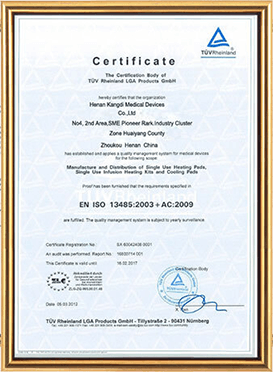
Henan Kongdy Medical Devices Co., LTD. (KONGDY) was founded in 1989 and has 37 years of production experience as of 2026 across pain relief patches, slimming patches, capsicum plasters, heat patches, cooling gel patches, detox foot patches, steam eye masks, mosquito repellent patches and nose strips. Headquartered in Henan, China, KONGDY operates a 100,000-class GMP workshop built in 2008 and obtained ISO 13485 medical device Quality Management System European Standard Certification in 2014. The company runs OEM and ODM services for international brands across multiple regulatory pathways.
For a 2026 procurement evaluation the qualification team can supply the ISO 13485 certificate, GMP workshop audit reports, stability programme documentation, and reference customer case studies upon request via our contact page.
Related Guides
Five further references from the KONGDY knowledge base:
- Capsicum Plaster OEM: pre-contract checklist
- Heat Patch OEM: heat output and classification
- Frequently asked compliance questions
- KONGDY OEM and ODM manufacturing services
- Pain Relief Patch OEM: contract and documentation overview


