-
 KONGDY
Heat Patch OEM Heat Output and Storage Behaviour: 12 Questions Buyers Ask Before Signing in 2026
Heat Patch OEM Heat Output and Storage Behaviour: 12 Questions Buyers Ask Before Signing in 2026
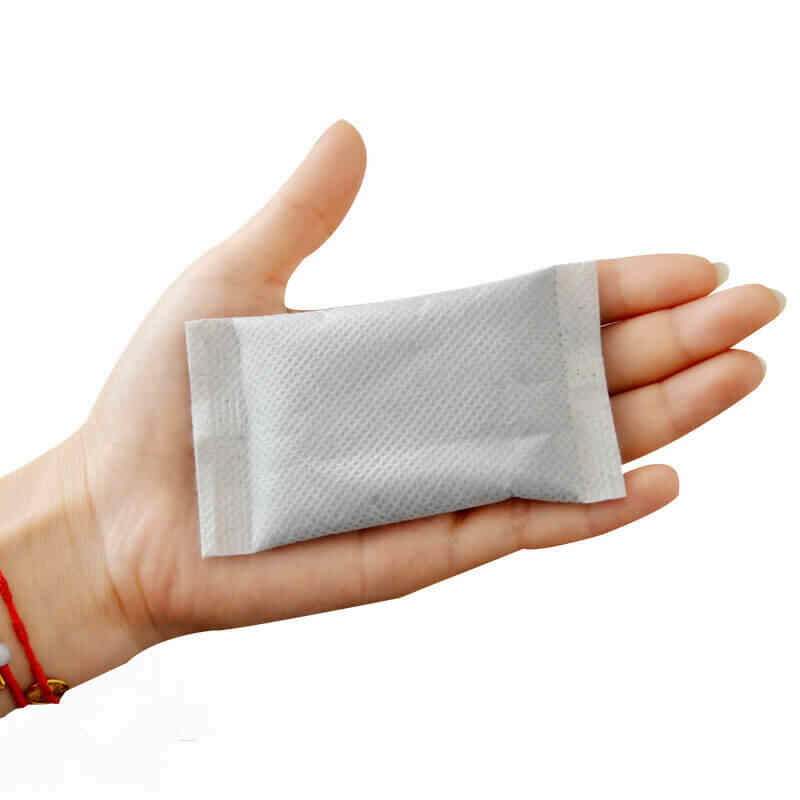
Iron powder, water, salt, a barrier pouch and a label. That is the whole of a heat patch, and every one of those five elements is adjustable, which is why two heat patches with the same words on the box can behave nothing alike.
Three variables decide the outcome, and a buyer who cannot name them is buying a number instead of a product. Oxygen supply sets how fast the reaction runs. Ambient temperature sets how fast it runs at the other end. And the pack sets how much of the heat can leave once it has been made.
A heat patch OEM that can explain those three variables can usually explain which measurement would change if one of them moved, and a supplier who cannot is describing a product rather than a process. That is the difference this set of questions is built to surface, and it is why a heat patch OEM is worth auditing on the file rather than on the sample.
A heat patch OEM that publishes a peak temperature without the curve behind it has given the buyer a number to check rather than a specification to build on, and the difference only becomes visible when a customer in a cold market asks why the product behaved differently from the description. That is the pattern a heat patch OEM avoids by reporting the shape rather than the headline.
The questions below are the order in which those variables get resolved. Each one is answered in its first sentence, and the answers are ordered so that a buyer who stops after question three still holds the three facts that matter most: the peak limit, the shape of the curve, and the condition the curve was measured in.
The framework behind the answers is short and worth stating up front. ASTM F2871 sets a peak temperature at or below 50 degrees Celsius for self-heating products, and that figure decides what the product may be called, how long it may be worn, and what the label is allowed to claim. ASTM F2259 covers peel and shear. ISO 14971 governs the risk file, ISO 10993-10 covers skin sensitisation, and ISO 13485:2016 governs the quality system that holds all of it together. For the United States device route the references are 21 CFR Parts 800 and 880 for classification, Part 807 for registration and listing, and Part 820.30 for design controls. For Europe they are EU MDR 2017/745 Annex VIII, Annex II, Annex IX and Annex XIV.
One word of warning about the subject itself. A heat patch does not hold a temperature, it produces heat for a period and then stops, and almost every disagreement between a supplier and a buyer about a heat patch is really a disagreement about which part of that curve each of them is describing.
For a buyer comparing suppliers, that framing is worth keeping in mind for the whole set. Two quotes that look identical may describe the plateau of one curve and the fall of another, and the only way to know which is to ask for the shape of the curve rather than for a duration. A heat patch OEM that offers the curve without being asked is a supplier who understands what the number means.
1. How does a heat patch actually produce heat?
By oxidising finely divided iron in the presence of water and salt, at a rate set by how quickly oxygen reaches the iron.
The mechanism explains every practical question about the product, so it is worth setting out in one table before the rest of the answers.
| Component | Role in the reaction | What changes if it is wrong |
|---|---|---|
| Iron powder | The material that oxidises and releases the heat | Wrong particle size or loading changes both the peak and the duration |
| Water | Carries the reaction across the surface of the iron | Too little stops the reaction early, too much makes the packet wet and uneven |
| Salt | Accelerates the oxidation rate | An incorrect salt load moves the whole curve up or down |
| Oxygen path | Sets the rate at which the reaction can proceed | A barrier that is too tight produces a slow patch, one too open produces a hot short one |
| Outer barrier | Keeps oxygen out of the sealed packet during storage | A compromised barrier lets the product age on the shelf |
The last row of that table is the one that surprises buyers, and it is why a storage question belongs on a heating product and not only on a cosmetic one.
There is a second reason the mechanism is worth understanding before the commercial conversation starts. A heat patch whose iron load has been reduced to hit a cost target is not a cheaper version of the same product; it is a different product with a different curve, and it will fail a duration claim in a cold market while passing one in a warm one. The mechanism is the reason a heat patch OEM has to be audited on formulation and not on price alone, and it is the reason the questions in this set focus on the variables rather than on the quoting.
The same reasoning applies to the salt load and to the water content, and it is why a heat patch OEM that will discuss the mixture openly is more useful to a buyer than one that only discusses the pouch. The pouch is the easier variable to specify and the harder one to see, and it is usually the one discussed in place of the one that determines the behaviour.
2. What is the peak temperature and where does the limit come from?
50 degrees Celsius, the ceiling set by ASTM F2871 for self-heating products.
The limit encodes a relationship between temperature and time, because skin injury depends on both. A surface at 50 degrees Celsius is tolerable for a defined period, and a surface above it is not, so the standard pushes the time into the temperature rather than leaving it to be negotiated on the label.
What that ceiling settles in one stroke:
- The product may be worn for a stated period, because the period is what the temperature limit is calibrated against.
- The label may describe warmth and comfort, but not a treatment effect.
- The risk file must carry a residual heat hazard, because the limit exists precisely because the heat can injure skin.
A peak temperature stated without a dated report is a target rather than a result, and a heat patch supplier who treats the 50 degree figure as a marketing line rather than as a test criterion will eventually ship something that sits against skin for longer than the evidence supports.
The heat patch OEM that takes this seriously reports the peak the way the standard asks for it, on the finished product, in the pack the customer will open, with the condition written next to the number. That is a small habit and it is the difference between a laboratory result and a catalogue figure.
3. Why is a curve better than a number?
Because the product has three phases and each one answers a different question, so a single peak figure discards two thirds of the information.
| Phase | The shape of it | The decision it supports |
|---|---|---|
| Rise | Temperature climbs from ambient to the peak | How long the user waits before feeling anything, and therefore what the instructions have to say about the first few minutes |
| Plateau | Temperature holds inside a usable band | The duration claim and the wear time on the pack |
| Fall | Temperature declines but the product stays warm | The instruction to remove the patch, and the residual heat hazard in the risk file |
| Peak | The maximum reached under a stated ambient condition | The ASTM F2871 result, and the claim the label is allowed to carry |
A curve lets a buyer write a label without inventing anything. The plateau supplies the duration, the peak supplies the claim ceiling, and the fall supplies the removal instruction. Three numbers, three different decisions, one document.
For a heat patch OEM the request is also the cheapest way to find out whether the supplier thinks in curves at all. A company that answers with a shape and a condition is a company that has watched its product run, and that company is the one whose numbers hold up when a customer in an unfamiliar climate opens the pack.
4. Does the ambient temperature change the result?
Yes, and the direction is not what most buyers expect, which is exactly why the condition belongs in the report rather than in the assumption.
Two effects pull in opposite directions and both are real.
| Effect | What happens | Consequence for the buyer |
|---|---|---|
| Faster reaction | Warmer ambient temperature accelerates the oxidation | A higher peak and a shorter total output in a warm market |
| Slower heat loss | A cooler room retains the heat more effectively once it is made | A lower peak and a longer total output in a cold market |
| Net result | The two effects do not cancel out and one does not dominate predictably | A single measured curve does not describe the product everywhere it sells |
The practical consequence is that a report stating a peak without an ambient condition has produced a number that cannot be compared with any other number, including the buyer's own expectations. The report is more useful with the condition attached than with an extra digit in the peak.
A heat patch OEM that operates across more than one climate has no choice about this, because the same report cannot cover both markets. Either the curve is reported at the condition that matters for each market, or the claim is written so loosely that it survives any of them. A supplier who can do neither has a product that only works in the laboratory conditions it was developed in, and that is worth discovering before the first container ships rather than after.
5. What happens to a heat patch in storage?
The iron in an unopened packet is already partly oxidised, and the packet exists to hold that oxidation down to a rate the shelf life can tolerate.
Nothing visible, provided the pouch is sealed and the product was validated for the stated period, and the failure mode is precisely why it is worth testing.
| Aspect of the storage question | What is actually happening | How it is verified |
|---|---|---|
| Sealed shelf life | Slow oxidation continues inside the barrier, at a rate the laminate controls | A dated stability programme with the heat curve re-measured at intervals |
| Appearance and weight checks | They catch gross changes only | Useful, and on their own they would not detect a curve that has flattened |
| After opening | Oxygen reaches the iron and the reaction starts deliberately | A separate check, because the opened state behaves nothing like the sealed one |
| Humidity exposure | Moisture taken up before use changes the starting point of the reaction | Storage at a stated humidity and temperature, with a defined excursion limit |
The row that catches most programmes is the second one. Appearance and weight are what a shelf gets checked for, and a heat patch whose curve has flattened can look entirely normal, which is the argument for re-measuring the curve rather than re-weighing the pouch.
A heat patch OEM that only checks appearance and weight at intervals is running a programme that would pass a degraded product, and the buyer inherits the risk without knowing it was ever tested for. This is one of the cases where the distinction between a check and a test decides whether the shelf life claim can be defended at all.
6. What does the packaging have to do with it?
It controls three of the variables in the reaction table, which is why a laminate change is a product change rather than a procurement change.
| Job of the pouch | Which variable it controls | What a change would do |
|---|---|---|
| Outer barrier | Oxygen ingress and moisture egress during storage | Would age the product on the shelf and change the sealed shelf life |
| Mixture containment layer | How water is distributed across the iron when the pouch is flexed | Would produce a patch that behaves differently after a shelf and a courier |
| Vent arrangement | Where the heat and the reaction moisture go during use | Would change the curve and the heat the user actually feels |
| Seal integrity | Whether the closed state is genuinely closed | Would invalidate the entire storage argument in question five |
The consequence for a buyer is a change control question worth asking: has the laminate specification changed since the test reports were issued, and if so, which reports were re-issued against it.
It is worth asking that question of any heat patch OEM, because the answer is usually available and is usually not volunteered. A supplier who can name the laminate revision behind each report has a controlled process. A supplier who answers that the packaging has not changed has answered a different question, and the buyer now knows to ask about change control at all.
7. How do you tell a real heat programme from a brochure?
By asking for the curve on the finished product in the commercial pack, with the conditions stated, and by listening to whether the answer arrives as a report or as a description.
The single most informative question is narrow enough to be easy to ask and hard to fake.
| The question | A programme answer | A brochure answer |
|---|---|---|
| On what product was this measured? | Names the mixture, the pouch, the unit weight and the ambient condition | Names a product family or a standard configuration |
| How many batches were measured? | Gives a number and can say how the batches varied | Cannot answer without checking |
| Which pack was used? | The commercial pouch from the commercial run | A development pouch or a sample from the laboratory |
| When was it measured? | A dated report with a revision number | A date without a report reference |
| What happens if the ambient condition differs? | Explains how the curve moves and offers the other condition | States one number as though it were universal |
The five answers in the middle column are what a supplier looks like when the work has actually been done, and none of them requires the buyer to be a laboratory expert to appreciate.
The practical version of the test is simple enough to apply at a trade show. Ask a heat patch OEM to describe the curve for a specific batch, in a specific pack, at a stated temperature. A supplier with real data will do it without reaching for a specification sheet. One without it will describe the product instead, and the description will sound just as confident.
8. Is a heat patch a medical device or a consumer product?
It depends on the intended use and the claims, and a self-heating product can sit on either side of that line.
| Claim in the marketing | Route implication | What it drags in |
|---|---|---|
| Relieves muscle pain, relieves joint pain, relieves arthritis pain | A therapeutic claim, which points to the medical device route | A determination under 21 CFR Parts 800 and 880, design controls under Part 820.30, registration and listing under Part 807 |
| Warming, relaxing, soothing, comfortable heat, relieves stiffness | A comfort claim, which may stay on the consumer route | A general product safety frame, consumer labelling, and no device file |
| Relieves arthritis pain, and also warms and soothes | The stronger claim governs the route | The device route, with the comfort language written to fit inside it |
Adding a comfort benefit to a therapeutic claim does not produce a product with two lighter frameworks. The therapeutic claim sets the route, and the comfort language then has to live inside whatever that route requires.
There is also an OTC route that a supplier should rule out in writing rather than by assumption. A product marketed as an OTC external analgesic may be legally marketed without an approved application if it conforms to the conditions of the monograph for that category. A supplier who has jumped straight to the device route has skipped a question that belongs in the file.
For a heat patch OEM the classification question is the one that most often decides the size of the whole programme, and it is worth settling before the first test is commissioned rather than after. The same heat curve, the same pouch and the same production line can serve a device file, an OTC monograph file or a general product safety file, and the cost difference between the three is large enough that getting the route wrong is an expensive way to start a project. A buyer who has not settled it is not yet able to compare a heat patch OEM quotation against a competing one, because the two may be quoting against different frameworks entirely.
9. What does the buyer ask for in the file?
Five documents, each of them a dated record rather than a description of a procedure.
- The classification determination for the exact product, with the intended use and the regulation cited together.
- The ASTM F2871 report on the finished product in the commercial pack, with the full curve and the ambient condition.
- The stability programme on the sealed product in its commercial pack, with the curve re-measured at intervals.
- The risk management file under ISO 14971, with hazards, controls and residual risk, covering the risks that come from heat.
- The peel and shear report under ASTM F2259 on the final construction.
Each entry is a record that could only have been produced by doing the work, and each is cheap to request. A supplier that can hand over all five has a programme rather than a presentation.
A heat patch OEM that treats these five as routine has usually already found the answer to question ten, because the answers to question ten are visible in the five documents. The two questions are the same question asked from two ends, and a supplier who is comfortable with one is comfortable with the other.
10. What is the most common gap in a heat patch file?
A test performed on a different construction from the one that ships, and it shows up in four predictable places.
| Where the mismatch appears | What was measured instead | Why the number does not describe the product |
|---|---|---|
| Heat curve | A loose mixture on a bench rather than a sealed pouch | The pouch is what controls oxygen supply and heat loss |
| Adhesion | A sample of the film rather than the finished patch | The backing and the release liner both change peel behaviour |
| Sensitisation | The individual components rather than the blend | The blend is what reaches the skin |
| Condition | A curve measured at a different ambient temperature | The same product behaves differently in a warmer market |
The second most common gap is the risk file, and it has a recognisable shape. The hazards are listed, the controls are missing, and the file has not been revisited since the mixture was last changed. It is running the risk assessment for a product that is no longer made.
This is the gap that a heat patch OEM closes cheaply, because the fix is a review rather than a laboratory. The hazards do not change when the mixture does; what changes is which controls apply and whether the residual risk still sits where the risk file says it sits. A file that has been reviewed against the current mixture takes an afternoon, and a file that has not will eventually be found by someone else.
11. Who signs the file off?
The quality function, and the record is a dated one naming the product, the configuration and the documents it covers.
ISO 13485:2016 puts responsibility for the quality system on the organisation, and a self-heating product puts the organisation at the centre of a hazard that is visible and measurable. A file signed by production alone expresses a commercial position rather than a quality decision.
| What the signature commits to | Why a buyer wants it |
|---|---|
| The accepted peak temperature and where it came from | It names the person who made the acceptance rather than the person who requested it |
| The configuration the acceptance applies to | It ties the acceptance to a specific product so the file can be re-qualified after a change instead of rebuilt |
| The documents covered | It states the scope, so a later reader knows what was and was not assessed |
| The date | It places the acceptance relative to the change history |
A dated record that names the mixture revision, the laminate and the test condition is what makes a file re-qualifiable. Without it, any change to the product means starting the evidence again.
For a heat patch OEM this is also the point where the quality function earns its place in the programme, because the acceptance of a temperature limit is not a production decision. Production can tell a buyer how the line runs. Only the quality function can tell a buyer why the limit is what it is, and that is the sentence a reviewer is looking for.
12. What is the shortest defensible heat patch file?
A classification determination, a curve on the commercial pack with its condition attached, a stability programme, and a risk file that covers the whole curve rather than only its peak.
| Component | The minimum version | Why it is defensible |
|---|---|---|
| Route | One determination with the intended use attached | It fixes every other requirement in the file |
| Heat evidence | The curve on the commercial pack with the ambient condition | It supports the wear instruction, the claim and the risk control at once |
| Storage | A stability programme with the curve re-measured at intervals | It verifies the product still behaves at the end of its shelf life |
| Risk | Hazards, controls and residual risk, dated | It covers the risks that heat creates rather than only the risks chemistry creates |
| Sign-off | One dated record naming the configuration | It makes the file re-qualifiable rather than a one-off document |
The heat elements are specific to self-heating products. The file structure around them is not, and the same five-part structure works for a steam eye mask OEM programme and for a nose strip OEM programme once the framework is swapped at the classification step.
For a buyer comparing a heat patch supplier against a broader KONGDY OEM and ODM manufacturing services offer, the practical point is that the same five-part structure applies whether the product is a warming patch or a cooling gel patch or a pain relief patch. Only the classification step changes, and only the classification step changes what the file has to contain.
About KONGDY Medical

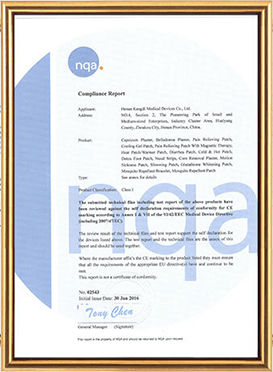
Henan Kongdy Medical Devices Co., LTD. (KONGDY) was founded in 1989 and has 37 years of production experience as of 2026 across pain relief patches, slimming patches, capsicum plasters, heat patches, cooling gel patches, detox foot patches, steam eye masks, mosquito repellent patches and nose strips. Headquartered in Henan, China, KONGDY operates a 100,000-class GMP workshop built in 2008 and obtained ISO 13485 medical device Quality Management System European Standard Certification in 2014. The company runs OEM and ODM services for international brands across multiple regulatory pathways.
For a 2026 procurement evaluation the qualification team can supply the ISO 13485 certificate, GMP workshop audit reports, stability programme documentation, and reference customer case studies upon request via our contact page.
Related Guides
Five further references from the KONGDY knowledge base:
- Cooling Gel Patch OEM: regulatory categories and stability evidence
- Steam Eye Mask OEM: heat output and classification
- Frequently asked compliance questions
- KONGDY OEM and ODM manufacturing services
- Pain Relief Patch OEM: contract and documentation overview


