
-
 KONGDY
Seven Letters, Five Domains: A Clause Cross-Reference for a Nose Strip OEM in 2026
Seven Letters, Five Domains: A Clause Cross-Reference for a Nose Strip OEM in 2026
Seven warning letters sit in this library with their clauses recorded, and reading them one at a time produces a list of clauses. Reading them as a cross-reference produces something more useful, which is a map of the compliance domains behind the clauses.
The distinction matters because the domains fail differently and cost differently. A claim failure and a release-testing failure can both be closed with documents, but one of them closes in a week and the other closes in months, and the letters say which is which.
For a nose strip OEM the practical use of the map is to answer a question a supplier is asked constantly, which is which of my documents does this finding concern. The answer is rarely the one the clause number suggests.
One note on scope. This article covers the United States records held in this library. The European alert system is a different instrument with a different naming convention, and the final section compares the two rather than mixing them.
1. The five domains
The seven letters reduce to five kinds of failure, and the first grid names each one with the clauses that produce it.
| Domain | What fails | The clauses it produces | Which letters |
|---|---|---|---|
| Claim | What the product says it does, and what it is made of | 21 U.S.C. 355(a), 331(d), 321(g)(1), 321(p), 352(ee), 331(a), 21 CFR 201.128, section 505G, M017.12, M017.50(b), M017.2 | 735346, 736006, 718720, and the claim findings in 724506 |
| Release and laboratory | Whether a finished product was determined before it was released | 21 CFR 211.165(a) and (b), 211.194(a), USP general chapters 61 and 62 | 724506 |
| Material and supplier | Whether what came in was identified, and whether the supplier was trusted rather than verified | 21 CFR 211.84(d)(1) and (d)(2) | 724506 |
| Facility and process | Whether the building, the equipment and the process were fit for the purpose | 21 CFR 211.42(b) and (c), 211.67(a) and (b), 211.100(a), parts 210 and 211 | 726976, 320-26-99, and the process findings in 724506 |
| Stability and shelf life | Whether the date on the pack was supported by evidence | 21 CFR 211.137(a), 211.166(a), ICH Q1A | 721916, 726976 |
The first row is the broadest and it is the row that generates most of the letters in this library. Four of the seven involve a claim finding, and the claim domain is the one a marketing decision can create without a laboratory.
The last row is the one that generates the fewest letters and the most expensive consequences, because it is the only domain whose failure reaches back to product already sold.
2. The claim domain in detail
Four letters touch it, and the clauses they produce are the most widely quoted in this library, so it is worth setting out what each one contributes.
| Case | The claim finding | What it turns on |
|---|---|---|
| 735346 | A product labelled for a condition was an unapproved new drug | The labelling, read from a website and a storefront |
| 736006 | Nine products were unapproved new drugs and one also fell outside the monograph | Labels read from a website and from products bought through a storefront |
| 718720 | Two topical analgesics failed on their active ingredients | A labelling review of a website and two social accounts |
| 724506 | Claims to promote healing, improve circulation and reduce inflammation, and natural herbs as active ingredients | The permitted intended uses and the permitted active ingredients |
The third row is the one that separates this domain from the others. The products in that letter failed on what they were made of, and the uses quoted in their Drug Facts panels were the ordinary permitted ones for a topical analgesic.
A nose strip OEM should take from this that a claim review and a formulation review are separate activities that can each fail on their own, and that passing one says nothing about the other.
3. The laboratory and release domain in detail
This domain is narrow, it is technical, and it has one letter behind it, which makes it easy to under-read.
21 CFR 211.165(a) requires a laboratory determination of satisfactory conformance to final specifications, including the identity and strength of each active ingredient, before release. 21 CFR 211.165(b) requires appropriate microbiological testing where the product must be free of objectionable microorganisms. 21 CFR 211.194(a) governs the laboratory record.
| The record | What it has to show | The failure in the letter |
|---|---|---|
| The release specification | Limits, identity and strength, applicable to the batch | The firm could provide evidence of finished product testing for appearance and weight only |
| The analytical report | The method, the raw data, the calculation and the conclusion | Reports lacked specifications, and a sub-potency finding was reported without scientific justification |
| The microbiological method | The method as written, with any modification described and validated | Reports referenced modified pharmacopeial methods without describing the modifications |
The first row is the one to sit with. Appearance and weight are real tests with real acceptance criteria, and they answer a question about consistency rather than about composition. A batch made with the wrong material passes both.
For a nose strip OEM the domain applies whenever the product is a drug rather than a device, and the cost of getting it wrong is a laboratory file rather than a marketing correction.

4. The facility and process domain in detail
This domain produces the longest letters and the most detailed evidence, because a building can be described.
21 CFR 211.42(b) and (c) require adequate space and defined areas to prevent mix-ups and contamination. 21 CFR 211.67(a) and (b) require equipment to be cleaned and maintained at appropriate intervals and adequate written procedures to exist. 21 CFR 211.100(a) requires written production and process control procedures approved by the quality control unit. 21 CFR 211.22 requires the quality unit to have the responsibility and authority, and 211.22(d) requires its own written responsibilities and procedures.
| Clause | What the letter found | The evidence in the record |
|---|---|---|
| 211.42(b) and (c) | Materials stored on floors, along walls and in hallways between packaging lines, without identification, status or run association, and with no quarantine area | A described floor plan |
| 211.67(a) and (b) | A cleaning procedure without cleaning agents, concentrations, contact times, sampling requirements or test specifications; no logs at all; a batch record cleaning step left blank across multiple lots; a cleaning medium that repeatedly produced too-numerous-to-count bioburden | A missing log and an empty cell |
| 211.100(a) | Process validation studies absent, so reproducibility was not demonstrated | A programme that had never been qualified |
| 211.22 and 211.22(d) | The quality unit had no written responsibilities of its own | An absence of a document |
The second row contains the single most transferable finding in this library. The batch record had a designated step for documenting equipment cleaning, and that step was not completed for multiple drug product lots. A procedure that exists and a step that was designed and skipped are different failures, and only one of them can be answered by asking for the procedure.
A nose strip OEM should read that row as the reason to audit the completed entries rather than the templates.

5. The stability domain and what it reaches
The stability domain is the smallest by volume and the widest by consequence, because it is the only one that reaches product already in the market.
21 CFR 211.137(a) requires the drug product to bear an expiration date supported by appropriate stability testing. One letter in this library states the consequence in the plainest terms available: without the appropriate stability studies there is no adequate scientific evidence that the drug product retains its quality attributes throughout the labelled expiry period, and the agency can withhold export certificates and withhold approval of new applications.
| What stability failure reaches | Who absorbs it |
|---|---|
| The expiry date on the pack | A consumer who bought on the strength of it |
| Export certificates | A customer registering the product in its own market |
| New applications naming the site | A customer adding the site to its file |
| The batch already distributed | A retrospective review and a risk assessment |
| The change log | The link between the current formula and the evidence behind the date |
The last row is the one that connects this domain to change control. A formula that changed and never entered the stability programme leaves the expiry date supported by evidence for a product that is no longer made, and the change log is the only record that shows when that happened.
A nose strip OEM should treat the stability file as the domain with the longest tail, because a finding here is corrected by data and data takes the longest to produce.

6. Which domains the United States record actually contains
A cross-reference of clauses is only useful if it is read against the population those clauses come from, and the population is measurable.
A sample of 100 letters published between 29 September and 10 November 2026 breaks down by issuing office as follows, and the distribution is the point.
| Issuing office | Share of the sample | What it tends to find |
|---|---|---|
| Center for Drug Evaluation and Research | 50 percent | Drug and over-the-counter drug findings, which is the claim and release domain |
| Human Foods Program | 15 percent | Food findings, which have no analogue in a patch file |
| Office of Inspections and Investigations | 12 percent | Promotion, labelling and pricing conduct across product categories |
| Center for Devices and Radiological Health | 7 percent | Device findings, which is where a patch on the device route appears |
| Center for Veterinary Medicine | 6 percent | Veterinary findings |
| Center for Tobacco Products | 4 percent | Tobacco findings |
| Other | 6 percent | The remainder |
The third row deserves a second look, because the Office of Inspections and Investigations handles conduct across product categories rather than a single regime, and at 12 percent of the sample it is the third largest source of letters in the whole database.
A nose strip OEM that reads the table should notice what is absent from it. There is no cosmetics office in the top six, and no cosmetics share is visible in the sample. That is a striking contrast with the European picture, where cosmetics accounted for 36 percent of all 2025 alerts and chemical risk for 53 percent of notifications.
The two systems are watching different things. The United States register is dominated by drug and device conduct, and the European alert system is dominated by cosmetics and consumer products. A firm selling the same product into both markets faces two different populations of enforcement activity.
7. What a buyer should ask, domain by domain
Five questions, one per domain, and each one is answerable from a document rather than from an assurance.
- Claim. For each marketed claim, the written determination that it sits inside the permitted framework, and a check of every live listing against it.
- Release and laboratory. The release specification for the batch being purchased, and one recent assay report with its method, raw data and calculation.
- Material and supplier. One incoming identity test on a received lot, and the programme that validates reliance on a supplier result.
- Facility and process. The cleaning log and the completed batch record entry, and the qualification report for the line that makes the product.
- Stability. The stability protocol naming the pack, the timepoints and the attributes, and the entry that put the current batch into it.
The second question in the list is the one that separates a claim-complete supplier from a release-complete one, and it is the second because the first is usually answered readily. A nose strip OEM that produces the release specification and one report with its raw data has demonstrated more than a quality certificate demonstrates, and has demonstrated it for the batch rather than for the system.

8. What the cross-reference settles and what it does not
A five by five map is useful and it is also easy to over-read.
| The cross-reference settles | The cross-reference does not settle |
|---|---|
| Which domain each clause belongs to | Which domain a given firm is most exposed to |
| Which domains fail on documents and which on laboratories | How long any remediation takes in a particular case |
| That the same failure type recurs across letters and across years | Why any particular firm failed |
| That the United States population is drug-led and the European population is cosmetic-led | That the two systems measure comparable things |
| Which document answers each question a buyer would ask | Whether the document produced would satisfy the agency |
The third row of the second column is the one worth dwelling on, because the whole article is about what recurs. Seven letters across four offices and fourteen months show the same failure types again and again, and a nose strip OEM should treat the recurrence as the finding. The regime that produces a letter is not the interesting fact. The regime that produces the same letter twice is.
A nose strip OEM that has mapped its own file against these five domains can answer a buyer in one sitting, and a nose strip OEM that has mapped only the domain it expects to be asked about will find the other four when it matters.

9. Building the map for your own file
A cross-reference is only useful once it is applied, and applying it takes a single afternoon if it is done by domain rather than by document.
| Step | What to do | The output |
|---|---|---|
| List every document in the file | One row per document, with the date and the owner | The inventory the rest of the exercise reads from |
| Assign each document to a domain | Claim, release and laboratory, material and supplier, facility and process, or stability | A count showing which domains are covered and which are thin |
| Mark the gaps against the clauses | For each domain, the clauses that produced findings in this library | The specific requirement that is unmet, rather than a general concern |
| Record what the missing item would cost | A document, a laboratory programme, or a change to the formula | A budget decision rather than a compliance worry |
The third row is the one that converts the exercise from a mapping into a plan. A nose strip OEM that ends with a list of thin domains has a clear picture; one that ends with a list of missing documents has a work order.
The fourth row is what stops the exercise becoming a paperwork exercise. A gap in the stability domain is closed with data and a calendar, and a gap in the claim domain is closed with a decision. Those are different kinds of work, and a nose strip OEM that has separated them can plan both in the same quarter rather than discovering that one of them cannot be done in a quarter.
A nose strip OEM that has done this once can do it again after any change, because the inventory is the same and only the gap marks move. A nose strip OEM that has not started has a list of documents and no idea which of them matter. A nose strip OEM with the map has both, and the map costs one afternoon.
The five domains are also the five places where a nose strip OEM will be asked questions, in any order, by a customer, an auditor or an agency. A nose strip OEM with the map can answer them from the file, and a nose strip OEM without it will answer from memory. The gap between those two is the whole of this article.
About KONGDY Medical

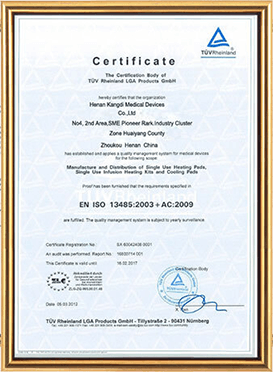
Henan Kongdy Medical Devices Co., LTD. (KONGDY) was founded in 1989 and has 37 years of production experience as of 2026 across pain relief patches, slimming patches, capsicum plasters, heat patches, cooling gel patches, detox foot patches, steam eye masks, mosquito repellent patches and nose strips. Headquartered in Henan, China, KONGDY operates a 100,000-class GMP workshop built in 2008 and obtained ISO 13485 medical device Quality Management System European Standard Certification in 2014. The company runs OEM and ODM services for international brands across multiple regulatory pathways.
For a 2026 procurement evaluation the qualification team can supply the ISO 13485 certificate, GMP workshop audit reports, stability programme documentation, and reference customer case studies upon request via our contact page.
Frequently asked questions
How many warning letters does this library hold, and from which offices?
Seven, with their clauses recorded: Aidance Scientific 735346, Medical Products Laboratories 721916, Macau-Union 724506, Amazon 736006, FairyGene 726976, International Medication Systems 320-26-99 and Sinsin 718720. Five were issued by the Center for Drug Evaluation and Research and two by the Center for Devices and Radiological Health.
What are the five domains?
Claim, release and laboratory, material and supplier, facility and process, and stability and shelf life. Four of the seven letters involve a claim finding, and the stability domain reaches the furthest because it is the only one that affects product already sold.
Which domain is cheapest to fix?
The claim domain, if the fix is a label or a listing change. The letters on claim findings are the shortest, and the correction is a document rather than a laboratory programme.
Which domain is most expensive to fix?
Stability, because the correction is data and data takes the longest to produce. One letter in this library records that without appropriate stability studies there is no adequate scientific evidence that the product retains its quality attributes throughout the labelled expiry period, and that export certificates and new applications can be withheld as a result.
What is the most transferable single finding?
A cleaning step that was designed in the batch record and left blank across multiple lots. It matters because a procedure existed, so asking for the procedure proves nothing, and because it shows a step treated as a formality rather than a control.
Is there really a difference between what the two systems watch?
Yes, and it is measurable. In a sample of 100 letters published between 29 September and 10 November 2026, the Center for Drug Evaluation and Research accounts for 50 percent and the Center for Devices and Radiological Health for 7 percent, with no cosmetics office visible. In the European Safety Gate for 2025, cosmetics accounted for 36 percent of alerts and chemical risk for 53 percent of notifications. The two populations are not comparable and should never be added together.
Does a repeated failure type mean a firm is being targeted?
The cross-reference cannot support that, and the reason is worth stating. Seven letters in one library is a selected set rather than a random sample, and the recurrence shows that the failure types are common rather than that any particular firm is targeted.
How does this differ from a plain list of clauses?
A list of clauses tells a reader what was cited. The cross-reference tells a reader which domain each clause belongs to, which domain a given document answers, and which domains the population of letters is actually drawn from, which in this library is drug-led in the United States and cosmetic-led in Europe.
Related Guides
Five further references from the KONGDY knowledge base:
- Pain Relief Patch OEM: six warning letters compared
- Heat Patch OEM: twelve record gates from material to release
- Frequently asked compliance questions
- KONGDY OEM and ODM manufacturing services
- Cooling Gel Patch OEM: the 24-point data integrity walkthrough


