
-
 KONGDY
The Register Is a Queue, Not a Feed: Reading the Publication Lag of FDA Warning Letters for a Steam Eye Mask OEM in 2026
The Register Is a Queue, Not a Feed: Reading the Publication Lag of FDA Warning Letters for a Steam Eye Mask OEM in 2026

A register that is read as a live feed produces the wrong answer most of the time, and the reason is measurable rather than a matter of opinion.
The measurement is this. On 6 November 2026 the FDA warning letters register held 3,797 entries, of which 503 had a 2026 issue date. On 11 November 2026 the 2026 count was 513. Five days, ten letters, two a day, which is the same rate that the whole register implied when it grew from 3,779 on 28 October to 3,797 on 6 November.
That part is unremarkable. The remarkable part is what a hundred consecutive published entries look like when the two dates on each row are compared.
Those hundred entries, published between 29 September and 10 November 2026, carry issue dates running from 2 February 2026 to 3 November 2026. Nine months of letters were published inside seven weeks.
For a steam eye mask OEM the consequence is a rule about reading, not a rule about preparing. The register is a queue of cases that have come due, and everything a supplier concludes from it depends on understanding that.
1. The distribution, in full
The lag is the number of days between a letter being issued and the entry being published. The sample is the hundred consecutive entries published between 29 September and 10 November 2026, taken from the register with the year filter set to 2026.
| Statistic | Value | What it means |
|---|---|---|
| Sample size | 100 consecutive published entries | Not a sample of all letters, and not a sample of one week |
| **Median lag** | **14 days** | Half the entries were published within two weeks of issue |
| Minimum lag | 4 days | The fastest observed in the sample |
| **Maximum lag** | **239 days** | An entry issued in February and published in September |
| Entries at 8 days or less | 70 of 100 | The bulk of the register moves quickly |
| Entries between 8 and 40 days | 24 of 100 | A middle band with no obvious pattern |
| Entries beyond 40 days | 6 of 100 | Including four entries beyond 160 days |
The second row and the fourth row are the pair that matters, and they are the opposite of what a summary would suggest. Most entries move fast and a few move very slowly, and the middle of the distribution is thin.
A steam eye mask OEM who reads the register expecting a uniform delay will draw the wrong conclusion in both directions, because the distribution has no plateau to stand on.
2. The full distribution
Every lag value in the sample, with the number of entries at each, so that a reader can see the shape rather than a summary of it.
| Lag in days | Entries |
|---|---|
| 4 | 2 |
| 5 | 14 |
| 6 | 3 |
| 7 | 7 |
| 8 | 10 |
| 11 | 3 |
| 12 | 6 |
| 13 | 2 |
| 14 | 5 |
| 15 | 1 |
| 18 | 1 |
| 19 | 2 |
| 20 | 1 |
| 21 | 3 |
| 22 | 3 |
| 25 | 1 |
| 28 | 1 |
| 29 | 1 |
| 32 | 3 |
| 33 | 1 |
| 34 | 2 |
| 35 | 4 |
| 36 | 1 |
| 39 | 1 |
| 40 | 1 |
| 47 | 1 |
| 50 | 1 |
| 55 | 1 |
| 56 | 2 |
| 60 | 1 |
| 61 | 1 |
| 62 | 1 |
| 67 | 1 |
| 69 | 1 |
| 71 | 1 |
| 76 | 2 |
| 81 | 1 |
| 83 | 1 |
| 89 | 1 |
| 97 | 1 |
| 162 | 1 |
| 207 | 1 |
| 232 | 1 |
| 239 | 1 |
The shape is visible in the first six rows. Four, five, six, seven and eight days account for 36 entries between them, and the mode is five days at 14 entries. After that the counts thin out quickly and never recover.
The last row is where the register stops being a schedule. Four entries in the sample waited between 162 and 239 days, and those four are the ones that turn a weekly count into a misleading one.
3. The batch effect, stated plainly
The nine-month span of issue dates inside a seven-week publication window is the finding, and it is worth restating because it inverts the ordinary reading.
| What a reader assumes | What the sample shows |
|---|---|
| The newest entry is the newest event | The newest entry belongs to a batch of cases that have come due |
| A slow month means enforcement slowed | A slow month may be a publication batch that did not arrive |
| The posted date says when it happened | The issue date says when it happened, and it can be months earlier |
| Counting entries counts events | Counting entries counts the arrival rate of a queue |
The third row is the one that changes a supplier conclusion. A register entry dated November tells a reader that a letter was issued in November, and a reader who treats the publication date as the event date will place the enforcement action in the wrong month.
For a steam eye mask OEM building a market trend from public data, the rule is short. Sort by issue date, not by posted date, and expect the two to disagree by months.

4. What the lag is not
Three explanations are available and they are worth separating, because they imply different things about how quickly a supplier would learn about a problem.
| Possible explanation | What the sample supports | The implication |
|---|---|---|
| Administrative processing time | Partly. Most entries are within 8 days | A letter becomes visible quickly in the ordinary case |
| A queue of cases finishing their internal review | Supported by the long tail of 162 to 239 days | A case can be finished and published long after the event |
| Deliberate batching for systematic review | Supported by the narrow spread of posted dates inside seven weeks | The register moves in waves rather than continuously |
The second and third rows are not alternatives, and the sample cannot separate them completely. What it does establish is that the publication process is not a simple delay applied to every case.
A steam eye mask OEM should not read the register as an early warning system, and the reason is not that the register is late. It is that the register is a sample of the past rather than a stream of the present.
5. The three measurements that agree
The register has been read three times in this library, and the three readings agree with each other closely enough to establish a base rate.
| Measurement | Value | What it gives |
|---|---|---|
| 2026-10-28, whole register | 3,797 minus 3,779 over 9 days | About 2.0 entries a day arriving |
| 2026-11-06, year filter | 503 letters with a 2026 issue date | About 1.62 letters a day issued in 2026 to that date |
| 2026-11-11, year filter | 513 letters with a 2026 issue date | Ten more in five days, which is 2.0 a day again |
The third row is the one that closes the argument. Ten letters in five days is exactly the rate implied by the nine-day interval in the first row, measured a fortnight earlier and by a completely different filter.
A steam eye mask OEM can therefore rely on the register for two things. The arrival rate of entries into it, and the fact that the register reflects issuance rather than publication when sorted correctly.

6. Who the letters are from
The same sample carries the issuing office on every row, and the distribution says more about where enforcement attention sits than any single letter does.
| Issuing office | Entries in the sample | What it tends to find |
|---|---|---|
| Center for Drug Evaluation and Research | 50 | Drug and over-the-counter findings, which is the claim and release domain |
| Human Foods Program | 15 | Food findings |
| Office of Inspections and Investigations | 12 | Promotion, labelling and pricing conduct across product categories |
| Center for Devices and Radiological Health | 7 | Device findings, which is where a patch on the device route appears |
| Center for Veterinary Medicine | 6 | Veterinary findings |
| Center for Tobacco Products | 4 | Tobacco findings |
| Other | 6 | The remainder |
Two readings follow from that table. The first is that the largest single source of letters in the whole register is the drug office, which is consistent with this library holding five of its seven letters from that office.
The second is what is missing. There is no cosmetics office in the top six and no visible cosmetics share, while the European alert system put cosmetics at 36 percent of its 2025 alerts and chemical risk at 53 percent of notifications. The United States register is drug-led and device-led; the European one is cosmetic-led and consumer-led.
For a steam eye mask OEM the two populations should be read as two different bodies of evidence rather than added together, and the question of where a product would appear is answered by its route rather than by its ingredients.

7. How to read the register properly
Six rules, and each of them exists because ignoring it produces a specific wrong answer.
- Sort by issue date. The posted date is the date the entry arrived, which can be months after the event.
- Treat a quiet period as unknown rather than as calm. With a long-tailed lag and batch publication, a gap in the register is as likely to be a batch that did not arrive as it is to be a quiet enforcement period.
- Use the median rather than the average when describing the lag. In this sample the median is 14 days and the mean is dragged far above it by four entries.
- Count the entries, not the companies. One firm can hold several letters, and one letter can name several products.
- Keep the measurement date with every figure. These counts move daily, and a number without a date is a claim rather than a measurement.
- Read the two systems separately. The United States register names firms and the European system names products, and neither is a substitute for the other.
The fourth rule has a practical consequence that a reader meets quickly. In a hundred entries it is entirely normal for one company to appear more than once, and a firm that appears twice has had two separate matters rather than one serious one.
A steam eye mask OEM that has adopted these six rules is reading a queue accurately. A steam eye mask OEM reading it as a live feed will draw a trend line through a set of points that were never measured at the same time.

8. What this dataset settles and what it does not
An honest close, because the numbers are precise and the conclusions drawn from them are not.
| The dataset settles | The dataset does not settle |
|---|---|
| That the median publication lag in this sample is 14 days | What the lag is for any other sample, or for the whole year |
| That 70 of 100 entries were published within 8 days | That the remaining 30 are anomalies, since the tail may be systematic |
| That issue dates in one publication window span nine months | Why the window is seven weeks, which the register does not explain |
| That the register reflects issuance when sorted by issue date | The time at which any particular firm would learn of a problem |
| That the United States sample is drug-led and device-led | That the European population is comparable, which it is not |
The third row of the second column is the one a careful reader should hold on to. The register does not state why entries arrive in waves, and this article does not guess. What it does establish is the effect, and the effect is enough to change how the register should be used.
A steam eye mask OEM that has understood the effect has a better relationship with the register than one that has only counted it, and that relationship is measured in months rather than in entries.

9. What to do with a register that behaves this way
A queue is not useless. It is a record of what has already been decided, and a record that is complete in one direction is worth having.
| Use the register for | Do not use the register for |
|---|---|
| Checking whether a named firm has been the subject of a letter | Estimating how likely your own product is to be named |
| Reading the clauses a particular office cites and the pattern behind them | Reading a trend line across publication dates |
| Confirming that a matter was closed, where a close-out letter exists | Confirming that a matter is closed because it is not in the register |
| Benchmarking what your own file would need to contain to answer the same questions | Benchmarking against the number of letters, which says nothing about severity |
The third row carries a qualification that is easy to miss. A register with a response and close-out filter is a complete record of matters that reached closure, and it is silent about matters that did not, because those were never published. Absence of a letter is therefore evidence about the letter register and not evidence about the firm.
A steam eye mask OEM that uses it for the first column and not the second has the right instrument. A steam eye mask OEM that has also read its own file against the clauses the register cites has done something the register cannot do for it, which is the difference between reading a public record and holding a file.
That is the whole of the argument in one line. The register reports enforcement after the fact, and it reports it in batches, and a steam eye mask OEM that wants to know whether it is compliant has to read its own file rather than the register. The register is worth reading because it shows what other people were cited for.
There is one further use that is specific to this register and worth putting separately, because it is the use that most helps a steam eye mask OEM preparing for a customer meeting. The register shows which clauses recur, and a recurrence is a better guide to what to prepare than a headline count.
The letters in this library show the same domains recurring across four offices and fourteen months, and that recurrence is a measurable signal about what an inspector reaches for first. A steam eye mask OEM that has read the clauses rather than the count knows which of its own documents an inspector will ask for, and that is a different and more useful piece of knowledge than how busy the register is.
A steam eye mask OEM that has read the count instead knows only that the register is busy, which tells it nothing about its own file.
There is also a limitation worth stating, because the register is a public document and public documents are read as more complete than they are. The sample in this article is the first hundred entries published in a window, and the window was not chosen by the author of this article. It is the most recent hundred, which is the natural way to take a sample and also the way that guarantees a recent-looking dataset.
For a steam eye mask OEM the honest way to use the figure is as a description of that window and not as a description of the year, and the distinction is worth making in a customer meeting as well. A steam eye mask OEM that says "in the hundred entries published between 29 September and 10 November 2026" has said something checkable. A steam eye mask OEM that says "FDA publishes warnings with a median delay of 14 days" has said something that a reader will test against the whole register and find to be wider than the sample supports.
About KONGDY Medical

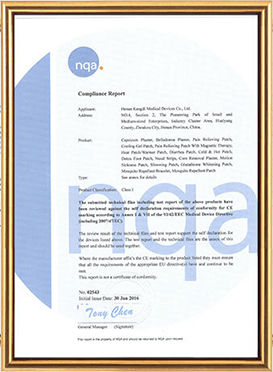
Henan Kongdy Medical Devices Co., LTD. (KONGDY) was founded in 1989 and has 37 years of production experience as of 2026 across pain relief patches, slimming patches, capsicum plasters, heat patches, cooling gel patches, detox foot patches, steam eye masks, mosquito repellent patches and nose strips. Headquartered in Henan, China, KONGDY operates a 100,000-class GMP workshop built in 2008 and obtained ISO 13485 medical device Quality Management System European Standard Certification in 2014. The company runs OEM and ODM services for international brands across multiple regulatory pathways.
For a 2026 procurement evaluation the qualification team can supply the ISO 13485 certificate, GMP workshop audit reports, stability programme documentation, and reference customer case studies upon request via our contact page.
Frequently asked questions
What is the median publication lag for FDA warning letters?
In a sample of the 100 consecutive entries published between 29 September and 10 November 2026, measured from the register with the year filter set to 2026, the median lag between issue date and posted date was 14 days, the minimum was 4 days and the maximum was 239 days. The sample size matters and should always be quoted with the figure.
What does the lag distribution look like?
It is strongly right-skewed. Seventy of the hundred entries were published within 8 days, with the mode at 5 days and 14 entries. Twenty-four were between 8 and 40 days, and six were beyond 40 days, including four beyond 160 days.
Why do the issue dates in one publication window span nine months?
Because the register publishes cases in batches as they come due rather than as they are issued. The sample in this article was published between 29 September and 10 November 2026 and carries issue dates from 2 February to 3 November 2026. The register does not state the reason for the batching, and this article does not guess it.
What does that mean for reading the register?
Sort by issue date rather than posted date, and treat a quiet period as unknown rather than as calm. A gap in the register is at least as likely to be a publication batch that did not arrive as it is to be a period without enforcement.
How many letters are there now?
The 2026 count measured on 11 November 2026 was 513, against 503 on 6 November 2026, which is ten letters in five days and two a day. The whole register held 3,797 entries on 6 November against 3,779 on 28 October. All figures are on a calendar-year, all-product-category basis.
Why use the median rather than the average?
Because of the shape. Four entries in the sample waited between 162 and 239 days, and they pull an average upward substantially while barely moving the middle of the distribution. The median of 14 days describes the ordinary case; the mean does not.
Which offices issue most of these letters?
In the sample, the Center for Drug Evaluation and Research accounts for 50 of the 100 entries, the Human Foods Program for 15, the Office of Inspections and Investigations for 12, the Center for Devices and Radiological Health for 7, the Center for Veterinary Medicine for 6 and the Center for Tobacco Products for 4.
Is the United States register comparable with the European alert system?
No. The United States register names firms and the European system names products, and the populations are visibly different. Cosmetics account for 36 percent of European alerts in 2025 while no cosmetics office appears in the top six United States issuing offices. The two should be read as two bodies of evidence rather than added together.
Can a supplier use the register as an early warning system?
Not reliably. It reports issuance once a case has cleared the agency, and the delay is measured in weeks for most entries and in months for a visible tail. A supplier who wants early warning has to build it from its own records, because the register is a report rather than a warning.
Related Guides
Five further references from the KONGDY knowledge base:
- Nose Strip OEM: seven letters and five compliance domains
- Pain Relief Patch OEM: six warning letters compared
- Frequently asked compliance questions
- KONGDY OEM and ODM manufacturing services
- Cooling Gel Patch OEM: the 24-point data integrity walkthrough


