-
 KONGDY
Pain Relief Patch Claims: 12 Questions Buyers Ask Before Approving Label Copy in 2026
Pain Relief Patch Claims: 12 Questions Buyers Ask Before Approving Label Copy in 2026
Twelve questions decide whether a claim set is lawful before anyone debates whether it is persuasive. They are asked by buyers because the answer determines what a pain relief patch may be sold as, which in turn determines the label format, the evidence package and the launch timeline. A claim set approved in the wrong order produces a compliant label for the wrong product.
Each answer below opens with the shortest defensible answer and then explains the reasoning and the published text it rests on. Where the framework does not answer the question precisely, the answer says so rather than supplying a number that sounds authoritative.
One deliberate constraint runs through the twelve. Only the monograph concentrations registered in this knowledge base are quoted, which is why the ranges named here cover menthol, methyl salicylate and camphor and stop there. A list of permitted actives that grows with each article is a list that will eventually contain something invented.
The order matters. Questions one to three fix the route, four to eight test the wording, and nine to twelve decide how the claim set is owned, inherited and reviewed. A buyer who starts at question four is choosing words before choosing a framework.
1. What is the difference between a claim and a description?
For a pain relief patch buyer this distinction is the one that decides whether a sentence enters the regulated set at all.
A description says what a product is; a claim says what it will do, and only the second one is regulated as an assertion about effect.
Describing a patch as an adhesive topical product with two actives is a description. Stating that it relieves muscle aches is a claim, because it asserts an effect that a regulator will want supported. The distinction matters because marketing copy slippage almost always happens on the boundary: a sentence that reads as a description carries an implied effect, and an implied effect is a claim in substance even when it is not one in grammar.
| What is written | Description or claim | Why |
|---|---|---|
| A flexible patch with menthol and camphor | Description | States composition and form, asserts no effect |
| For everyday muscle stiffness | Claim | Asserts relief of a symptom |
| The same comfort professionals choose | Claim | Implies an effect through a comparison |
| Contains 5 percent menthol | Description | A composition statement, provided the actives are inside the monograph range |
| Works in minutes, lasts for hours | Claim | Asserts a time-based effect that needs support |
A pain relief patch buyer reviewing copy should therefore ask a single question of every sentence: does this assert, imply or promise an effect. If it does, the sentence is a claim and enters the regulated set.

2. Which claims put the product into the drug route?
The route question is the first one a pain relief patch claim set has to answer, because every other requirement follows from it.
Any claim that the product treats, prevents or relieves a condition or symptom places it in the drug conversation, and in the United States that means the OTC monograph route for an external analgesic.
The practical test is not the word used but the effect asserted. A patch sold for comfort and a patch sold for pain relief may be physically identical and occupy different regulatory positions, because what differs is the sentence on the pack.
| Claim type | Route consequence | What it requires |
|---|---|---|
| Relief of minor aches and pains of muscles and joints | Drug route, external analgesic monograph | Conformity with 21 CFR Part 348.10 and a Drug Facts label under 21 CFR Part 201.66 |
| Comfort, cooling sensation, freshness | Potentially cosmetic route where no therapeutic effect is asserted | Cosmetic labelling obligations for the market of sale |
| Cure, treatment of a condition, prevention of disease | Outside both routes as described | A different regulatory pathway that this article does not cover |
| Cosmetic benefit such as skin care alongside a relief claim | The relief claim still governs the route | The stronger claim sets the framework |
The last row is the one that surprises buyers. Adding a cosmetic benefit to a relief claim does not create a dual product with two simpler frameworks; the therapeutic claim continues to set the route, and the cosmetic language has to fit inside it.
A useful consequence of the table is that it gives a buyer a way to price a claim change. Moving a sentence from the relief row to the comfort row does not simplify the paperwork, because the comfort row still carries labelling obligations for the market of sale. What it removes is the monograph conformity requirement, and what it adds is a claim that has to stay cosmetic under pressure for the life of the product.
3. What may a pain relief patch claim under the OTC monograph?
A pain relief patch claim set inside the monograph is bounded in a way that a claim set outside it is not, and that boundary is the useful part.
It may claim what the monograph permits, expressed in the monograph's own terms, with actives inside the published concentration ranges and a Drug Facts panel in the prescribed format.
| Active | Published range in 21 CFR Part 348.10 | What a buyer must verify |
|---|---|---|
| Menthol | 3 to 16 percent | The labelled strength sits inside the range |
| Methyl salicylate | 10 to 30 percent | The combination follows the monograph, not a market habit |
| Camphor | 3 to 11 percent | The declared strength matches the batch formula |
Two rules make this section usable. First, the use statement in the label should be taken from the monograph rather than composed from memory, because paraphrase is where a broader indication creeps in. Second, a strength outside the published range does not fail a test; it stops being a monograph product, which is a different and more expensive situation.
A pain relief patch sold on a combination of actives needs the combination checked as a combination, because each active can be inside its own range and the pairing still not be what the monograph describes.

4. Can I say clinically proven?
A pain relief patch page that describes its evidence rather than concluding from it is doing the harder but safer thing.
Only where there is evidence of a standard a reviewer would accept, and the phrase is a poor choice even then because it asserts a conclusion rather than a result.
The problem is structural rather than semantic. A statement of proof invites the question of what was proved, in what population, against what comparator, and by what method. Most programmes cannot answer all four, so the phrase converts a supportable claim into an unsupportable one.
A workable alternative describes the evidence instead of concluding from it. Stating that a patch was evaluated in a named type of study, on a stated number of subjects, for a stated duration, is both more modest and more defensible, and it survives the question that the word proven invites.
The same logic applies to percentages and durations. A figure in a claim is a claim about a measurement, so it needs the measurement behind it. A pain relief patch page that states a duration without a source document has stated something the file cannot support.
A wording pattern that survives review is to state method, population and duration in one sentence and then stop. The sentence is longer than the phrase it replaces and it is also the sentence that can be checked, which is the trade a claim set should always make. A reviewer asks for the basis, so a statement that already contains the basis ends the exchange earlier rather than later.
5. Can I compare with a named brand?
Named comparison is the claim type most likely to arrive from a pain relief patch sales team and most likely to leave without a document behind it.
Only with a documented test that supports the specific comparison being made, because a named comparison invites a request for the basis rather than a general claim of superiority.
Three problems arrive together. The comparison has to be measurable, the test has to address the attribute the reader will infer, and the result has to be presented without implying more than was measured. A test of wear time does not support a comparison of relief, and a reader will infer relief from any comparative sentence.
An unnamed comparison is not automatically safer. Language that invites the reader to supply the brand functions as a comparison while leaving the supplier without a test, which is the worst of both positions. The defensible option is either a named comparison with a documented basis or no comparison at all.
A procurement note belongs with this answer. When a supplier offers comparative copy as part of a launch package, the basis for the comparison is part of what is being purchased. A supplier that cannot produce the test has offered a sentence rather than a claim set, and the buyer carries the exposure because the buyer owns the page.

6. Is natural a claim?
A pain relief patch claim set can keep the word natural and still remove the inference, which is the practical goal here.
Natural describes an ingredient and never a safety conclusion, so using it as reassurance turns a description into an implied claim.
The phrase is legitimate when it describes origin or composition and stays there. It becomes a claim when it is placed where a reader expects a safety statement, because the inference is that naturalness is what makes the product safe. That inference is exactly what the evidence would have to support, and ingredient origin does not support it.
A pain relief patch programme can keep the word and remove the inference by separating the two ideas: state the ingredient origin as a fact, and support the tolerability statement with tolerability evidence, which for a patch usually means skin response data rather than an ingredient story.
7. How do testimonials fit into a claim set?
For a pain relief patch page layout is where this question is actually decided.
A testimonial is legitimate as a testimonial and illegitimate as evidence, and the difference is usually a layout decision rather than a wording one.
Placing a review next to a claim makes the review function as support for the claim, and a reader who sees two things adjacent reads them as connected. Moving the review to a clearly separated section, under a heading that describes it as customer feedback, removes the function while keeping the content.
The operational rule is worth writing into the approval procedure: no review may sit inside a claim block, and no review may be quoted in a sentence that also makes a performance assertion. That rule survives staff changes, which a wording guideline does not.
8. What changes if I sell it as a cosmetic in the EU?
For a pain relief patch sold in both markets the two claim sets have to be kept separately, because editing one into the other is how a route change happens by accident.
The claim boundary and the labelling obligations change, and the product has to stay inside the cosmetic boundary for the market of sale.
| Element | US drug route | EU cosmetic route |
|---|---|---|
| Governing claim standard | The monograph indication in 21 CFR Part 348.10 | The cosmetic boundary for the market of sale |
| Labelling instrument | Drug Facts panel under 21 CFR Part 201.66 | Labelling under Regulation (EC) No 1223/2009 Article 19 |
| Named responsible party | The labeler of record | A responsible person established under Article 10 |
| Technical file | The stability and batch records behind the label | The product information file under Article 11 |
| Substance control | Monograph actives and their concentration ranges | The restriction list in force, checked under Article 22 |
The consequence for a pain relief patch programme is that the same physical product may need two claim sets, and the EU set is the stricter one on therapeutic language. A cosmetic claim set carrying a relief assertion has changed route without changing its paperwork.

9. Who signs off a claim set, and what records the decision?
A pain relief patch claim set without a signature is a document without an owner.
The quality function signs, and the record is a dated one-page memo that names the route, the framework and every claim in the set.
The signature matters because it is the same authority that 21 CFR 211.22(a) places on the quality control unit for approval and rejection of materials and products. A claim set approved by marketing alone is a commercial position, not a quality decision, and it will not survive the first review that asks who accepted it.
The record matters for a different reason. A one-page memo that lists the claims in the set makes every later sentence checkable against it, which is what turns a claim review into a comparison rather than an argument. Without the memo, each new page is evaluated on its own and consistency has no reference point.
A second record is worth keeping alongside the memo: the list of sentences that were rejected. A rejected claim that reappears on a marketplace listing nine months later is a common pattern, and a written rejection gives the review something to compare against. It also settles internal arguments faster than a guideline, because it records what was already decided and why.
Two further records complete the file without adding much work: the revision history of the claim memo, and the version of the distributor copy block that was actually sent. Together they answer the three questions that arrive after every launch, which are what was approved, when it was approved, and what ended up published.
10. How do I handle a claim that comes from a distributor?
A pain relief patch brand that relies on distributor self-restraint is relying on something that is not a control.
Treat distributor copy as your copy, because the page that carries the sentence is the page a reviewer will read, whoever wrote it.
The mechanism is usually innocent. A distributor rewrites a product description for its own marketplace, adds a sentence that sounds persuasive, and the manufacturer learns about it after publication. The public record shows that marketplace surfaces are reviewed: warning letter MARCS-CMS 735346, issued on 2026-10-01, records that FDA reviewed a company website and its Amazon storefront in July 2026.
The control that works is contractual and cheap: an approved copy block that distributors may use, a prohibition on writing new claims, and a notification obligation when a listing changes. A pain relief patch brand that supplies an approved block has made the distributor's easiest option also the compliant one.
The approved copy block is worth more than a contract clause because it is usable. A distributor that already has a paragraph it is allowed to publish has no reason to compose one, so the manufacturer keeps the sentence under control without policing listings. The block should be short enough to paste and complete enough that nothing obvious is missing, because a gap in it invites improvisation.
11. What happens to a claim that was lawful last year?
A pain relief patch claim that was lawful last year is a claim with a shelf life, not a permanent position.
It may no longer be lawful, because both the framework and the enforcement reading move, and a claim set has no expiry date unless the procedure gives it one.
Three things change independently. The framework text changes when a restriction or a labelling requirement is amended. The enforcement reading changes when a letter records a new surface as reviewable. And the product itself changes when the formula moves, which can invalidate the route a claim set was built on.
The practical consequence is that a review trigger list belongs with the claim set, not with the calendar. Formula change, market change, framework change and new channel are four triggers that each require a re-read rather than a scheduled annual review that nobody attends.
There is a practical test for whether a claim set is being maintained. Ask for the last two revisions of the claim memo and the reason recorded for each. A set that has never been revised in a market where the framework has moved is not a stable set; it is an unread one.
12. What is the shortest defensible claim set?
Shortness is the property a pain relief patch claim set needs most and is usually given last.
One route, one framework, one use statement taken from the regulation, and no other effect language anywhere on the page.
| Component | The minimum version | What makes it defensible |
|---|---|---|
| Route | One named route for the market of sale | It determines every other requirement |
| Framework | The specific text the route rests on | A named provision can be checked; a category cannot |
| Use statement | Taken from the regulation rather than composed | Paraphrase is where a broader indication enters |
| Effect language elsewhere | None | Every additional sentence is a new claim to support |
| Approval record | A dated one-page memo with a quality signature | It makes the set auditable and consistent |
Short is not the same as cautious. A short claim set is the only kind that can be held consistent across a website, a marketplace listing, packaging and a distributor page, and consistency is what a reviewer tests first.
The same five components apply to a capsicum plaster OEM programme, a cooling gel patch OEM programme and a slimming patch OEM programme, with the framework swapped at the route step and the rest of the structure unchanged.
About KONGDY Medical

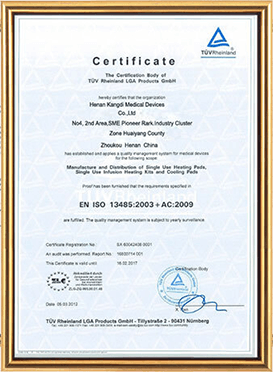
Henan Kongdy Medical Devices Co., LTD. (KONGDY) was founded in 1989 and has 37 years of production experience as of 2026 across pain relief patches, slimming patches, capsicum plasters, heat patches, cooling gel patches, detox foot patches, steam eye masks, mosquito repellent patches and nose strips. Headquartered in Henan, China, KONGDY operates a 100,000-class GMP workshop built in 2008 and obtained ISO 13485 medical device Quality Management System European Standard Certification in 2014. The company runs OEM and ODM services for international brands across multiple regulatory pathways. For 2026 procurement evaluation, the qualification team can provide the ISO 13485 certificate, GMP workshop audit reports, stability programme documentation, and reference customer case studies upon request via our contact page.
Related Guides
Four further references from the KONGDY knowledge base:
- Pain Relief Patch OEM: qualification and documentation overview
- Frequently asked compliance questions
- KONGDY OEM and ODM manufacturing services
- Nose Strip OEM: device pathway documentation
- Cooling Gel Patch OEM: regulatory categories and stability evidence


