-
 KONGDY
No Inspector Came: What FDA Warning Letter 707956 Shows About Proving Release Testing to a Pain Relief Patch OEM in 2026
No Inspector Came: What FDA Warning Letter 707956 Shows About Proving Release Testing to a Pain Relief Patch OEM in 2026
On 11 August 2025 the Center for Drug Evaluation and Research issued warning letter MARCS-CMS 707956 to Everlaan Organics, Inc., doing business as Maple Organics, of Surrey, British Columbia. No inspector visited the facility.
That sentence is the whole point of the case, and it is why the letter is worth reading carefully. The firm was registered with the agency as a manufacturer of over-the-counter drug products. On 4 September 2024 the agency sent a request for records and other information under section 704(a)(4) of the Federal Food, Drug, and Cosmetic Act. Correspondence followed. The letter came eleven months after the first request, and every finding in it was reached from documents that existed or did not.
The finding itself is stark enough to quote. The firm said in writing that it tested each batch of finished product before release. The agency asked for the test data. The firm could not provide any records demonstrating that it tested its finished products before release, and the letter concluded that the firm did not appear to be performing release testing on finished products at all.
For a pain relief patch OEM the lesson is not about Canada and it is not about over-the-counter products. It is that a documented claim about a quality system can be disproved by a question, and that a firm which has never answered one has never tested whether the answer exists.
1. The facts, exactly as the letter states them
The identification facts are worth having in one place, because two of them are unlike anything else in this library.
| Item | What the letter states |
|---|---|
| Letter | MARCS-CMS 707956, dated 11 August 2025 |
| Firm | Everlaan Organics, Inc., doing business as Maple Organics |
| Facility identifier | FEI 3025798567 |
| Address | 17220 Heather Dr, Unit 106, Surrey, British Columbia, Canada |
| Recipient | Ms. Atwal |
| Issuing office | Center for Drug Evaluation and Research |
| Registration status | Registered with FDA as a manufacturer of over-the-counter drug products |
| How the finding arose | A review of the records the firm submitted in response to a 4 September 2024 request and subsequent correspondence, for records and other information pursuant to section 704(a)(4) of the FD&C Act |
| Interval from first request to letter | About 11 months |
| Products named | Four: Joint Pain Relief, Muscle Pain Relief, Cough & Cold Relief for Kids, and Cough & Cold Relief |
The seventh row is the one that makes this case different from every other in the library, and the third row is the one that makes it different in practice. A Canadian facility and a United States registration are not unusual. A finding reached entirely on paper is.
2. What a records request actually is
It is a lawful demand for information with no inspection attached, and its power comes from the same place a warning letter does.
Section 704(a)(4) of the Federal Food, Drug, and Cosmetic Act is the provision under which the agency may require a firm to furnish records and other information relating to the manufacture and distribution of drugs. The letter in this case states that the review was of the records the firm submitted in response to that request and subsequent correspondence.
| What the instrument does | What it does not do | Why that matters here |
|---|---|---|
| Creates an obligation to produce records, and produces a record of what was produced | It does not inspect, and it does not test | A firm with no records has already answered the question, and the answer is the finding |
| Can be followed by correspondence and further requests | It does not require a prior inspection | The firm had eleven months in which to produce the evidence |
| Answers a question about a claim the firm has made | It does not accept the claim as evidence of itself | The letter records the firm saying it tested every batch, and the data being the thing asked for |
The third column is the transferable insight. A records request is not a softer version of an inspection. It is a different question, asked in writing, and it is answered by what the firm can produce rather than by what the firm says.
For a pain relief patch OEM the question it asks is the same one a buyer asks. Which records do you have for the batch that shipped, and can you send them today.

3. The first finding: a system that existed in the reply
The letter records that the firm failed to have, for each batch of drug product, appropriate laboratory determination of satisfactory conformance to final specifications, including the identity and strength of each active ingredient, prior to release, under 21 CFR 211.165(a).
The mechanism by which the agency reached that conclusion is the part worth reading closely, because it is short.
| The exchange | What it establishes |
|---|---|
| The firm stated that it tests each batch of finished product before release | A claim about the system, made in writing |
| The agency requested the test data | The evidence behind the claim |
| The firm failed to provide any records demonstrating that it tested its finished products before release | The claim is unsupported by any record |
| The letter concluded that the firm does not appear to be performing release testing on finished products | The finding, reached without an inspection |
| The letter states that without adequate testing there is no scientific evidence to assure that the drug products conform to appropriate specifications before release | Why the absence is itself the violation |
The fourth row is the finding and the fifth row is the reasoning, and the reasoning is the transferable part. A firm with a procedure and no record has the same evidential position as a firm with nothing, and the letter treats them the same way.
A pain relief patch OEM should read the third row as a test of its own file. The question the agency asked is one the buyer will ask, and the answer is either a set of records or a silence.
4. The second finding: a procedure that named no test
The letter records that the firm failed to conduct at least one test to verify the identity of each component under 21 CFR 211.84(d)(1), and the way it reached that finding is a second illustration of the same technique.
The firm said it identifies all items through its receiving practices, and it supplied a receiving procedure. The letter records that the procedure did not specify chemical identity testing for incoming components, and that the incoming component testing data for the most recent batches shipped to the United States was not provided when subsequently asked.
| What the firm offered | What the letter found missing |
|---|---|
| A statement that all items are identified at receiving | No chemical identity test was specified in the procedure |
| The receiving procedure itself | The procedure does not specify chemical identity testing for incoming components |
| Nothing further on request | Testing data for the most recent batches shipped was requested and not provided |
The second row is the subtle one. The firm produced a document, and the document was insufficient because it did not say what test to run. A procedure that says identify incoming materials is an instruction, and an instruction that names no method produces a different result depending on who reads it.
The third row is the one that matters for a pain relief patch OEM that has a receiving procedure. The data for the most recent batches is the first thing an agency asks for, because it is the easiest to produce and the hardest to have produced.

5. The third finding: a stability programme that was not established
The letter records that the firm failed to establish and follow an adequate written testing programme designed to assess stability, and the company had no such programme to follow.
This one appears in the letters in this library more often than its position in the list would suggest, and it is the finding with the longest tail, because it reaches product that has already been sold.
| The element of a stability programme | What the letter required |
|---|---|
| A written programme | Stability-indicating methods, studies in the marketed container-closure system before distribution is permitted |
| An ongoing programme | Representative batches of each product added each year so that the shelf-life claim remains valid |
| A risk assessment | For products already distributed without the supporting data |
The last row appears in the letters in this library with a frequency that does not match how often the subject is discussed commercially. A product without stability data has an expiry date that nobody can defend, and it has been sold on that basis already.
For a pain relief patch OEM this is the finding to watch for, because unlike the other two it cannot be closed by producing records that exist. It requires data that takes time to generate. A pain relief patch OEM should check that one first.
6. Four products and three misbranding grounds
The misbranding analysis in this letter is the most detailed in the library, and it contains a combination that appears nowhere else.
| Product | Unapproved new drug | Misbranding grounds cited |
|---|---|---|
| maple organics Joint Pain Relief | Yes, 21 U.S.C. 355(a) | 352(a) and 352(ee) |
| maple organics Muscle Pain Relief | Yes, 21 U.S.C. 355(a) | 352(a) and 352(ee) |
| maple organics Cough & Cold Relief for Kids | Not cited | 352(a) |
| maple organics Cough & Cold Relief | Not cited | **352(a), 352(f)(1) and 352(ee)** |
The fourth row is the one that makes this case worth reading for its labelling content alone. A single product carries two misbranding grounds at once, and the second is specific: a product can be suitable in form and still be misbranded because of what its labelling fails to include.
The third row is the counter-example, and it is the more instructive one. A product misbranded only under 352(a) and 352(ee) tells a reader that the labelling failed on its face, while a product carrying 502(f)(1) as well is telling the reader that the omissions were structural.
For a pain relief patch OEM the practical use is a review of what a label is required to contain rather than what it currently contains, because the second column of that table is a list of ways a label can fail that no amount of proofreading would have caught.

7. What the agency asked for, and why it looks familiar
The list of materials required in this letter overlaps almost completely with the list required in another letter in this library, and that overlap is the most useful cross-case fact available.
| What was required | Which letter also required it |
|---|---|
| Chemical and microbial specifications with adequate test methods | MACRS-CMS 724506 |
| An action plan and timelines for retain sample testing of distributed batches within expiry | MACRS-CMS 724506 |
| A summary of all results obtained, with rapid corrective action including notifying customers and product recalls | MACRS-CMS 724506 |
| A comprehensive independent review of the material system and of laboratory practices, procedures, methods, equipment, documentation and analyst competencies | MACRS-CMS 724506, for the material system |
| A commitment to conduct at least one specific identity test for each incoming component lot | MACRS-CMS 724506 |
Two letters, four months apart, different firms, different countries, and substantially the same list of materials.
That is the most actionable finding in this case, because it means the list is a specification rather than a reaction. A pain relief patch OEM that assembles those items once, without being asked, holds the answer to a records request, a warning letter and a buyer questionnaire at the same time, and the cost of assembling them once is a fraction of the cost of assembling them under a deadline.
8. Six questions a buyer can ask
Each question corresponds to a finding above, and each is answerable from a document rather than from an assurance.
- Show me the release determination for a batch that shipped last month. Not the procedure and not the template. The determination itself.
- Show me the underlying data behind that determination. If the answer is a summary, the underlying data does not exist.
- Show me the laboratory report for a recent batch, with the method named. Any modification has to be described.
- Show me the identity test for a recent incoming lot. A certificate from the supplier is not an identity test performed by the receiving firm.
- Show me the stability protocol, the pack it was run in, and the timepoints measured. And show me the batch that was released against it.
- Name the person who signed the release, and produce the document that gives them the authority to do so. A name without authority is not a decision.
The first question is the one that would have answered this case before the agency asked it, and the fifth is the one that would have taken longest to fix, which is why the first and the fifth are the two worth asking every year.
A pain relief patch OEM that answers all six from the folder has described a system rather than a procedure, and a pain relief patch OEM that answers the first and the fifth has closed the two findings that a records request exposes first.

What this case adds to the rest of the library
Nine letters are now held here, and this one changes a pattern rather than adding a detail.
| The pattern before this case | What this case does to it |
|---|---|
| Enforcement reaches a firm by inspecting it | It also reaches a firm by writing to it, and a firm that cannot answer in writing is in the same position as one that failed an inspection |
| The interval from the event to the letter runs from about 5.4 to 6.4 months for inspection cases and 3 to 7 months for review cases | Add a records route at about 11 months, which is longer than both and is the mildest interval in the library |
| A finding means something was done and was insufficient | A finding here means something was claimed and was unsupported, which is a weaker starting point for the firm |
| The remedy list is assembled case by case | The remedy list is substantially identical to another letter four months later, which makes it a specification |
The third row is the one to sit with. A firm that fails an inspection has usually done something and got it wrong. A firm that receives a records request and cannot produce what it described has a problem that is easier to fix and much easier to avoid, and it is the one that sits in every file.
For a pain relief patch OEM the practical reading is that the cheapest exercise in the whole series is to write to your own laboratory and ask for a record you have never been asked for. If the answer takes more than a day, that is the finding. A pain relief patch OEM that has tested the exercise has already found the gap that this letter took eleven months to reach. A pain relief patch OEM that has not tested it is holding a question it does not know the answer to, and a question it does not know the answer to is the one that gets asked.
The same is true of the component identity finding, and it is worth repeating because it is the cheaper of the two. A pain relief patch OEM that has a receiving procedure naming a chemical identity test, and recent data for the last few incoming lots, has answered both questions in the same afternoon that the agency spent eleven months on. A pain relief patch OEM that has neither has confirmed that the two are the same question, and the one that is cheapest to answer is the one nobody asks.
There is a final point for a pain relief patch OEM that has read this far. The case did not begin with an inspector and it will not end with one. It began with a letter asking for records, and the part of it that a supplier can act on is the same part a buyer can check: the release determination for one recent batch, the data behind it, the identity test for one incoming lot, the stability protocol, and the name and authority of the person who signed. A pain relief patch OEM that can produce those five items on request has described a system rather than a procedure, and that is the whole difference the case turns on.
About KONGDY Medical

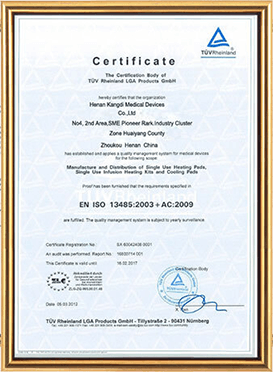
Henan Kongdy Medical Devices Co., LTD. (KONGDY) was founded in 1989 and has 37 years of production experience as of 2026 across pain relief patches, slimming patches, capsicum plasters, heat patches, cooling gel patches, detox foot patches, steam eye masks, mosquito repellent patches and nose strips. Headquartered in Henan, China, KONGDY operates a 100,000-class GMP workshop built in 2008 and obtained ISO 13485 medical device Quality Management System European Standard Certification in 2014. The company runs OEM and ODM services for international brands across multiple regulatory pathways.
For a 2026 procurement evaluation the qualification team can supply the ISO 13485 certificate, GMP workshop audit reports, stability programme documentation, and reference customer case studies upon request via our contact page.
Frequently asked questions
What is warning letter MARCS-CMS 707956?
A warning letter dated 11 August 2025 from the Center for Drug Evaluation and Research to Everlaan Organics, Inc., doing business as Maple Organics, at Surrey, British Columbia, facility identifier FEI 3025798567. It concerns four over-the-counter products and was reached through a records request rather than through an inspection.
Was there an inspection?
No. The letter states that FDA reviewed the records the firm submitted in response to a 4 September 2024 request and subsequent correspondence, for records and other information pursuant to section 704(a)(4) of the Federal Food, Drug, and Cosmetic Act. It is the only case in this library where a CGMP finding of this kind was reached without an inspector visiting.
How long did the process take?
About eleven months, from the first records request on 4 September 2024 to the letter on 11 August 2025. The interval is longer than the five and a half to six and a half months seen in the inspection cases, and it reflects a process that starts with a letter rather than with a visit.
What was the most serious finding?
21 CFR 211.165(a), with the agency stating that when it requested the test data the firm failed to provide any records demonstrating that it tested its finished products before release, and that the firm does not appear to be performing release testing on finished products. The letter adds that without adequate testing there is no scientific evidence to assure that the drug products conform to appropriate specifications before release.
What did the firm say that turned out to be unsupported?
That it tested each batch of finished product before release. It also said it identifies all items via receiving practices and provided a receiving procedure, but the letter records that the procedure did not specify chemical identity testing and that testing data for the most recent batches shipped was not provided when subsequently asked.
Which misbranding provisions were cited?
21 U.S.C. 352(a) for all four products, 352(f)(1) for Cough and Cold Relief in addition, and 352(ee) for Joint Pain Relief, Muscle Pain Relief and Cough and Cold Relief. Joint Pain Relief and Muscle Pain Relief were also found to be unapproved new drugs under 355(a).
Which clause is the hardest one to satisfy, and why?
21 CFR 211.137(a), the stability requirement, because it cannot be closed by producing records that exist. It needs data that takes time to generate, and a firm that has shipped without it has already sold on an expiry date that nobody can defend.
What should a supplier do with this case?
Ask its own laboratory whether it can produce the release determination and the underlying data for a recent batch, without a notice, today. The case in this library turned on exactly that request, and it was made in writing eleven months before the letter arrived.
Related Guides
Five further references from the KONGDY knowledge base:
- Slimming Patch OEM: twelve determinations behind one release
- Capsicum Plaster OEM: the monograph in twelve questions
- Frequently asked compliance questions
- KONGDY OEM and ODM manufacturing services
- Cooling Gel Patch OEM: four working days at the border


