
-
 KONGDY
Four Working Days at the Border: The EU Suspension Clock Step by Step for a Cooling Gel Patch OEM in 2026
Four Working Days at the Border: The EU Suspension Clock Step by Step for a Cooling Gel Patch OEM in 2026
A consignment stopped at the European border runs on a clock measured in working days, and it is the shortest clock in this whole knowledge base. Everything else is measured in weeks or months.
The comparison is worth stating at the outset because it calibrates the rest. The FDA register publishes letters with a median lag of 14 days from the date printed on them and a maximum of 239 days in the sample measured on 11 November 2026. A European border suspension gives four working days.
That difference is not a difference in severity. It is a difference in what the clock measures. The American clock runs after the agency has decided. The European clock runs before, and it is designed to lapse unless somebody extends it.
For a cooling gel patch OEM the practical consequence is that a border suspension is the one regulatory event where a document produced on the day changes the outcome. Everywhere else in this series, the work has already been done or it has not.
The process below is set out from the regulation rather than from a case, because the provisions are published and the sequence is fixed by them.
1. Stage one: the consignment is selected
Selection is where the process begins, and it is a targeting decision rather than a quality finding.
The scale explains why targeting exists. The Commission publication of 7 January 2026 records 4.6 billion packages entering the EU market in 2024, the volume of small packages doubling every year since 2022, a 36 percent increase still observed in July 2025 against the same month a year earlier, close to 180 direct shipments imported every second, and small consignments at 97 percent of shipments in 2025.
| The figure | What it means for selection |
|---|---|
| 4.6 billion packages in 2024 | Physical examination of every consignment is not a capacity question, it is an arithmetic one |
| 97 percent small consignments in 2025 | The category that is hardest to control by traditional means is almost the whole traffic |
| Close to 180 shipments a second | The unit of control cannot be the parcel |
| 13 refusals per million released in 2024 | The average rate across all traffic, which is a different number from the rate inside a category somebody chose |
The fourth row is the one that governs expectations. A refusal rate of 13 per million is not a description of the risk in a chosen category, and a manufacturer who reads it as one has read a population average as though it were a probability.
A cooling gel patch OEM should understand selection as the stage at which nothing can be done. By the time a consignment is selected the question has become documentary rather than substantive. A cooling gel patch OEM should plan for that.
2. Stage two: release is suspended on one of five grounds
The suspension is governed by a single article with a list of grounds, and the list is worth reading because three of the five require no test of the product.
Regulation (EU) 2019/1020, Article 26(1) requires border authorities to suspend release for free circulation where they establish one of a set of grounds. The grounds recorded in this knowledge base are these.
| Ground | What it covers | Whether a laboratory is needed |
|---|---|---|
| Documentation missing | The product is not accompanied by the documentation required by Union law | No |
| Documentation doubtful | Reasonable doubt as to the authenticity, accuracy or completeness of that documentation | No |
| Marking or labelling | The product is not marked or labelled as required | No |
| Economic operator | No identifiable operator established in the Union | No |
| Any other ground | Any other reason to believe the product does not comply or presents a serious risk | Sometimes |
The fourth column is the finding. Four of the five grounds can be established without examining the product at all, and the first three are documentary by definition.
A cooling gel patch OEM should note the fourth row separately, because it is the ground that a technical file answers and a product does not. An operator established in the Union is a named party with an address, and its absence is a structural gap rather than a quality defect. A cooling gel patch OEM should plan for that.

3. Stage three: the four working day clock starts
The clock is the centre of this process, and it runs in the manufacturer favour by default.
Article 27 provides that a suspended product shall be released for free circulation where all other requirements are met and either of two conditions is satisfied: within four working days of the suspension, the border authorities have not been asked by the market surveillance authorities to maintain the suspension, or those authorities have been informed of approval for release.
| The condition | What has to happen | What the clock does |
|---|---|---|
| No request to maintain | The market surveillance authority does not ask for the suspension to be maintained within the window | Release follows by default |
| Approval for release | The authority is informed that release is approved | Release can follow sooner |
| A request to maintain arrives | The authority asks for the suspension to continue | The clock stops being decisive and the matter moves to Article 28 |
The first row is the part that is least understood and most useful. The default is release, and the suspension expires unless it is extended. A manufacturer does not have to win an argument; it has to avoid losing one within four working days.
The third row is the one that ends that comfort. Once a request to maintain arrives, the question stops being about time and becomes about the file. A cooling gel patch OEM should plan for that.
4. Stage four: what the four days actually require
Four working days is a short period, and what it requires is a document that exists rather than a document that can be produced.
| What the four days are long enough for | What they are not long enough for |
|---|---|
| Sending a file that already exists and is already assembled | Requesting a document from a factory in another time zone |
| Naming the Union operator and supplying its address | Appointing an operator that has not been appointed |
| Producing a declaration of conformity that was already signed | Arranging for a declaration to be signed by a party who has not seen it |
| Showing that the marking and labelling on the goods match the artwork | Reprinting labels and relabelling stock |
| Supplying a test report that was already commissioned and received | Commissioning a test and waiting for the result |
The right-hand column is the list of things that cannot be done in the window, and every one of them is a thing a manufacturer discovers it needs on the day.
A cooling gel patch OEM should read the left-hand column as an inventory requirement. Whatever is in it has to exist before the consignment ships, because the four days do not create documents, they only move them. A cooling gel patch OEM should plan for that.

5. Stage five: refusal and the notice that persists
If the suspension is maintained and the matter is not resolved, the outcome is a refusal with a record that outlasts the consignment.
Article 28 provides that market surveillance authorities require the goods not to be released and have a notice entered in the customs data-processing system. The notice records either that the product is dangerous and release is not authorised, or that the product is not in conformity and release is not authorised.
| The notice | The wording recorded | What it attaches to |
|---|---|---|
| Serious risk | Dangerous product, release for free circulation not authorised | The product and the operator |
| Non-conformity | Product not in conformity, release for free circulation not authorised | The product and the operator |
The second column matters operationally rather than editorially. The two notices say different things about the goods, and a supplier whose consignment was refused for non-conformity has not thereby been found to be shipping a dangerous product.
A cooling gel patch OEM should note where the notice sits. It is entered in the customs data-processing system, which means future shipments are filtered through the same system, and the record does not expire with the consignment that produced it.

6. Stage six: what a release does not prove
A released consignment is a cleared consignment and not a compliant one, and the regulation says so explicitly.
Article 27 adds that release for free circulation shall not be deemed to be proof of conformity with Union law. The sentence sits in the same article as the four day condition, which makes it easy to read past.
| A release establishes | A release does not establish |
|---|---|
| That the suspension was not maintained within four working days | That the product conforms |
| That the consignment may enter free circulation | That the documentation was complete rather than merely untested |
| That the border authority took no further step | That a market surveillance authority will not act later |
| That this consignment is not detained | That a future consignment will clear |
The third row is the one that connects the border to the market. The Safety Gate system operates after the goods are in circulation, and a consignment that cleared at the border can still become a notified product later. In 2025 the eSurveillance Webcrawler found more than 20,800 products already listed in Safety Gate still being offered online, which is a measure of how long the market stage can run after the border stage has ended.
A cooling gel patch OEM that treats clearance as approval has misunderstood the architecture. The border is a filter and the market is a second filter, and passing one says nothing about the other. A cooling gel patch OEM should plan for that.
7. Stage seven: the costs that arrive in 2026
Two per-item charges come into effect during 2026, and both change the arithmetic of a small consignment.
| The change | When | What it does |
|---|---|---|
| End of the duty exemption below 150 euro, replaced by a single customs duty of 3 euro per item | From 1 July 2026 | Removes the reason a small parcel was cheaper to import than to declare, and adds a fixed cost per item |
| Union handling fee of 2 euro per item under Commission Delegated Regulation (EU) 2026/2152 | From 1 November 2026 | A second per-item charge on every parcel sold to an EU consumer |
| Platforms and sellers as official importers under the EU Customs Reform | Under the reform | Moves responsibility from the individual consumer and carrier to the parties in the supply chain |
The first two rows are fixed charges per item, which means a low unit price feels them disproportionately. The third row changes who has to answer a border question, and the answer is a party with a commercial relationship rather than a consumer.
For a cooling gel patch OEM selling direct, the combined effect is that the compliance cost per item has risen at the same time as the documentary requirement has become the thing that decides whether the item clears.

8. What to have ready before the consignment moves
Five items, and each one maps to a stage above rather than to a general instruction to be prepared.
- The Union operator, named with a postal address. Stage two, fourth ground. It has to be on the product, the packaging, the parcel or an accompanying document, and for a cosmetic product the responsible person sits under a different instrument.
- The declaration of conformity, where the product is subject to legislation that requires one. Signed, with the standards named, and available as a file rather than as a promise.
- The technical documentation, or a written statement of which products share one file and why. Article 9(2) of Regulation (EU) 2023/988 requires the internal risk analysis and technical documentation to be kept for ten years and to be available on request.
- Test reports on the finished article, dated, with the standards tested against. The date is what allows a report to be related to a batch.
- A named person reachable on a working day in the Union who can send all of the above within four working days. The fifth item is the one that is usually missing and the cheapest to fix.
The fifth item is the whole of stage three in one line. Four working days is not a long period if the answer has to travel through a factory, and it is a comfortable period if the answer is in a folder with a name on it.
A cooling gel patch OEM that has the five items can treat a suspension as an administrative event. One that has four of them has a clock running against a document that does not exist yet. A cooling gel patch OEM should plan for that.

9. What a manufacturer cannot do, and why the list is short
The four day window is restrictive, and the useful thing about it is how few things are actually impossible.
| Cannot be done in the window | Can be done before it |
|---|---|
| Produce a document that does not exist | Assemble a folder that contains every document the five grounds can ask for |
| Appoint a Union operator who has not been appointed | Name the operator on the pack, the parcel or the accompanying document |
| Sign a declaration that has not been reviewed | Review and sign it once, and keep the signed version |
| Relabel stock already in transit | Check the artwork against the shipped labels before the consignment leaves |
| Obtain a test result that has not been commissioned | Commission the test once and keep the report with its date |
The right-hand column has one property in common. Every item in it is completed before any consignment moves, which means the four day window is not a preparation period at all. It is a delivery period.
For a cooling gel patch OEM that is the whole discipline of this article compressed into a table. The window rewards a firm that has already done the work and penalises one that has planned to do it later.
A cooling gel patch OEM should also note what is absent from the left-hand column. Nothing in it requires a laboratory, a lawyer or an argument. Every item is a record, and a record is the cheapest thing to have ready and the most expensive thing to need.
A cooling gel patch OEM that has read this far has the seven stages in order and the five items in the inventory, which is the whole of what the four day window asks for in advance.
About KONGDY Medical

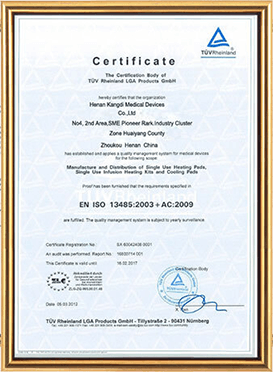
Henan Kongdy Medical Devices Co., LTD. (KONGDY) was founded in 1989 and has 37 years of production experience as of 2026 across pain relief patches, slimming patches, capsicum plasters, heat patches, cooling gel patches, detox foot patches, steam eye masks, mosquito repellent patches and nose strips. Headquartered in Henan, China, KONGDY operates a 100,000-class GMP workshop built in 2008 and obtained ISO 13485 medical device Quality Management System European Standard Certification in 2014. The company runs OEM and ODM services for international brands across multiple regulatory pathways.
For a 2026 procurement evaluation the qualification team can supply the ISO 13485 certificate, GMP workshop audit reports, stability programme documentation, and reference customer case studies upon request via our contact page.
Frequently asked questions
How long does a manufacturer have when a consignment is suspended?
Four working days. Regulation (EU) 2019/1020, Article 27 provides that a suspended product is released if, within four working days of the suspension, the market surveillance authorities have not asked the border authorities to maintain it, or have been informed of approval for release. The default is release.
On what grounds can a consignment be suspended?
Article 26(1) lists the grounds, of which four can be established without examining the product: documentation missing, documentation whose authenticity, accuracy or completeness is in doubt, marking or labelling not as required, and no identifiable economic operator established in the Union. There is also a general ground of any other reason to believe the product does not comply or presents a serious risk.
Does a cleared consignment prove the product conforms?
No, and the regulation says so. Article 27 states that release for free circulation shall not be deemed to be proof of conformity with Union law. The sentence appears in the same article as the four day condition.
What happens if the suspension is maintained?
Article 28 provides that market surveillance authorities require the goods not to be released and have a notice entered in the customs data-processing system, recording either that the product is dangerous or that it is not in conformity. The notice sits in a system that future shipments are filtered through.
Is a notice different depending on the reason?
Yes. The two notices recorded are dangerous product and product not in conformity, and they say different things about the goods. A consignment refused for non-conformity has not thereby been found to be a dangerous product.
What documentation has to be kept and for how long?
Article 9(2) of Regulation (EU) 2023/988 requires an internal risk analysis and technical documentation, kept for ten years and made available to market surveillance authorities on request. For a cosmetic product the product information file sits under Article 11 of Regulation (EC) No 1223/2009.
Which products need an economic operator in the Union?
Article 4 of Regulation (EU) 2019/1020 applies to a listed set of legislation covering toys, machinery, personal protective equipment, radio equipment, electromagnetic compatibility, low voltage, RoHS, gas appliances, construction products and others. Cosmetics are not in that list and have their own responsible person arrangement, and a general consumer product reaches the same requirement through Article 16(1) of Regulation (EU) 2023/988.
What changes in cost during 2026?
The duty exemption for parcels below 150 euro ends and is replaced by a single customs duty of 3 euro per item from 1 July 2026, and a Union handling fee of 2 euro per item applies from 1 November 2026 under Commission Delegated Regulation (EU) 2026/2152. Both are per-item charges.
How does this compare with the American process?
The clocks are not comparable because they measure different things. A European border suspension gives four working days and lapses by default. An American warning letter follows a decision, and in the register sample measured on 11 November 2026 the median gap between the issue date and the publication date was 14 days with a maximum of 239 days. One clock runs before a decision and the other after it.
Related Guides
Five further references from the KONGDY knowledge base:
- Detox Foot Patch OEM: the 20-point change control checklist
- Steam Eye Mask OEM: the register is a queue, not a feed
- Frequently asked compliance questions
- KONGDY OEM and ODM manufacturing services
- Slimming Patch OEM: nine stages of an FDA site inspection


