
-
 KONGDY
What FDA Warning Letter 320-26-105 Teaches a Pain Relief Patch Manufacturer About the Quality Unit
What FDA Warning Letter 320-26-105 Teaches a Pain Relief Patch Manufacturer About the Quality Unit

Warning letter 320-26-105 was issued to Dabur India Limited on 2026-07-24, following an inspection of its Silvassa over-the-counter drug facility from 2026-01-12 to 2026-01-16. The letter cites four provisions of 21 CFR Part 211, and the first of them is 21 CFR 211.22(a), the provision that establishes the quality control unit. That ordering is the most useful thing in the document for a pain relief patch manufacturer, because it shows what the agency reaches for when a facility's output cannot be trusted.
Most reading of a warning letter stops at the finding. This one is more valuable as a description of a system: four clauses that, taken together, describe a closed loop between written procedure, equipment state, laboratory record and the authority to say no. A gap anywhere in that loop defeats the other three, which is why the lead clause is about authority rather than about a test result.
The article has three parts. First, the case facts and what each cited clause actually covers, using the published regulation text rather than any claim about what the inspectors observed. Second, what the case implies for a patch programme that has never been inspected. Third, the five documents a buyer can request that test the same loop without visiting the plant.
Two limits are stated at the outset. The letter is a public document about one facility on one set of dates, and this article does not attribute any observation to it beyond the four cited provisions and the inspection window. And a warning letter is not a risk score for a specific product; section seven sets out what it can and cannot establish.
The Case Facts, and Why the Order of the Citations Matters
A pain relief patch manufacturer reads this letter differently from a drug facility, because the clauses transfer even though the products do not.
A pain relief patch manufacturer reads this letter differently from an OTC drug facility, because the clauses transfer even though the products do not.
A pain relief patch manufacturer reads this letter differently from a drug facility, because the clauses transfer even though the products do not.
The public record of 320-26-105 gives a company, a facility type, an inspection window, a letter date and four cited provisions. Everything else about the letter is inference, and this article keeps that line visible.
| Item | Public record | Why it matters to a buyer |
|---|---|---|
| Letter number | 320-26-105 | The 320-26 prefix identifies the CDER compliance series |
| Recipient | Dabur India Limited | A named manufacturer, so the record is checkable at any requalification |
| Facility type | Silvassa OTC drug facility | An over-the-counter drug site, which is the same category as a monograph patch line |
| Inspection window | 2026-01-12 to 2026-01-16 | Five calendar days of inspection produced the observations behind the letter |
| Letter date | 2026-07-24 | Roughly six months after the inspection closed |
| Lead citation | 21 CFR 211.22(a) | The quality control unit provision, cited first |
| Supporting citations | 21 CFR 211.194(a), 211.67(b), 211.100(a) | Laboratory records, equipment cleaning and maintenance, production procedures |
The order is the message. A letter that opened with a laboratory result would be telling the facility that a test failed. A letter that opens with 211.22(a) is telling the facility that the function responsible for approving or rejecting materials and products did not occupy the position the regulation requires it to occupy. The difference matters because a failed test can be repeated and a misplaced authority cannot.
For a pain relief patch manufacturer the translation is direct: the first question about a supplier is not "did the last batch pass" but "who had the authority to reject it, and what did they reject recently".

The Four Cited Clauses, and the Loop They Describe
The four provisions are the same four a pain relief patch manufacturer already works under, which is what makes the loop portable across dosage forms.
The four provisions are the same four a pain relief patch manufacturer already works under, which is what makes the loop portable between product lines.
Each of the four provisions covers a different control, and together they form a loop that either holds or does not. The table below paraphrases what each provision requires, in the terms a buyer can actually check.
| Provision | What it requires, in plain terms | The document it generates |
|---|---|---|
| 21 CFR 211.100(a) | Written procedures for production and process control, designed so that the product has the identity, strength, quality and purity it claims, with a procedure for handling deviations | Approved production procedures plus the deviation record |
| 21 CFR 211.67(b) | Written procedures for cleaning and maintaining equipment, with the evidence that the procedures do what they claim | Cleaning and maintenance procedures plus their validation record |
| 21 CFR 211.194(a) | Laboratory records that identify the sample, the method, the calculations and the results, signed by the analyst and reviewed by a second person | Analytical worksheets with two signatures |
| 21 CFR 211.22(a) | A quality control unit with both the responsibility and the authority to approve or reject materials, containers, closures, in-process material, packaging, labelling and finished product, and the authority to review production records | Rejection decisions and the review sign-off on batch records |
Each clause in the loop is ordinary for a pain relief patch manufacturer to produce, and the loop as a whole is what a buyer is actually checking.
Read top to bottom, the loop runs: procedures define what should happen, cleaning and maintenance keep the equipment in the state the procedures assume, laboratory records prove what actually happened, and the quality unit holds the authority to act on the difference. Read bottom to top, the loop breaks at the first point where the authority is nominal.
That is why a single weak clause is worse than four weak clauses. A facility with four weak controls has an obvious problem. A facility with three strong controls and a nominal quality unit looks organised and cannot stop a bad batch, because the one function designed to stop it has no effective power.
Why the Lead Citation Is Authority and Not a Test Failure
For a pain relief patch manufacturer the governance question is the one that cannot be answered with a test report.
The lead citation tells a buyer where to look first, and 211.22(a) points at governance rather than at chemistry. Three practical consequences follow for any pain relief patch manufacturer review.
First, the question changes from "is your testing adequate" to "who signs a rejection". Testing adequacy is a technical argument that a supplier can win by producing a method validation. Authority is an organisational fact that is either present or absent, and it is visible in one document set.
Second, the evidence is retrospective rather than prospective. A quality unit with real authority has rejected something recently, and the records of those rejections exist. A supplier that cannot show a rejection in the last twelve months is either exceptionally lucky or structurally unable to reject, and the second explanation is more common than the first.
Third, the finding scales across products. A chemistry problem at one facility may be specific to one formulation. An authority problem at one facility applies to every product the facility makes, which is why this letter is relevant to a patch programme even though the facility described is an OTC drug site.

The Inspection-to-Letter Interval, and What "No Letter Today" Proves
The interval matters most to a pain relief patch manufacturer that is relying on silence as evidence of good standing.
The interval between the close of an inspection and the publication of a letter is long enough that the absence of a letter is weak evidence, and the public record lets a buyer see the length of that interval rather than guess at it.
| Letter | Inspection window | Letter date | Interval |
|---|---|---|---|
| 320-26-105 | 2026-01-12 to 2026-01-16 | 2026-07-24 | about six months |
| 320-26-99 | 2025-12-09 to 2025-12-19 | 2026-07-02 | about six and a half months |
| 320-26-12 | 2025-04-28 to 2025-05-09 | 2025-10-31 | about five and a half months |
Those intervals are computed from two published dates per letter, and the computation is the whole method: subtract the inspection close from the letter date. The point is not precision, because the interval includes review and response time that varies by case. The point is order of magnitude: the pipeline from a finding to a public document runs in months, not weeks.
Two conclusions follow for a buyer. When a supplier says it has no warning letter, the answer describes the publication status on that day and not the inspection status. When a buyer runs a requalification, the useful search is not only for letters but for inspection outcomes, because an inspection can have happened without a letter yet existing.
The same arithmetic applies to the online route. Warning letter MARCS-CMS 735346, issued on 2026-10-01, records a website and marketplace review conducted in July 2026, which is a shorter path because there is no facility inspection to schedule. A pain relief patch manufacturer that treats the plant as the only place a finding can originate is running a governance question against a chemistry answer.
One caution belongs with that arithmetic. The interval says nothing about whether a finding will produce a letter at all, because a facility can respond to observations and close them without a public document. So the arithmetic supports one conclusion only: silence has a shelf life measured in months, and a buyer who treats it as permanent evidence is reading a status, not a trend. Renewing the check at every requalification is cheaper than reasoning about what silence means.
The practical reading of the interval is a scheduling one. A buyer who last checked a supplier in the first quarter is looking at a record that predates the inspection cycle, and a requalification that happens once a year can miss a finding entirely because the publication lags the visit. Requesting the inspection outcome alongside the letter status closes that gap, and it takes one dated search rather than a new audit.
Why a Letter About Another Dosage Form Applies to a Patch Line
A pain relief patch manufacturer will recognise every row below from its own equipment train and its own release decisions.
A pain relief patch manufacturer will recognise every row in the table below from its own equipment train.
The four cited provisions are dosage-form neutral. They attach to the quality system, the equipment, the laboratory records and the production procedures of a drug facility, and every one of them applies unchanged to a topical patch line.
| Provision | How it appears on a patch line | The typical weak point |
|---|---|---|
| 211.100(a) | Coating weight, drying profile, lamination and cutting procedures | A procedure written from a pilot batch rather than before it |
| 211.67(b) | Coating head, oven and cutting tool cleaning between formulations | Cleaning validated for one active and reused across a family |
| 211.194(a) | Assay, related substances and adhesion testing records | Results without the chromatogram or without a second signature |
| 211.22(a) | Release and rejection of laminate, coating batches and finished patches | A quality unit that reports through production |
The fourth row is the one that travels furthest. In a patch operation the quality unit approves laminate lots, in-process coat weights and finished product, and if it sits inside the production reporting line, the approval is a formality. That is the same structural issue the letter leads with, in a different manufacturing environment.
This is also why the case transfers to adjacent categories with the terminology changed rather than the logic: a heat patch OEM, a capsicum plaster OEM, a cooling gel patch OEM and a slimming patch OEM programme all release against the same four controls.

Five Documents That Test the Loop in Your Own Supplier
The five requests are the practical test a pain relief patch manufacturer buyer can run without a site visit.
The five requests are the practical test that a pain relief patch manufacturer buyer can run without a site visit.
The five requests are the practical test a pain relief patch manufacturer buyer can run without a site visit or a technical specialist.
The loop can be tested without an inspection, using five requests that a buyer can make in one meeting. Each request maps to one of the four provisions, and the fifth maps to the loop as a whole.
- The last two rejection decisions, with the reason. Maps to 211.22(a). A quality unit with authority has rejected something; the record proves it. This is the single most informative request in the list.
- The production procedure for the exact product, with its issue date. Maps to 211.100(a). The date shows whether the procedure preceded the batch.
- The deviation record for the last twelve months. Maps to 211.100(a). An empty deviation log over a year is a statement about reporting, not about performance.
- The cleaning procedure for the equipment train, with its validation summary. Maps to 211.67(b). The useful question is whether the validation covers the formulation the buyer is ordering.
- One complete analytical worksheet, including the second signature. Maps to 211.194(a). A worksheet with one signature is an unfinished record.
A pain relief patch manufacturer that produces all five in an afternoon is showing that the loop works rather than describing it.
A pain relief patch manufacturer that produces all five in an afternoon is demonstrating that the loop works, without claiming that it does.
The five requests are deliberately asymmetric in cost. A functioning supplier produces all five in an afternoon because they are ordinary outputs of its quality system. A supplier that has to construct them first is telling the buyer something that no audit report would say as clearly.
A topical analgesic manufacturer that closes all five has, in effect, demonstrated the loop without being inspected for it.

What a Warning Letter Does Not Tell You
Being clear about the limits is what makes the letter usable for a pain relief patch manufacturer rather than merely alarming.
Being clear about these limits is what makes the letter usable for a pain relief patch manufacturer rather than merely alarming.
Being clear about the limits is what makes the letter usable for a pain relief patch manufacturer rather than merely alarming.
A warning letter is evidence about one facility on one set of dates, and reading it as anything more produces exactly the kind of overreach that a buyer should be suspicious of in a supplier.
| The letter does not establish | Why the limit matters |
|---|---|
| That any specific product is unsafe | The letter describes system deficiencies, and a system deficiency is not a product finding |
| That the facility is currently in the same state | The inspection dates are in the record, and a corrective action may have followed |
| That other sites of the same company share the finding | A letter names a facility, and corporate structure is a separate question |
| That a supplier without a letter is compliant | The publication pipeline runs in months, and an inspection may not have happened |
| That the severity is comparable across letters | Different clause sets describe different problems, and the letter is not a ranking |
The honest use of the document is narrow and still valuable: it identifies the control that a regulator reached for in a comparable facility, and it tells the buyer which document to request. Everything beyond that is the buyer's own inference and should be labelled as such.
The same discipline applies in the other direction. A analgesic patch manufacturer that cites its own absence of letters as a qualification claim is making an argument from silence, and section four explains why that silence is short.
What to Write Into the OEM Contract About the Quality Unit
Contract language is where a pain relief patch manufacturer relationship either carries the authority question or drops it for the whole term.
Contract language is where a pain relief patch manufacturer relationship either carries the authority question or quietly drops it.
The authority question is the one clause that buyers almost never write down, because it sounds like an internal matter. It is not internal: it determines whether the buyer's release decision is supported by someone else's rejection power.
- A named quality unit with the authority to reject incoming laminate, in-process coating and finished product, stated as a contractual representation.
- A notification obligation when a batch is rejected for a reason that could affect a lot already shipped.
- An annual summary of rejection and deviation counts, supplied without being asked.
- A right to see one complete analytical worksheet per shipment cycle, with both signatures.
- A change-notification clause covering production procedures and equipment cleaning, not only the formula.
None of these five clauses costs the supplier a facility investment, and all five are answerable from records that a functioning quality system already produces. That combination is what makes them worth asking for: they are cheap for the honest supplier and expensive for the other kind.
About KONGDY Medical

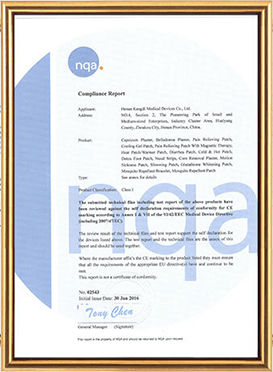
Henan Kongdy Medical Devices Co., LTD. (KONGDY) was founded in 1989 and has 37 years of production experience as of 2026 across pain relief patches, slimming patches, capsicum plasters, heat patches, cooling gel patches, detox foot patches, steam eye masks, mosquito repellent patches and nose strips. Headquartered in Henan, China, KONGDY operates a 100,000-class GMP workshop built in 2008 and obtained ISO 13485 medical device Quality Management System European Standard Certification in 2014. The company runs OEM and ODM services for international brands across multiple regulatory pathways. For 2026 procurement evaluation, the qualification team can provide the ISO 13485 certificate, GMP workshop audit reports, stability programme documentation, and reference customer case studies upon request via our contact page.
Frequently Asked Questions
Eight questions that follow from the case, answered as directly as the public record allows.
What exactly does warning letter 320-26-105 cite?
The four provisions are also the ones a pain relief patch manufacturer should recognise before any other clause in the letter.
The four provisions are the ones a pain relief patch manufacturer should recognise first in any supplier file.
It cites 21 CFR 211.22(a) as the lead provision, together with 21 CFR 211.194(a), 21 CFR 211.67(b) and 21 CFR 211.100(a). The inspection that preceded it ran from 2026-01-12 to 2026-01-16, and the letter was issued on 2026-07-24.
Does the letter concern patches?
No. The facility described is an over-the-counter drug site at Silvassa. The four cited provisions are dosage-form neutral, which is why they transfer to a patch line, but the letter itself is not about patches.
Why does 21 CFR 211.22(a) matter more than the other three?
Because it is the provision that makes the other three enforceable. Procedures, cleaning records and laboratory records only change outcomes if some function has the authority to act on them, and 211.22(a) is where that authority is established.
How long after an inspection does a warning letter appear?
In the three letters where both dates are public, the interval runs from about five and a half to about six and a half months. That is an order of magnitude, not a fixed rule, because review and response time varies by case.
What single document best tests a quality unit?
For a pain relief patch manufacturer the rejection record is the fastest available read on governance.
The last two rejection decisions with reasons. A quality unit that has real authority has used it recently, and the record is ordinary output rather than a special report prepared for a visit.
Is an empty deviation log a good sign?
It is a statement about reporting. A year with no deviations in a patch operation is unusual enough that the more useful question is how deviations are classified and who decides whether an event counts as one.
How does this case differ from warning letter 721916?
721916 is about product evidence: it concerns stability studies and the labelled expiry period. 320-26-105 is about the organisation that produces and releases the product. One is answered with data, the other with authority records, and a buyer needs both.
Should a buyer stop sourcing because of a public letter?
A pain relief patch manufacturer that answers with records has answered the only question the letter raises.
That is a commercial decision and the letter does not make it. What the letter does is identify the control to test and the documents to request, and a supplier that answers those requests with records has addressed the question the letter raises.
Related Guides
Four further references from the KONGDY knowledge base:
- Pain Relief Patch OEM: qualification and documentation overview
- Frequently asked compliance questions
- KONGDY OEM and ODM manufacturing services
- Cooling Gel Patch OEM: regulatory categories and stability evidence
- Detox Foot Patch OEM: EU Safety Gate risk mapping


