-
 KONGDY
Five Ways a Supplier Handles a Failed Batch Result: A Comparison Matrix for Pain Relief Patch Buyers in 2026
Five Ways a Supplier Handles a Failed Batch Result: A Comparison Matrix for Pain Relief Patch Buyers in 2026

There are five ways a supplier can respond to a failed batch result, and only two of them produce an investigation. The other three produce a new number, which is a different thing. For a pain relief patch buyer the distinction is the whole question, because a supplier that answers "we re-tested and it passed" has told you the result changed and has not told you why.
The five responses are compared below on four dimensions: what each one proves, what it costs the supplier, what it cannot fix, and what a buyer should ask for in order to know which response is actually happening. The framework that decides the question is 21 CFR 211.192, which requires a thorough investigation of any unexplained discrepancy or any failure of a batch to meet specification, whether or not the batch was distributed.
Two things are deliberately left out. No cost figure is quoted, because the regulation contains none and a supplier cost estimate would be an invention. And no warning letter is treated as evidence that a named company used the wrong response; the public letters are used only to show which provision the agency reaches for, which is a narrower and checkable claim.
The practical output is a five-question test in the closing section. A buyer who asks those five questions in one meeting learns which of the five responses the supplier actually practises, without needing to understand chromatography.
The Five Responses at a Glance
A pain relief patch buyer can use this table as a diagnostic, because each row behaves differently in a supplier meeting.
Here is the whole comparison in one table. Read the third column first, because what a response proves is the dimension that separates a real investigation from a lucky result.
| Response | What it produces | What it proves | What it cannot fix |
|---|---|---|---|
| 1. Re-test the retained sample | A second result from the same sample | Nothing new about the batch | Whether the original failure was real |
| 2. Re-sample and re-test from the batch | A result from a different portion of the batch | Whether the batch is homogeneous in that attribute | Whether the failure was analytical or manufacturing |
| 3. Laboratory assessment | A conclusion about the method and the analyst | Whether the failure was an analytical artefact | A real manufacturing failure, if the method was sound |
| 4. Full investigation under 21 CFR 211.192 | A written record with a root cause and a conclusion | Why the batch failed and whether other batches are affected | Whether the process will fail again, unless corrective action follows |
| 5. Rejection, deviation and corrective action | A disposition decision plus a change to the process | What the supplier did about the cause | The batches already released, unless the investigation extends to them |
Two features of the table matter more than the rest. First, responses one and two are not investigations at all; they are measurements. Second, only response five changes anything, which is why 21 CFR 211.192 requires the investigation to extend to other batches and to record the follow-up.
For a pain relief patch buyer the ranking is therefore not a matter of taste. Responses three to five answer the question a buyer is actually asking, which is whether the supplier can tell the difference between a bad batch and a bad test.
Response One: Re-test the Retained Sample
For a pain relief patch buyer this is the response most likely to be offered and the one least likely to be explained.
Re-testing the retained sample produces a second measurement of the same material, and it is the weakest of the five responses because it changes nothing about the evidence.
The mechanism is worth understanding, because the response is common and not always dishonest. A retained sample is a portion of the batch kept for exactly this purpose. Re-testing it can be legitimate as a confirmation step when a result is obviously anomalous, for example when an instrument failure is visible in the chromatogram. What makes it weak is when the second result is used as the finding and the first result is discarded without a stated reason.
A pain relief patch supplier that reports only the passing retest has produced a number and suppressed a record. The record is what 21 CFR 211.194(a) requires, and it includes the original result, the method, the calculations and a second signature.
The question that separates the legitimate use from the weak one is simple: what happened to the first result. If it is in the file with a documented reason for rejecting it, the retest is part of an assessment. If it is not in the file, the file is not a record.

Response Two: Re-sample and Re-test From the Batch
A pain relief patch buyer should treat this response as informative even when it closes the failure, because it has revealed a batch characteristic.
Re-sampling answers a different and more useful question: whether the attribute that failed is uniform across the batch. It is stronger than a retest and still short of an investigation.
For a coated patch the sampling question is concrete. A failed assay on a coated web can come from a localised coating weight excursion, from an edge effect, or from the sampling location itself. Re-sampling from a different position distinguishes those cases, and the pattern of results carries information that a single retest cannot.
The response becomes inadequate when it stops at the second result. A batch that passes on re-sample has passed on a different set of samples, and the supplier now knows the attribute is not uniform, which is itself a finding that requires an investigation under 21 CFR 211.192. Treating the second pass as closure is how a non-uniformity becomes an undocumented process characteristic.
A buyer can test this response with one request: the sampling plan with the positions named, and the results by position rather than as an average. A supplier that cannot produce results by position did not re-sample; it re-tested.

Response Three: Laboratory Assessment
For a pain relief patch programme this is the response that most often decides whether a batch ships, so the quality of the assessment matters more than its conclusion.
A laboratory assessment asks whether the failure was analytical rather than manufacturing, and it is the first of the five responses that can legitimately close a failure without rejecting a batch.
The assessment has a defined shape. It reviews the method, the calibration record for the instrument on the day, the preparation of the sample, and the analyst's worksheet, and it looks for a specific assignable cause. If it finds one, the original result can be invalidated with a documented reason, and the batch is released on a valid result. If it does not, the failure stands and the investigation moves to the process.
The failure mode of this response is the assignable cause that is asserted rather than shown. A laboratory assessment that concludes "analyst error" without naming the error, the record it appears in, and the correction is not an assessment. It is a label, and 21 CFR 211.192 requires the investigation to reach a conclusion, which is a higher bar than a category.
For a pain relief patch programme the assessment should also cover the adhesion and peel methods, not only the assay, because those methods have their own preparation steps and their own failure modes.
Response Four: Full Investigation Under 21 CFR 211.192
A pain relief patch buyer should read this response as the dividing line between the two halves of the table.
A full investigation produces a written record with a root cause, an extension to other batches, and a conclusion, and it is the only response that answers the question a buyer is asking.
The provision is specific about scope. 21 CFR 211.192 requires the investigation of any unexplained discrepancy and any failure of a batch to meet specification, whether or not the batch was distributed, and it requires the investigation to extend to other batches that may have been associated with the same failure. That last clause is the one buyers should quote, because it converts a single event into a population question.
The provision is also specific about the record, which must state the conclusions and follow-up. A conclusion without a follow-up is an observation, and an observation is not what the clause requires.
A pain relief patch buyer reading an investigation report should look for four things in this order: the failure as observed, the investigation as performed, the conclusion as stated, and the follow-up as dated. A report that has the first three and not the fourth is a description of the past rather than a commitment about the future.

Response Five: Rejection, Deviation and Corrective Action
For a pain relief patch supplier this is the response that turns a bad quarter into a controlled one.
Rejection is the response that changes something. It produces a disposition decision, a deviation record and a corrective action, and it is the only one of the five that reduces the chance of the same failure next quarter.
The sequence matters. The batch is rejected or reworked on the basis of the investigation, not instead of it. A rejection without an investigation has disposed of the material and not the cause, and the next batch inherits the same risk with no record connecting the two events.
The authority question sits underneath this response and is easy to miss. A rejection is only real if the function that took the decision had the authority to take it, which is the requirement in 21 CFR 211.22(a). A batch rejected by the production manager is not a quality decision, and a batch released over a quality objection is the same event in reverse.
Corrective action is where this response becomes visible to a buyer. A pain relief patch supplier that can show the change it made after a failure, and the evidence that the change worked, has closed the loop. A supplier that can only show the rejection has closed the batch.
The Decision Matrix: Which Response Fits Which Failure
A pain relief patch buyer will find that most supplier meetings skip this matrix and go straight to a number.
The five responses are not ranked by quality in the abstract; they are fitted to the type of failure. The matrix below shows the appropriate first response for different failure classes.
| Failure class | Appropriate first response | Not appropriate |
|---|---|---|
| An obviously anomalous result with a visible instrument fault | Laboratory assessment, then retest with the fault documented | Retest alone with no documented fault |
| A single specification failure on a homogeneous attribute | Full investigation under 21 CFR 211.192 | Retest until the result passes |
| A specification failure with an unexplained spread across the batch | Re-sample by position, then investigate the spread | Retest the retained sample |
| A failure that recurs across two or more batches | Investigation plus corrective action on the process | Blaming the analyst without a record |
| A failure on an attribute the customer will test | Investigation plus buyer notification before shipment | Release on a retest and ship without notice |
The second column is the one to memorise. Most buyer frustration comes from a supplier applying the first response where the second or third is required, and most documentation failures come from a supplier that cannot distinguish the two before the fact.
What Each Response Does Not Fix
For a pain relief patch file the fifth row is where most of the quiet commercial risk sits.
The comparison is completed by the negative column, because a buyer is usually deciding between imperfect options rather than between good and bad ones.
| Response | What it does not fix | Residual exposure for the buyer |
|---|---|---|
| Re-test | Nothing about the original result | A batch released on a second measurement with no cause |
| Re-sample | The non-uniformity it just revealed | A process that is known to vary and was not changed |
| Laboratory assessment | A genuine process failure | A failure that will recur in the next batch |
| Full investigation | The cause, unless corrective action follows | A complete report describing a problem nobody fixed |
| Rejection with corrective action | Batches already released | Product in the market that the investigation did not cover |
The last row is the one that buyers most often miss. An investigation that finds a cause and corrects it for future batches has done nothing about the batches that already shipped, which is why the extension clause in 21 CFR 211.192 matters and why buyer notification is a separate action.

What the Public Record Shows About This Question
Two public items are worth reading here, and both are used narrowly: they show which provision the agency reaches for, not what any company did.
Warning letter 320-26-12 was issued to Apotex Inc. of Richmond Hill, Ontario on 2025-10-31 after an inspection from 2025-04-28 to 2025-05-09. It cites 21 CFR 211.192 on the failure to investigate batch failures, together with 21 CFR 211.113(b) and 21 CFR 211.42(c)(10) on microbiological control in aseptic processing. The first citation is directly relevant to any manufacturer of a drug product; the second and third are specific to sterile manufacturing and do not transfer to a non-sterile patch line.
That distinction is worth stating plainly, because it is the kind of precision that separates a useful reading from a sloganeered one. A pain relief patch programme should import 21 CFR 211.192 and should not import the sterile clauses, which impose requirements that a patch line cannot meet and does not need.
The second item is the action status rather than the clause text. Eugia Pharma Specialities Limited Units II and III, identified by FEI 3009883410 and FEI 3008461619, were classified as Official Action Indicated following inspections in November 2025 and January to February 2026. The status is the buyer-relevant part: it indicates that the facility must take action before the next review proceeds, which is a stronger signal than an observation set that was closed on the spot.
Five Questions That Tell You Which Response You Are Getting
The questions work because they describe a pain relief patch practice rather than a policy.
The test is short and requires no technical training. Ask the five questions in order and record the answers, because the answers describe a practice rather than a claim.
- What did the original result say? A supplier that cannot produce the first result has discarded evidence rather than assessed it.
- What was the documented reason for rejecting it, if it was rejected? The reason must name a cause and a record, not a category.
- Did the investigation extend to other batches? This is the clause in 21 CFR 211.192 that converts one event into a population question.
- What change followed, and when? A dated corrective action is the only part of the record that looks forward.
- Who signed the disposition decision? A rejection or release is only a quality decision if the quality unit held the authority under 21 CFR 211.22(a).
The five answers produce a picture quickly. A supplier that answers all five with documents is practising response four or five. A supplier that answers the first two and then speaks generally is practising response one or two and describing it generously.
The test also scales. The same five questions work on a heat patch OEM file, a capsicum plaster OEM file, a cooling gel patch OEM file and a slimming patch OEM file, because the clause is about investigation rather than about chemistry.
One closing note on what the comparison cannot do. It cannot tell a buyer whether a particular supplier has ever used the wrong response, because the record that would show it is the record a weak supplier does not keep. What it can do is define the five answers clearly enough that a buyer recognises which one is being given, and that is the limit of what a checklist can achieve in a single meeting.
About KONGDY Medical

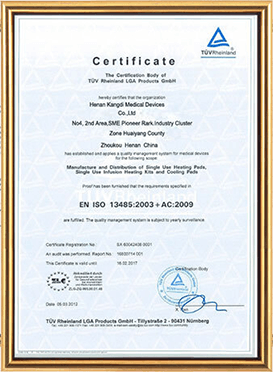
Henan Kongdy Medical Devices Co., LTD. (KONGDY) was founded in 1989 and has 37 years of production experience as of 2026 across pain relief patches, slimming patches, capsicum plasters, heat patches, cooling gel patches, detox foot patches, steam eye masks, mosquito repellent patches and nose strips. Headquartered in Henan, China, KONGDY operates a 100,000-class GMP workshop built in 2008 and obtained ISO 13485 medical device Quality Management System European Standard Certification in 2014. The company runs OEM and ODM services for international brands across multiple regulatory pathways. For 2026 procurement evaluation, the qualification team can provide the ISO 13485 certificate, GMP workshop audit reports, stability programme documentation, and reference customer case studies upon request via our contact page.
Frequently Asked Questions
Eight questions that follow from the comparison, answered as directly as the published texts allow.
Is re-testing a failed batch ever legitimate?
A pain relief patch buyer should treat the presence of the first result as the entry condition for any credible answer.
Yes, when the original result is retained and a specific fault is documented. The problem is the version where the second result becomes the finding and the first result disappears from the file.
What does 21 CFR 211.192 actually require?
A thorough investigation of any unexplained discrepancy and any failure of a batch to meet specification, whether or not the batch was distributed, extending to other batches that may be associated with the failure, with a written record stating the conclusions and follow-up.
Does a certificate of analysis show which response was used?
No. A certificate reports the released result. It does not show whether a failure preceded it, so it cannot distinguish a first-pass batch from a batch released after an investigation.
How do I know if a batch was released after a failure?
Ask for the batch record review, not the certificate. The review under 21 CFR 211.192 and the quality unit sign-off under 21 CFR 211.22(a) are where a release following an investigation becomes visible.
Is a rejection without a corrective action acceptable?
It disposes of the material and not the cause. The rejection protects the market from that batch, and the same failure can recur in the next one with no record linking the two events.
Why does the sterile clause matter here?
It does not, and that is the point. Warning letter 320-26-12 cites 21 CFR 211.113(b) and 21 CFR 211.42(c)(10) because the facility is a sterile operation. Those clauses impose controls that a non-sterile patch line does not need, so a buyer should import 21 CFR 211.192 and leave the sterile provisions where they belong.
What does Official Action Indicated mean for a buyer?
It is a facility outcome indicating that action is required before the next review proceeds, which is a stronger signal than observations closed during an inspection. It does not by itself say which product is affected.
Which single question is most diagnostic?
For a pain relief patch programme this single question separates a documented system from a described one.
Whether the investigation extended to other batches. A supplier that answers that question with a dated record is running a real investigation; a supplier that answers it with a general assurance is describing a habit rather than a system.
Related Guides
Four further references from the KONGDY knowledge base:
- Pain Relief Patch OEM: qualification and documentation overview
- Frequently asked compliance questions
- KONGDY OEM and ODM manufacturing services
- Detox Foot Patch OEM: EU Safety Gate risk mapping
- Cooling Gel Patch OEM: regulatory categories and stability evidence


