-
 KONGDY
EU Safety Gate 2026: What 76 China-Origin Cosmetic Alerts Mean for a Slimming Patch Programme
EU Safety Gate 2026: What 76 China-Origin Cosmetic Alerts Mean for a Slimming Patch Programme
The short answer is that cosmetics accounted for 76 of the 1,528 China-origin alerts published in the EU Safety Gate panel for weeks 1 to 38 of 2026, which is 5.0 percent of the China-origin total, and the United States is not the regulator doing the counting. For a slimming patch programme sold on the European cosmetic route, that panel is the most concrete public statement available about which substances are actually being caught.
This is a dataset reading, so the arithmetic is shown rather than asserted. The panel figures used here are the registered ones: 2,663 alerts in weeks 1 to 38 of 2026, of which 1,528 concerned China-origin products, a 57.4 percent share against 40.1 percent in 2025. The category split of the China-origin subset is also registered, and the residual is declared rather than filled.
Two things make this reading useful rather than decorative. First, cosmetics is a small category inside a large panel, which means the cosmetics alerts are individually readable: the weekly record names the substance, the country and the measure taken. Second, the substance families that dominate are the ones a manufacturer actually chooses during formulation, so the panel translates directly into an ingredient screening routine.
What this article does not do is convert the panel into a risk score for a specific supplier. Section seven sets out the four things the dataset cannot tell you, and they are the four things buyers most often assume it does.
The Panel, Stated Precisely
A slimming patch programme reading this panel should start with the category that contains it rather than with the headline share.
Three numbers define the dataset, and they should be quoted together or not at all, because each one alone supports a misleading conclusion.
| Figure | Value | Source and period |
|---|---|---|
| Total Safety Gate alerts | 2,663 | Weeks 1 to 38 of 2026, publication window 9 January to 25 September |
| China-origin alerts | 1,528 | Same period |
| China-origin share | 57.4 percent | Against 40.1 percent in the 2025 comparison period, a rise of 17.3 percentage points |
| Cosmetics, China-origin | 76 | Same period, category split of the China-origin subset |
| Governing framework | Regulation (EU) 2023/988 | The General Product Safety Regulation, which replaced the older directive framework |
The framework matters for the reading. Regulation (EU) 2023/988 is a general consumer product safety instrument, and cosmetics alerts are published under it even though the substantive cosmetic requirements sit in Regulation (EC) No 1223/2009. So the panel tells you what was caught and by whom, while the underlying obligation comes from the cosmetic regulation.
The 57.4 percent share is the number most often quoted and the least useful on its own. It combines eight listed categories of very different engineering complexity, and a share that moves with toy production does not describe anything about a cosmetic product. The category split is where the information is.
The reason quoting a share alone misleads is that the eight named categories are not substitutes for one another. A company that makes cosmetics cannot improve its position because a toy category moved, and a buyer who reads 57.4 percent as a statement about cosmetics has misread the denominator. The category split and the country share answer different questions, and the useful order is category first, share second.
Where a Slimming Patch Programme Sits in the Category Split
For a slimming patch programme the useful part of the split is the middle of the table, where cosmetics sits level with childcare articles.
The China-origin subset breaks down across eight named categories, and cosmetics sits fourth with 76 alerts, effectively tied with childcare articles at 77.
| Category, China-origin | Alerts | Share of the 1,528 subset | Relevance to a cosmetic patch |
|---|---|---|---|
| Toys | 456 | 29.8 percent | None directly |
| Electrical appliances and equipment | 405 | 26.5 percent | None directly |
| Childcare articles and children's equipment | 77 | 5.0 percent | Indirect, through adjacent consumer expectations |
| Cosmetics | 76 | 5.0 percent | Direct, this is the patch category |
| Lighting chains | 61 | 4.0 percent | None directly |
| Machinery | 58 | 3.8 percent | None directly |
| Chemical products | 45 | 2.9 percent | Indirect, overlapping substance concerns |
| Clothing, textiles and fashion items | 44 | 2.9 percent | Indirect, relevant to a dermal contact product |
Those eight categories sum to 1,222, which leaves a residual of 306 alerts in the China-origin subset that the registered split does not assign to a named category. That residual is stated rather than distributed, because inventing shares for the unnamed remainder is exactly the kind of arithmetic that makes a dataset reading unreliable.
The honest conclusion from the category table is modest and useful: a slimming patch programme belongs to a category that produces about one in twenty of the China-origin alerts, which is small enough that each alert is individually readable and large enough that the pattern is not noise.
The Four Substance Families in the 2026 Weekly Record
The published weekly record for 2026 names four substance families across the cosmetic alerts that are registered in this knowledge base. Each one is a formulation decision, not a manufacturing accident.
| Family | What it is | Where it appeared | Measure taken |
|---|---|---|---|
| BMHCA, also called Lilial, chemically 2-(4-tert-butylbenzyl)propionaldehyde | A fragrance allergen restricted from cosmetic use | Two perfumes notified by Bulgaria, together with HICC | Withdrawal from the market |
| TPO, chemically Diphenyl(2,4,6-trimethylbenzoyl)phosphine oxide | A photoinitiator found in UV-cured materials | Nail polishes notified by Czechia | Destruction and sales ban |
| Formaldehyde | A preservative and a known sensitiser, prohibited as an added ingredient in cosmetics | Two hair products notified by Slovakia | Sales stop |
| delta-9-THC and delta-9-THCA | Cannabinoids, restricted in cosmetic products | A skincare oil notified by Lithuania | Withdrawal from the market |
The pattern across all four is the same, and it is the pattern worth teaching: every one of these is an input decision made before the product exists. None of them is a process failure that a better production line fixes. A slimming patch programme that gets these four inputs right has removed the majority of the substance risk visible in this record.
The measures in the last column are also worth reading as a sequence of escalating cost. A sales stop is cheaper than destruction, and both are cheaper than a consumer recall, which appeared in the same period against a group of hair and wash products notified by Slovakia for BMHCA. The measure chosen tracks how far the product travelled, not how serious the substance is.
A second pattern is worth extracting from the same four rows. In three of them the substance entered the product through a commercial choice rather than through a process fault: a fragrance compound chosen for its note, a preservation strategy chosen for shelf life, and a botanical chosen for its story. That is why the screening routine later in this article starts with a list of inputs rather than with a list of tests, and why a formulation meeting is the place where most of the exposure in this record could have been removed.
Why Substances Rather Than Products Drive Cosmetic Alerts
For a slimming patch programme the consequence is that the enforcement question is answered at the formulation stage rather than at the production stage.
Cosmetic alerts are substance alerts in disguise, because the obligation being tested is about what may be in the product rather than about whether the product performs. That is a structural difference from the drug enforcement record.
Under Regulation (EC) No 1223/2009 the safety of a cosmetic product is established through the Cosmetic Product Safety Report, prepared under Article 11 and guided by the SCCS Notes of Guidance, with the manufacturer carrying the obligation and a responsible person established under Article 10. A substance that is restricted or prohibited produces a finding regardless of whether the product has ever harmed anyone, because the restriction is a condition of placing it on the market.
That is why the panel is full of named chemicals and short on product complaints. It is also why a slimming patch programme should treat the ingredient declaration as a regulated document rather than as a label element, and why an ISO 22716:2007 good manufacturing practice framework matters less here than the specification of what goes in.
The same logic explains the zero-tolerance character of the record. All four families above are conditions of market access, so the enforcement question is not whether exposure was harmful; it is whether the substance was present.
What the Panel Means for a Slimming Patch Formulation
A slimming patch programme faces a narrower version of the same problem, because the formulation is usually simpler and the contact time is longer.
A cosmetic patch concentrates the risk, because everything in the formulation sits against the skin for hours and because the product is often marketed with claims that invite scrutiny. Four formulation decisions follow from the panel.
- Fragrance. If the patch carries a fragrance, the allergen declaration and the restriction list have to be checked substance by substance. BMHCA appearing in two perfumes in one national notification is a reminder that fragrance is a compliance category, not a marketing one.
- Processing aids that survive into the product. TPO is a photoinitiator from UV-cured material, and its presence in nail polish shows that a chemical introduced by a process can become a product finding. For a patch, the equivalent question is what the adhesive and the backing are cured with.
- Preservative strategy. Formaldehyde-releasing preservation is the classic version of a decision that reads as sensible in the plant and prohibited in the market. The safer move is a declared preservative system with a documented justification.
- Botanical inputs. The cannabinoid alerts show what happens when a botanical ingredient is treated as natural rather than as a regulated substance. Every botanical needs a specification and a current status check.
None of those four is expensive to fix at the formulation stage and all four are expensive after a market notification. That asymmetry is the commercial argument for treating the panel as a design input rather than as news.
One practical note on formulation lock. A formula that changes after the Cosmetic Product Safety Report is written can invalidate the substance declarations that supported it, because the declarations describe inputs and the inputs have moved. Treating a formulation change as a documentation event rather than as a production event is what keeps the four documents current, and it costs a revision rather than a relaunch.
The Documents That Answer Each Family
A slimming patch programme needs four dated documents rather than a compliance statement, and the table below names each one.
Each substance family has one document that answers it, and the document is the same one a buyer would request from a supplier. The mapping is the practical output of this dataset reading.
| Family | Document that answers it | What to check in the document |
|---|---|---|
| Fragrance allergens | A dated allergen declaration per fragrance compound | That the declaration is against the current restriction list, not against an earlier one |
| Processing residues | A specification for the adhesive and backing, including cure system | That the specification names the chemistry rather than a trade name |
| Preservatives | The preservative system declaration within the Cosmetic Product Safety Report | That the system is named and justified, and that no prohibited releasing agent is used |
| Botanicals | A specification with botanical name, plant part and current status | That the status check is dated within the last twelve months |
A supplier that produces all four has answered the panel. A supplier that answers with a general assurance of compliance has answered nothing, because compliance here is a substance-by-substance statement and not a posture.
The same document set travels to adjacent categories. A detox foot patch OEM programme and a nose strip OEM programme run on the cosmetic route and need the same four documents, while a cooling gel patch OEM or heat patch OEM programme may sit on a device or drug route and substitute the framework at the point where the route changes.
What the Dataset Cannot Tell You
For a slimming patch programme the four limits below are the difference between a defensible reading and a confident guess.
Four limits matter before anyone turns this panel into a supplier score, and each one is a place where a confident-sounding number would be fabricated.
| The dataset cannot tell you | Why not |
|---|---|
| Whether a specific supplier is compliant | The panel names notified products, not suppliers, and a notification is an outcome rather than an audit |
| How many cosmetic alerts occurred in total | The registered split covers the China-origin subset only; the all-origin cosmetic count is not in this panel |
| Whether a substance is currently restricted | The panel records past notifications; the restriction list is a separate, current legal document |
| Whether the trend for cosmetics is rising | One period cannot show a trend, and the 40.1 to 57.4 percent movement is a share of all categories, not a cosmetic-specific change |
There is a fifth limit that is more subtle. A notification count reflects both market surveillance intensity and product volume, so a category with more alerts may simply be a category that authorities inspect more. Treating the count as a measure of how dangerous a category is mistakes the detection system for the hazard.
The defensible use of the panel is therefore narrow: it tells a slimming patch programme which four substance families to screen for, and it supplies a reason for screening that a supplier cannot dismiss as hypothetical.

A Six-Step Screening Routine
Six steps turn the panel into a routine that can be run at every formulation change and every requalification. None requires a laboratory relationship.
- List every input, including fragrance compounds, adhesive chemistry, cure system and botanicals, with the botanical name and the plant part.
- For each input, obtain a dated substance status declaration against the current restriction list for the market of sale.
- Check the fragrance line separately, because allergen declaration is the most frequently outdated part of a cosmetic file.
- Name the preservative system, and confirm that no prohibited releasing agent is part of it.
- Confirm that the Cosmetic Product Safety Report references the market of sale, since a report prepared for another jurisdiction may not answer the same questions.
- Re-run steps one to five at every formulation change and every requalification, and keep the dated output in the supplier file.
The routine is deliberately boring. The panel shows what happens when a formulation input is treated as settled: four substance families, four sets of notifications, and measures ranging from a sales stop to destruction and recall.
A slimming patch programme that runs these six steps has a defensible answer to the question a European buyer will eventually ask, which is not whether the product is good but what is in it and why that is permitted.
A note on what to do when a supplier cannot produce one of the four. The useful question is not whether the document exists somewhere but whether it exists with a date that predates the current formulation. A declaration dated after the last formulation change is evidence; one dated before it describes a product that is no longer being made, and a programme that accepts the second kind has accepted a document rather than a fact.
About KONGDY Medical

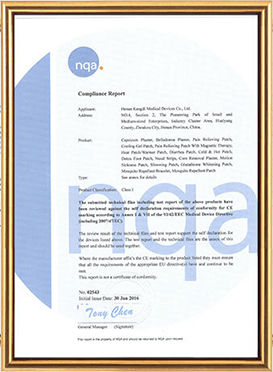
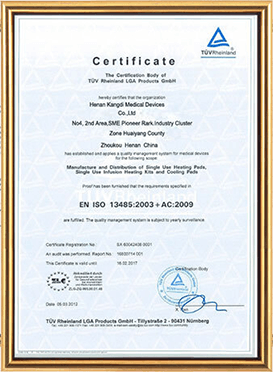
Henan Kongdy Medical Devices Co., LTD. (KONGDY) was founded in 1989 and has 37 years of production experience as of 2026 across pain relief patches, slimming patches, capsicum plasters, heat patches, cooling gel patches, detox foot patches, steam eye masks, mosquito repellent patches and nose strips. Headquartered in Henan, China, KONGDY operates a 100,000-class GMP workshop built in 2008 and obtained ISO 13485 medical device Quality Management System European Standard Certification in 2014. The company runs OEM and ODM services for international brands across multiple regulatory pathways. For 2026 procurement evaluation, the qualification team can provide the ISO 13485 certificate, GMP workshop audit reports, stability programme documentation, and reference customer case studies upon request via our contact page.
Frequently Asked Questions
Eight questions that follow from the panel, answered as directly as the registered data allows.
How many cosmetic alerts were there in 2026?
The registered panel gives 76 China-origin cosmetic alerts in weeks 1 to 38 of 2026. The all-origin cosmetic count is not part of this panel, so it is not quoted here.
Is 76 a small or a large number?
That figure matters because a slimming patch programme competes for buyer attention with childcare articles rather than with toys.
Inside the China-origin subset it is 5.0 percent of 1,528 alerts, which places cosmetics fourth among eight named categories and effectively level with childcare articles at 77. That is small enough that each alert is readable and large enough that the pattern is not noise.
Which substances appeared most often in the record?
The registered record names four families: BMHCA with HICC in perfumes, TPO in nail polish, formaldehyde in hair products, and delta-9-THC with delta-9-THCA in a skincare oil. They are four different chemistry problems with one shared property: each is an input decision.
Do these alerts apply to a slimming patch?
The substances matter, the specific products do not. A cosmetic slimming patch needs the same allergen declaration, processing residue specification, preservative justification and botanical status check that the notified products lacked.
Which regulation governs a cosmetic patch in the EU?
Regulation (EC) No 1223/2009 sets the substance and safety obligations, including the Cosmetic Product Safety Report under Article 11 and the responsible person under Article 10. The Safety Gate alerts themselves are published under Regulation (EU) 2023/988, which is the general product safety instrument.
Does the China-origin share mean Chinese products are less safe?
A slimming patch programme should read the panel as a detection record rather than as a hazard ranking.
The panel cannot support that inference. A share reflects both surveillance intensity and product volume, not hazard alone, and a country-level percentage aggregates eight categories with different chemistry and different inspection priorities.
What is the single most useful document to request?
A dated substance status declaration covering every input, including fragrance compounds and processing chemistry. It answers more of the panel than any other single document, and its date is what makes it checkable.
How often should the screening be repeated?
At every formulation change and every requalification. Restriction lists move and supplier declarations age, so the routine is a calendar item rather than a one-off project.
Related Guides
Four further references from the KONGDY knowledge base:
- Slimming Patch OEM: cosmetic pathway documentation
- Frequently asked compliance questions
- KONGDY OEM and ODM manufacturing services
- Pain Relief Patch OEM: qualification and documentation overview
- Nose Strip OEM: device pathway documentation


