-
 KONGDY
Two Neglected Columns of the EU Safety Gate Panel: What a Detox Foot Patch Programme Should Read, and What the Count Cannot Rank
Two Neglected Columns of the EU Safety Gate Panel: What a Detox Foot Patch Programme Should Read, and What the Count Cannot Rank
The EU Safety Gate panel for weeks 1 to 38 of 2026 contains 2,663 alerts, of which 1,528 concern China-origin products, a 57.4 percent share against 40.1 percent in 2025. Almost every reading of that dataset stops there, and the two columns that carry the operational information are the category split and the measure taken. A detox foot patch programme with several product lines needs both, because the first tells it where surveillance attention sits and the second tells it how far a finding travels.
This reading is written for a manufacturer rather than for a single-product buyer. A company that makes patches across several categories has one question the panel can actually answer: among the categories in which it operates, which ones are being notified most, and what happens when they are. That question is answerable from the registered numbers. The more common question, which category is most dangerous, is not.
The discipline applied here is the one this knowledge base uses throughout. Every derived figure is arithmetic on registered numbers and the arithmetic is shown. Where the panel does not assign a value, the residual is declared rather than distributed. And where a measure is not named in the record, the row is described as unspecified rather than filled in.
The article closes with a three-step priority routine and a list of four things the count cannot rank, because a manufacturer needs to know the limits before using a dataset as a plan.

The Panel, and the Two Columns Nobody Quotes
A detox foot patch programme reading this dataset should start by fixing its own denominator rather than by quoting a share.
Headline reporting on this dataset quotes one number, the China-origin share, and the share is the least actionable figure in it.
The share aggregates eight categories of different engineering complexity, different inspection intensity and different chemistry. A movement in toy production changes it without changing anything about a patch. A detox foot patch programme reading the share is reading a number that describes a portfolio it is not part of.
Two other columns do describe things a manufacturer can act on. The category split says which product families generated the alerts, and the measure column says what authorities did about them. Neither column is complicated, and both are usually omitted, which is why they are worth the whole article.
A buyer and a manufacturer read the same panel for different reasons, and the difference decides which column matters. A buyer is asking whether one product for one market is exposed, and that question is narrow enough to answer from a single row. A manufacturer is asking which of its lines inherits which screening routine, and that question is answered by the category rows and by nothing else in the panel. The two readings are compatible, but they are not the same reading, which is why the same dataset supports two different articles.
| Figure | Value | What it can support |
|---|---|---|
| Total alerts, weeks 1 to 38 | 2,663 | A scale reference for the period |
| China-origin alerts | 1,528 | The denominator for every category share below |
| China-origin share | 57.4 percent, against 40.1 percent in 2025 | A portfolio-level movement, not a product-level statement |
| Named categories in the split | Eight | The rows below |
| Residual after the eight | 306 | Unaligned alerts, declared here rather than distributed |
Column One: The Category Split, with the Residual Stated
For a detox foot patch line the useful part of this table is not the ranking but the residual, because the residual is where an unanticipated category sits.
The China-origin subset breaks across eight named categories, and the arithmetic does not close on 1,528, which is itself a useful fact.
| Category, China-origin | Alerts | Share of 1,528 | Relevance to a patch line |
|---|---|---|---|
| Toys | 456 | 29.8 percent | None directly |
| Electrical appliances and equipment | 405 | 26.5 percent | None directly |
| Childcare articles and children's equipment | 77 | 5.0 percent | Indirect, through adjacent consumer expectations |
| Cosmetics | 76 | 5.0 percent | Direct, this is the cosmetic patch category |
| Lighting chains | 61 | 4.0 percent | None directly |
| Machinery | 58 | 3.8 percent | None directly |
| Chemical products | 45 | 2.9 percent | Indirect, overlapping substance concerns |
| Clothing, textiles and fashion items | 44 | 2.9 percent | Indirect, relevant to a dermal contact product |
| Residual, not assigned to a named category | 306 | 20.0 percent | Unknown, and treated as unknown here |
The eight categories sum to 1,222 and the residual is 306, which is 20.0 percent of the subset. That is not a rounding error; it is a fifth of the data sitting outside the published split. Any article that presents the eight rows and implies they account for the whole subset has overstated its own coverage.
For a detox foot patch programme the relevant row is cosmetics at 76, and the honest reading of that row is modest. It is 5.0 percent of the China-origin subset, level with childcare articles at 77, and it is a category total that does not separate patches from creams. What it establishes is that the category exists in the record with a countable number, which is more than a marketing opinion provides.
The residual is also a reminder about a different kind of error. A manufacturer that converts this table into a priority list without noting the 306 will believe it has explained the whole subset, and the unassigned fifth is precisely where an unexpected category could be hiding.
What a manufacturer should do about the residual is procedural. Ask the question the split cannot answer, which is whether the line belongs to one of the eight named categories or to the unassigned fifth. For a patch product the answer is usually the cosmetics row, but the discipline of asking prevents a later assumption that the table was complete.

Column Two: The Measure Ladder
A detox foot patch manufacturer should read this column as a distribution map rather than as a penalty table.
The measure column records what authorities did, and it operates as a ladder rather than as a single outcome.
| Row in the 2026 record | Product | Substance | Measure recorded |
|---|---|---|---|
| Bulgaria | Two perfumes | BMHCA together with HICC | Withdrawal from the market |
| Czechia | Nail polishes | TPO | Destruction and sales ban |
| Lithuania | Skincare oil | delta-9-THC and delta-9-THCA | Withdrawal from the market |
| Slovakia | Two hair products | Formaldehyde | Sales stop |
| Slovakia | Wash and hair products | BMHCA | Withdrawal from the market, with consumer recall |
| Germany | Multiple products | See the weekly record | Not specified in the extract |
Distilled to counts, withdrawal appears in three of the six rows, sales stop in one, destruction with a sales ban in one, and a consumer recall accompanies one withdrawal. One row names no measure in the registered extract and is treated as unspecified rather than assigned a likely one.
The ladder runs roughly from withdrawal, which takes product off shelves that are still in the distribution chain, through sales stop and sales ban, which prevent further sale, to destruction and consumer recall, which reach product already with the public. The direction is by how far the product has travelled, which is a different axis from how serious the substance is.
That distinction matters commercially. A detox foot patch line that reaches consumers through several channels sits further along that axis than one sold through a single distributor, not because its formulation is riskier but because the recall arithmetic is larger.
The practical instruction is to read the ladder as a planning input rather than as a score. A line whose remedy would sit at the far end of the ladder, because the product reaches consumers directly, should carry an ingredient file that is complete before the first shipment rather than after the first question.
Why the Measure Tracks Distribution Rather Than Severity
For a detox foot patch line the ladder position is set partly before the product exists, by the channels it is designed for.
The measure chosen depends on where the product is, not only on what is in it, and reading the ladder as a severity scale produces the wrong lesson.
A prohibited substance found in a warehouse produces a sales stop or a sales ban. The same substance found in product already sold produces a withdrawal, and if the product is in consumers' hands it may produce a recall. The substance is identical in all three cases; the measure differs because the remedy differs.
For a manufacturer this reframes the panel from a chemistry document into a distribution document. The exposure a category carries is the product of what can go wrong and how far the product travels before it is found, and only the first half of that product sits in the formulation.
There is a practical consequence for a multi-line programme. A detox foot patch line sold as a cosmetic in several European markets, through online channels and through distributors, has a wider distribution surface than a single-market line, and the panel predicts that its remedy would sit further along the ladder. That is not a reason to change the product; it is a reason to protect the ingredient file before it travels.
Exposure in this framing has two halves that different teams manage. The formulation half is set during development and reviewed at every change, which makes it a quality function. The distribution half is set in commercial planning and reviewed when a channel or a market is added, which makes it a sales function that rarely thinks of itself as a compliance function. A programme that manages only the first has optimised the half it already understood.

What This Means for a Programme with Several Lines
The two columns produce a different priority order for a detox foot patch line than the headline share does.
The two columns combine into a priority view, and the view differs from what the headline share suggests.
| Question the two columns answer | Where a multi-line programme should look |
|---|---|
| Which category generated the alerts | The category the line belongs to, read with the residual in view |
| How many of that category generated them | The category count against the 1,528 denominator, not against the total |
| What happened when a finding occurred | The ladder position implied by the distribution surface |
| Which substances drove the cosmetics rows | The substance families, screened at formulation rather than at audit |
| What the panel does not separate | Patches from other cosmetics, and China-origin from all-origin for that category |
For a detox foot patch OEM relationship the actionable conclusion is narrow and useful: the category carries a countable alert history, the substances that drove it are formulation inputs, and the measure ladder is a function of distribution as much as of chemistry. A manufacturer that acts on all three has used the panel better than one that quotes a share.
The same reading transfers to adjacent lines, which is the point of writing it for a manufacturer rather than a buyer: a slimming patch OEM programme, a cooling gel patch OEM programme and a nose strip OEM programme sit in the same cosmetics row with the same substance families and a different distribution surface.
A category plan and a substance plan are different documents, and both are needed. The category plan decides which screening routine a line inherits. The substance plan decides which inputs are checked within it. A programme that has only the first knows where it stands and not what to check.
A Three-Step Priority Routine
For a detox foot patch programme the routine is the whole deliverable, so it has to be short enough to survive a busy quarter.
Three steps convert the reading into a standing task, and none of them requires a laboratory relationship.
- Place each line in a category and record the count. Use the category row and the 1,528 denominator, and write down the residual so that nobody later assumes the eight rows are complete.
- Screen the substance families at formulation. Fragrance allergens, processing residues from cure systems, the preservative strategy and botanical inputs are the four families the record names, and all four are decided before production.
- Map the distribution surface. Count the channels and the markets for each line, because that count predicts where a finding would sit on the measure ladder.
The routine is deliberately short. A detox foot patch programme that runs it annually has a defensible answer to the question a European buyer eventually asks, which is what the category record looks like and what was done about the inputs.
One further habit makes the routine durable: keep the dated output. A category count without a period reference is a number that cannot be compared to next year, which is how a dataset reading decays into an anecdote.

Four Things the Count Cannot Rank
A detox foot patch manufacturer should read these four limits before treating the panel as a plan.
Four limits belong with any use of this panel as a priority tool.
| The panel cannot rank | Why |
|---|---|
| Categories by danger | A notification count measures detection as well as hazard |
| Suppliers by compliance | The panel names products, not manufacturers |
| Substances by severity | A restriction is a condition of sale, so presence is the finding |
| Markets by stringency | A notified product reflects where it was found, not where it was made |
The first limit is the one that does the most damage when ignored. A category with more alerts may simply be a category that authorities inspect more, and reading the count as a hazard measure mistakes the detector for the hazard.
The second limit is the one a procurement team notices. Because the panel names products rather than manufacturers, a foot patch line buyer cannot search the dataset for a supplier name and expect a clean answer. The useful version of that search is the FDA warning letter database, which does name entities.
The remaining two limits are about vocabulary. Severity and stringency are words the dataset does not contain, and any ranking built on them is the author's, not the panel's.

Keeping the Reading Current
For a detox foot patch programme the refresh cost is low enough that neglecting it is a choice rather than a constraint.
The panel is published weekly, which makes the reading cheap to refresh and easy to neglect.
Three refresh points are enough for a manufacturer. Refresh the category counts at the start of each quarter, refresh the substance screen whenever a formulation changes, and refresh the distribution map whenever a new channel or market is added. Those three cover the columns that move.
A cosmetic patch line programme that refreshes on that schedule never has to reconstruct a year of data, because the output is dated and stored as it is produced.
The final point is about restraint. A dataset reading is a standing obligation with a small time cost, and the temptation is to expand it into a report. The version that survives is the version short enough to run without a meeting.
Storing the output matters as much as producing it. A dated one-page note per quarter, filed with the requalification pack, is worth more three years later than a slide deck that summarised the same period and cannot now be found. The note should carry the category row, the count, the denominator and the residual, because those four numbers are what make next year comparable to this one.
About KONGDY Medical

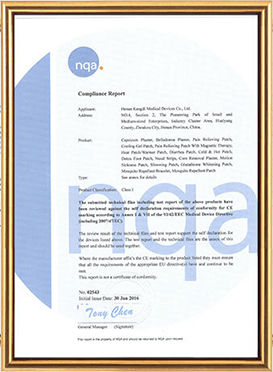
Henan Kongdy Medical Devices Co., LTD. (KONGDY) was founded in 1989 and has 37 years of production experience as of 2026 across pain relief patches, slimming patches, capsicum plasters, heat patches, cooling gel patches, detox foot patches, steam eye masks, mosquito repellent patches and nose strips. Headquartered in Henan, China, KONGDY operates a 100,000-class GMP workshop built in 2008 and obtained ISO 13485 medical device Quality Management System European Standard Certification in 2014. The company runs OEM and ODM services for international brands across multiple regulatory pathways. For 2026 procurement evaluation, the qualification team can provide the ISO 13485 certificate, GMP workshop audit reports, stability programme documentation, and reference customer case studies upon request via our contact page.
Frequently Asked Questions
Eight questions that follow from reading the two columns.
What are the two neglected columns?
A detox foot patch manufacturer reading this question should note that the two columns are several numbers rather than one.
The category split of the China-origin subset, and the measure recorded against each notified product. The headline share is quoted because it is one number; these two columns are omitted because they are several.
Do the eight categories add up to the China-origin total?
No. The eight named categories sum to 1,222, and the residual of 306 is 20.0 percent of the 1,528 subset. That residual is stated rather than distributed.
How big is the cosmetics row?
For a detox foot patch line that row is small enough to be read in full rather than summarised.
76 China-origin alerts in weeks 1 to 38 of 2026, which is 5.0 percent of the China-origin subset and level with childcare articles at 77.
What measures appear in the record?
Withdrawal from the market in three of the six rows that name a measure, a sales stop in one, destruction with a sales ban in one, and a consumer recall accompanying one withdrawal. One row in the registered extract names no measure.
Is a recall worse than a withdrawal?
It is not a difference in the substance, it is a difference in reach. A recall reaches product already with the public, which is why the ladder runs by distribution rather than by chemistry.
Can I use the panel to compare suppliers?
Not directly. The panel names products rather than manufacturers, so a supplier search is unreliable. The FDA warning letter database does name entities and is the right instrument for that question.
Does a higher category count mean a more dangerous category?
No. A count reflects detection intensity and product volume as well as hazard, so reading it as a danger ranking mistakes the detector for the hazard.
How often should the reading be repeated?
A detox foot patch programme can run this schedule alongside its existing requalification cycle without adding a meeting.
Category counts quarterly, substance screening at every formulation change, and the distribution map whenever a channel or market is added. Keep the output dated.
Related Guides
Four further references from the KONGDY knowledge base:
- Detox Foot Patch OEM: EU Safety Gate risk mapping
- Frequently asked compliance questions
- KONGDY OEM and ODM manufacturing services
- Slimming Patch OEM: cosmetic pathway documentation
- Pain Relief Patch OEM: qualification and documentation overview


