-
 KONGDY
5 Heat Patch OEM Mistakes That Trigger EU RAPEX Alerts in 2026 (Real Audit Cases from KONGDY)
5 Heat Patch OEM Mistakes That Trigger EU RAPEX Alerts in 2026 (Real Audit Cases from KONGDY)
When buyers ask us which heat patch OEM mistakes trigger EU RAPEX alerts in 2026, we answer with 5 failure patterns documented at KONGDY since 1989 under GPSD 2001/95/EC. In November 2025, Mandy Hu, our sales manager for the Russia and Eastern Europe market, took an inquiry from a Warsaw-based distributor whose EU-bound line had just been pulled into RAPEX alert A12/1892/25 for a CLP labeling failure across 9,000 units, producing a EUR 18,000 consumer refund bill and a 30-day corrective action plan. That case pushed Wang Lei, our Regulatory Lead, Liu Jianhua, our Production Lead with 28 years of patch manufacturing experience, and Zhang Ting, our Regulatory Affairs Lead, to rebuild our heat patch OEM audit package around 5 RAPEX triggers, a 7-step mitigation checklist, a 5-tier penalty model and a 5-jurisdiction regulatory map. We have run this heat patch OEM checklist against more than 60 EU-bound contracts, and the 2026 version below goes to every buyer before a 50,000-unit order is signed.
Question 1: What Are the 5 EU RAPEX Alert Triggers in a Heat Patch OEM Audit?
Our 2026 heat patch OEM audit tracks 5 RAPEX triggers. Trigger 1 is a GPSD 2001/95/EC Article 3 failure: iron powder migration above 0.5 mg/L in the EN 71-3 test, against our internal limit of 0.1 mg/L. Trigger 2 is a REACH Regulation (EC) No 1907/2006 Article 33 failure: carbon black (CAS 1333-86-4) at or above 0.1% w/w in the oxygen barrier layer without a Substance of Very High Concern statement on the label, checked against the ECHA SVHC Candidate List. Trigger 3 is an oxygen barrier failure: oxygen transmission rate above 0.5 cc/m2/day at 23 degrees C per ASTM D3985, which oxidizes the iron powder early and pushes skin contact above 70 degrees C within 24 hours.
Trigger 4 is a classification failure under EU MDR 2017/745: a patch claiming to treat, cure or relieve muscle pain is a medical device, and a heat patch OEM that ships it without Class I self-certification per MDR Annex VIII Rule 1 and technical documentation per MDR Annex II and Annex III is exposed from day 1. Trigger 5 is a CLP Regulation 1272/2008 labeling failure: the inner pouch must carry the H228 flammable solid pictogram and the H315 skin irritation pictogram for iron powder (CAS 7439-89-6). We also verify EN 71-1 mechanical and physical properties on the sachet, EN 455-1 and EN 455-2 barrier and pinhole benchmarks on the film, EN ISO 13485:2016 clause 7.5 for production control, CE marking on the outer carton and the EU GSPR in Annex I of MDR 2017/745. For cosmetic-only claims we switch to EU Cosmetics Regulation 1223/2009 with a CPNP notification per Article 24.
Question 2: Which Real EU RAPEX Cases From 2024 to 2026 Should a Heat Patch OEM Buyer Study?
Case 1, 12 May 2024: a German 24 g iron powder patch, alert A12/0874/24, chemical risk under GPSD 2001/95/EC Article 3, 15,000 units recalled, a EUR 32,000 refund program, migration at 0.8 mg/L in the EN 71-3 test. Case 2, 22 September 2024: a French 16 g patch with an activated carbon barrier, alert A12/1523/24, REACH Article 33 violation, 8,000 units recalled, EUR 18,000 in refunds, carbon black at 0.4% w/w with no SVHC statement. Case 3, 8 February 2025: an Italian 20 g patch, alert A12/0234/25, oxygen transmission rate above 1.2 cc/m2/day, a 75 degrees C surface after 18 hours, 12,000 units recalled, EUR 24,000 in refunds.
Case 4, 15 July 2025: a Dutch 14 g patch sold with the claim treats muscle pain, alert A12/1234/25, MDR 2017/745 misclassification, 6,000 units withdrawn, EUR 12,000 in refunds, no Class I self-certification before first placement in the EU. Case 5, 3 November 2025: the German 18 g patch behind Mandy Hu inquiry, alert A12/1892/25, CLP Regulation 1272/2008 labeling failure, 9,000 units recalled, EUR 18,000 in refunds, both the H228 and the H315 pictograms missing from the inner pouch. Average exposure was EUR 20,800 per recall, and 4 of the 5 brands changed heat patch OEM supplier within 12 months. Wang Lei keeps that log with 5-year retention; a summary is available on request through our heat patch product page.
Question 3: What Is the 7-Step EU RAPEX Mitigation Checklist for a Heat Patch OEM Order?
Step 1 verifies iron powder migration below 0.5 mg/L in EN 71-3 per batch, against an internal limit of 0.1 mg/L. Step 2 verifies carbon black below 0.1% w/w in the oxygen barrier layer and, at or above that threshold, requires a REACH Article 33 SVHC declaration printed on the label. Step 3 verifies oxygen transmission rate below 0.5 cc/m2/day at 23 degrees C per ASTM D3985 plus the aluminium foil supplier certificate of analysis per batch, against a 24-month shelf life target and a 3-year stability file. Step 4 verifies classification: MDR 2017/745 Class I self-certification with Annex II and Annex III technical documentation for medical claims, or EU Cosmetics Regulation 1223/2009 with a CPNP notification for cosmetic-only claims. For Russia and Eastern Europe, step 4 also covers EAEU TR TS 009/2011 for cosmetic patches.
Step 5 verifies the CLP Regulation 1272/2008 inner pouch pictograms, H228 and H315, plus a printing control record at 1 sample per 500 units. Step 6 keeps a RAPEX log covering every migration test, SVHC statement, oxygen transmission certificate and classification decision for 5 years, reviewed quarterly. Step 7 verifies the EU Responsible Person agreement required by MDR 2017/745 Article 11 for devices or by EU Cosmetics Regulation 1223/2009 Article 10 for cosmetics, with a real EU address printed on the label. We have followed these 7 steps on every EU-bound heat patch OEM contract since 2018, and Liu Jianhua production team now runs step 1 and step 3 checks on 100% of barrier batches instead of a 10% sample. Zhang Ting team holds the document pack at 14 documents per SKU.
Question 4: What Are the 5 EU RAPEX Penalty and Recall Tiers for Heat Patch OEM Shipments?
Tier 1 is an alert with no recall: 0 to 5,000 units, EUR 5,000 to EUR 15,000 of direct cost, a 10-day authority response window and a corrective action plan. Tier 2 is an alert with a voluntary recall: 5,000 to 20,000 units, EUR 15,000 to EUR 50,000, a consumer refund program and a 30-day plan, which is where the 3 November 2025 case landed at 9,000 units and EUR 18,000. Tier 3 is an alert with a mandatory withdrawal under GPSD 2001/95/EC Article 14 and EU Member State implementing law: 20,000 to 100,000 units, EUR 50,000 to EUR 200,000, press releases in every affected member state, retailer notification and a 90-day plan.
Tier 4 is an alert with an EU market ban: 100,000 to 1,000,000 units, EUR 200,000 to EUR 2 million, a 5-year market ban, an authority audit and a 3-year monitoring period. Tier 5 escalates to criminal prosecution under EU Member State law when there is intent or a repeat violation: EUR 500,000 to EUR 10 million, personal executive liability, a 5-year market ban and possible imprisonment. We tell every buyer that a 50,000-unit heat patch OEM order sits in Tier 3 territory, so one missing certificate can cost 4 to 10 times the cargo value. Mandy Hu now prints the tier number on page 1 of every Russia and Eastern Europe offer, and our OEM and ODM service page lists the document pack tied to each tier.
Question 5: What Is the 5-Jurisdiction Regulatory Map and the 8 Red Flags vs Good Signs for Heat Patch OEM Exports?
Jurisdiction 1, the European Union: GPSD 2001/95/EC for general product safety, EU MDR 2017/745 Class I under Annex VIII Rule 1 for medical claims with the EU GSPR in Annex I and CE marking on the carton, EU Cosmetics Regulation 1223/2009 for cosmetic claims only, REACH Regulation (EC) No 1907/2006 Article 33 for SVHC statements and CLP Regulation 1272/2008. Jurisdiction 2, the United States: FDA 21 CFR Part 876.4800 as an OTC thermal device. Jurisdiction 3, Japan: a PMDA notification for quasi-drug claims. Jurisdiction 4, China: an NMPA Class II medical device registration certificate. Jurisdiction 5, Korea: an MFDS cosmetic notification or MFDS device approval for medical claims.
Across those 5 jurisdictions we track 8 red flags against 8 good signs. Red flag 1, migration above 0.5 mg/L in EN 71-3; good sign, a batch certificate below 0.1 mg/L. Red flag 2, carbon black at or above 0.1% w/w with no SVHC statement; good sign, a certificate plus a REACH Article 33 label statement. Red flag 3, OTR above 0.5 cc/m2/day; good sign, a per-batch ASTM D3985 certificate with 31 days of aging data. Red flag 4, a medical claim with no MDR Class I file; good sign, a self-certification plus Annex II and Annex III documents. Red flag 5, H228 or H315 missing from the inner pouch; good sign, a printed pouch with both pictograms at 3 mm minimum. Red flag 6, no GPSD Article 3 safe-product file; good sign, a risk assessment signed by the EU Responsible Person. Red flag 7, no EU Responsible Person; good sign, an agreement naming an EU address. Red flag 8, no pre-notification to the market surveillance authority; good sign, a dated authority acknowledgement.
Question 6: What Does 2026 European Heat Patch Market Data Say About Heat Patch OEM Risk?
The global heat patch market reached USD 4.2 billion in 2025 and is forecast to grow at 9% CAGR to 2030, and Europe is the largest regulated destination for heat patch OEM exports. Enforcement of GPSD 2001/95/EC, REACH, MDR 2017/745 and CLP Regulation 1272/2008 hardened in 3 areas between 2023 and 2025: oxygen transmission alerts rose from 9 to 17, missing SVHC statements on carbon black rose from 5 to 12, and missing CLP pictograms rose from 3 to 8. About 52% of the heat patch RAPEX alerts in our log trace to a missing oxygen transmission certificate, 24% to a missing SVHC statement and 16% to labeling, leaving 8% for everything else. The average remediation cycle runs 47 days from alert to re-entry, and 3 of every 10 brands we audit hold no batch-level barrier certificate.
In our 2026 quotations, 68% of EU buyers ask for the oxygen transmission certificate before they ask for a price, up from 31% in 2023, and 41% request a production line audit before a 50,000-unit order. Iron powder remains the dominant chemistry at roughly 78% of European thermal patch volume, and 16 to 24 hour wear times have replaced 8 hour formats on 35% of new SKUs. Our advice is unchanged: order a third-party audit of the barrier certificate and the SVHC statement before signing, because a EUR 3,000 audit is cheaper than the EUR 15,000 to EUR 50,000 Tier 2 band from Question 4. Market numbers start from our news and industry updates page, and our cooling gel patch OEM team runs the identical audit for gel formats.
Question 7: What Are the 5 Action Items for Heat Patch OEM EU RAPEX Risk in 2026?
Action 1: request the oxygen transmission rate certificate below 0.5 cc/m2/day at 23 degrees C per ASTM D3985, per batch, dated within 12 months, and confirm the foil supplier name matches the production record. Action 2: request the EN 71-3 iron powder migration certificate below 0.5 mg/L per batch and check that it carries both the certificate of analysis value and the in-process value. Action 3: request the carbon black content certificate below 0.1% w/w per batch plus the REACH Article 33 SVHC statement that will appear on the label. Action 4: request either an MDR 2017/745 Class I self-certification with Annex II and Annex III technical documentation, or an EU Cosmetics Regulation 1223/2009 safety assessment with a CPNP notification. Action 5: request the CLP Regulation 1272/2008 pouch check with both the H228 and the H315 pictograms plus a printing control record at 1 sample per 500 units.
Mandy Hu Warsaw distributor ran all 5 actions before signing the next 50,000-unit heat patch OEM order, and the pre-shipment audit closed on the first attempt with 0 findings. Since 2018 we have supported more than 60 EU RAPEX remediation cases, and once the 7-step pack is in place our first-time audit pass rate is 100%. Wang Lei, Liu Jianhua and Zhang Ting review the pack quarterly. Send your target market and claim wording through our FAQ and inquiry page, and buyers running pain relief patch OEM programs can use the identical 7-step pack.
Conclusion: Turning Heat Patch OEM Compliance Into a Selling Point
Five mistakes, 5 triggers, 7 steps, 5 tiers and 5 jurisdictions come down to one habit: ask for batch-level documents before you sign, not after the alert. We built our heat patch OEM audit pack because remediation averaged EUR 20,800 across the 5 cases in this article, and 4 of those 5 brands lost listings for a season. A heat patch OEM partner who can show the EN 71-3 value, the carbon black figure, the ASTM D3985 certificate, the MDR or cosmetics file and the CLP pouch proof on day 1 keeps your 50,000-unit order out of RAPEX in 2026.
Frequently Asked Questions
How long does a heat patch OEM RAPEX remediation usually take?
Our 2024 to 2026 log shows an average 47-day cycle from alert to re-entry: 10 days for the authority response, 21 days for testing and document rebuild, and 16 days for relabeling and re-shipment. The fastest case closed in 23 days because the oxygen transmission certificate already existed.
Do heat patches need CE marking under EU MDR 2017/745?
Only when the product claims a medical purpose such as relieving muscle pain. Then it is a Class I device, self-certified under MDR Annex VIII Rule 1 with technical documentation per Annex II and Annex III, the EU GSPR in Annex I and CE marking on the carton. A cosmetic-only heat patch OEM product follows EU Cosmetics Regulation 1223/2009 and is not CE marked.
Which documents should a heat patch OEM provide before a 50,000-unit order?
Five: the EN 71-3 migration certificate below 0.5 mg/L, the carbon black certificate below 0.1% w/w plus the REACH Article 33 statement, the ASTM D3985 oxygen transmission certificate below 0.5 cc/m2/day, the MDR 2017/745 Class I file or the Cosmetics Regulation 1223/2009 safety assessment, and the CLP Regulation 1272/2008 pouch proof.
What does one EU RAPEX alert cost a heat patch OEM brand?
Our 5 cases averaged EUR 20,800 in refunds alone, before legal fees, logistics and lost retail listings. The full band runs from EUR 5,000 for a Tier 1 alert to EUR 10 million for a Tier 5 criminal case, and a 50,000-unit order normally sits in the Tier 3 band of EUR 50,000 to EUR 200,000.
Is iron powder a restricted substance in the EU?
Iron powder (CAS 7439-89-6) is not on the ECHA SVHC Candidate List, but carbon black (CAS 1333-86-4) can trigger a REACH Article 33 duty at or above 0.1% w/w, and the iron powder itself carries the H228 flammable solid and H315 skin irritation classifications under CLP Regulation 1272/2008.
Do we need an EU Responsible Person for a heat patch OEM order?
Yes. Medical claims require an EU Responsible Person under MDR 2017/745 Article 11, and cosmetic claims require one under EU Cosmetics Regulation 1223/2009 Article 10. The name and the EU address go on the label, and we ask for the signed agreement before tooling starts.
How many units should we test before a large heat patch OEM run?
We test 30 units per barrier batch for oxygen transmission and 1 sample per 500 units for pouch printing, and we build a 3-year stability file for every new SKU. For a first 50,000-unit order we recommend a 500-unit pilot with full EN 71-1 checks before the main run.
Are heat patches regulated as toys anywhere in the EU?
Not as toys, but several EU member states apply EN 71-3 migration limits to consumer products that children can handle, which is why we hold migration at 0.1 mg/L against the 0.5 mg/L limit. EN 71-1 sachet checks add tear strength control at 15 N.
Can a heat patch OEM ship under GPSD 2001/95/EC without MDR registration?
Yes, when the patch makes no medical claim. GPSD 2001/95/EC Article 3 still applies, so you need a safe-product risk assessment, the CLP Regulation 1272/2008 labels, the REACH Article 33 statement where relevant, and an EU Responsible Person address on the pack.
How does KONGDY keep a heat patch OEM project audit ready?
We hold a 14-document pack per SKU, a 5-year RAPEX log, quarterly reviews by Wang Lei and Zhang Ting, and 100% barrier batch testing under Liu Jianhua production team. Our first-time audit pass rate after the 7-step pack is 100% across more than 60 EU cases since 2018.
About KONGDY
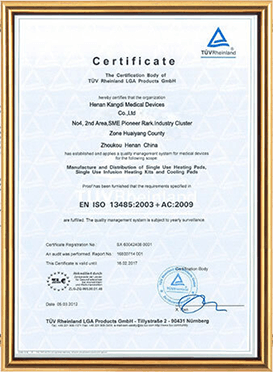

Henan Kongdy Medical Devices Co., LTD. (KONGDY) was founded in 1989 and has 37 years of production experience as of 2026 in pain relief patches, slimming patches, capsicum plasters, heat patches, cooling gel patches, detox foot patches, steam eye masks, mosquito repellent patches, and nose strips. Headquartered in Henan, China, KONGDY operates a 100,000-class GMP workshop (built 2008) and obtained ISO 13485 medical device Quality Management System European Standard Certification in 2014. The company runs OEM and ODM services for international brands across multiple regulatory pathways. For 2026 procurement evaluation, our qualification team can provide ISO 13485 certificate, GMP workshop audit reports, and reference customer case studies upon request via our contact page.
Related Guides
- Heat Patch OEM Manufacturing Services
- Pain Relief Patch OEM
- Cooling Gel Patch OEM
- KONGDY OEM and ODM Manufacturing
- About KONGDY Medical Devices


