-
 KONGDY
The 24-Point Substance Family Screen: A Capsicum Plaster OEM Checklist for the EU Market in 2026
The 24-Point Substance Family Screen: A Capsicum Plaster OEM Checklist for the EU Market in 2026
In 2025 the EU Safety Gate validated 4,671 alerts on dangerous non-food products, cosmetics accounted for 36 percent of them for the third consecutive year, and chemical risk accounted for 53 percent of all notifications across the whole system. Almost eight in ten of the cosmetics alerts related to one banned fragrance.
Those four numbers point at the same conclusion for a cosmetic patch programme. The dominant failure mode in the European system is a substance in the product, and the fastest way to deal with it is to screen the formula before the product exists rather than to explain it afterwards.
Most checklists in this series are organised by document, because most compliance problems are about a document that is missing. This one is organised by substance family instead, because the 2025 and 2026 record shows the substance is usually what the finding is about, and the families have properties that a buyer can check without opening a laboratory report.
For a capsicum plaster OEM the value of a substance-family screen is that it catches the failures that ingredient-level checking misses. A file that lists every raw material and confirms each one is not on a list will still pass a formula containing a botanical that was lawful to sell last year, or a preservative that nobody put on the label. The screen below is built to catch those.
A capsicum plaster OEM that already runs an ingredient-level check has most of the work done and can extend it, and one that has never screened at all is starting from the band that matters most.
The twenty-four points are grouped into five bands, and the order follows the dependency order rather than the theme: what the formula contains, what the label says about it, what the file has to record, what the online listing says about it, and what has to be true before the next batch goes out.
Band one: what the formula contains, points 1 to 8
The first band is the substance screen itself, and it is the band that the 2025 data says does most of the work.
| # | Check | What it has to show | Why this point exists |
|---|---|---|---|
| 1 | The banned fragrance family, including BMHCA and HICC | A screening result against the annex in force, dated | Almost eight in ten of the cosmetics alerts in 2025 involved BMHCA, and the January 2026 case in Bulgaria withdrew two perfumes for BMHCA and HICC at once |
| 2 | The photo-initiator family, including TPO | A confirmation that no member of the family is present, against the version of the annex in force on the date of the check | TPO was banned in 2025 and nail polish alerts containing it were notified for the first time that year, which means a formula written earlier can still contain it |
| 3 | The formaldehyde family, in preservatives and cross-linkers | A list of every preservative in the formula with its concentration | Slovakia ceased sales of two haircare products containing formaldehyde in the January 2026 cases, and formaldehyde is not usually marketed as an active ingredient |
| 4 | The cannabinoid family, including delta-9-THC and delta-9-THCA | A statement covering botanicals, extracts and carrier oils | Lithuania withdrew a skin care oil containing both in the January 2026 cases, and a botanical lawful to sell can be prohibited in a cosmetic formulation |
| 5 | Every botanical extract in the formula | The botanical name, the part of the plant used, and the supplier | The January 2026 cases show three different botanical or fragrance families failing in a single week |
| 6 | The colourant family, including azo dyes | A list of every colorant with its CI number | A colourant is rarely discussed as an active and is frequently the substance a sampling authority finds first |
| 7 | Every raw material supplier and its certificate of analysis | A named supplier with a dated certificate for the material | The January 2026 record shows cases decided on what was in the product, not on the paperwork, and a supplier certificate is a supplier statement |
| 8 | The date the screen was run and the annex version used | Both on one line, with the formula revision it applies to | Without both, a screen cannot be related to the product that was shipped and re-qualification becomes impossible |
The second row of that grid is the one that catches experienced programmes. A formulation screened against an annex version from two years ago satisfies the check on its own terms and still fails the second one, because the substance was lawful when the formula was written.
A capsicum plaster OEM that keeps one screen against one annex version and treats it as a permanent result has a screening record and not a screening programme.

Band two: what the label says, points 9 to 13
The second band is the label, and it exists because the label and the formula are two separate things that both have to be right.
| # | Check | What it has to show | Why this point exists |
|---|---|---|---|
| 9 | The ingredient list matches the formula | Every ingredient in the formula appears, and nothing else does | An incomplete ingredient list is the most common finding that does not involve a prohibited substance at all |
| 10 | The claims sit inside the permitted intended uses | A written determination against the annex, dated | The claim is what determines the route, and a claim outside the permitted uses changes the framework the product sits in |
| 11 | No claim implies that an ingredient furnishes activity | A statement of the claim boundary in the quality file | A claim that an ingredient works is what turns a permitted substance into an active one, and it does it through marketing copy rather than through the formula |
| 12 | The batch or lot reference on the label matches the records | A traceable reference on the pack and in the lot record | It is what makes step two of a recall possible, and step two is where most programmes discover they have no answer |
| 13 | The label is the label that ships | A dated artwork record matching the physical label on the goods | A file describing the intended label while the pack carries a different one is the commonest gap of all |
Point eleven is the one that reads as a marketing point rather than a technical one, and it is the point that most often decides a case. The substance screen in band one asks whether anything prohibited is in the product. This point asks whether the product says something that changes its status, which is a different question with a different answer.
A capsicum plaster OEM that treats the claim boundary as a marketing matter has left the substance screen answering a question the claim has already changed, and a capsicum plaster OEM that reviews both together closes the gap.
Band three: what the file has to record, points 14 to 18
The third band is the documentation, and the reason it is a band of its own is that a screen without a record is a screen that cannot be repeated.
| # | Check | What it has to show | Why this point exists |
|---|---|---|---|
| 14 | The product information file exists and matches the shipped product | The file under Article 11 of Regulation (EC) No 1223/2009, dated | It is the document produced at the moment a finding arrives, and it is only useful if it describes the product as shipped |
| 15 | The responsible person is named and reachable | The Article 10 record with a contact and a date | It is the party the authority deals with, and finding out late who that is a common and avoidable failure |
| 16 | The labelling file matches the artwork | The Article 19 record and the artwork under version control | Labels change more often than formulas, and the change is usually the one that was not screened |
| 17 | A change log covering formula, supplier, label and claim | One log with an entry per change, each naming the review that approved it | The change log is the only document that links a finding to the event that caused it |
| 18 | The supplier qualification record for every raw material | Verification that the supplier was assessed rather than trusted | The January 2026 cases were decided on the substance, and a supplier certificate cannot establish what is in the material |
Point seventeen is the one with the highest return on the effort, because it answers a question the other seventeen points cannot. The screen tells you what is in the product now. The change log tells you how it got there, and that is the question an authority asks after the screen has already failed.
For a capsicum plaster OEM the change log is also the shortest route to an answer, because it names the event that a buyer can then test against the formula revision.
Band four: what the online listing says, points 19 to 21
The fourth band is the newest one, and it exists because the enforcement surface moved online during 2025.
| # | Check | What it has to show | Why this point exists |
|---|---|---|---|
| 19 | Every listing matches the approved claim block | A listing inventory reconciled against the approved claims | The eSurveillance Webcrawler scanned more than 1.6 million websites in 2025 and found more than 20,800 products already listed in Safety Gate still being offered |
| 20 | The ingredient list on the listing matches the pack | The same ingredient list, with the same order and the same wording | A listing is the most visible version of the product, and it is the version a buyer and a crawler both see |
| 21 | No seller account is carrying a claim that was never approved | A list of the accounts and the claim blocks they are cleared for | A removal instruction goes to a platform with a single point of contact, and more than 1,200 online marketplaces had registered by the end of 2025 |
The third row of that grid is where a small programme loses an argument. A capsicum plaster sold through a distributor account that wrote its own description has produced a label that no one screened, and the finding arrives against the product rather than against the distributor.
A capsicum plaster OEM that has a claim block and a seller account list has closed band four, and one that has neither is running a claim review that nobody will read.

Band five: what has to be true before the next batch, points 22 to 24
The fifth band is the closing band, and it is what turns the screen from an event into a routine.
| # | Check | What it has to show | Why this point exists |
|---|---|---|---|
| 22 | Every formula change triggers the screen again | A rule in the change control procedure, not an intention | A substance can be banned after a formula is written, and the screen is the only thing that notices |
| 23 | The screen is repeated on a stated cycle | A schedule, and the last two screen records | An annex changes, and a screen run once against a version is a screen against a version |
| 24 | The batch release record names the screen it relied on | A release record that points at a dated screen | It is the difference between a released product and a released product with a record behind it |
Point twenty-four is the last one and it is the cheapest. A release record that names the screen it relied on costs one line, and it is the line that a buyer can read without understanding anything about the formula.
For a capsicum plaster OEM the release record is where the other four bands become visible to somebody who has never met the formula. A capsicum plaster OEM that names the screen on the release record has made the whole file readable from outside.

Band six: the two families that are specific to a plaster
The first five bands apply to any cosmetic product. Two more families apply to a plaster specifically, and a capsicum plaster OEM that runs a substance screen without them has screened the wrong product.
| # | Check | What it has to show | Why this point exists |
|---|---|---|---|
| 25 | The active component and its concentration | The component identity and the concentration in the finished plaster | A plaster is not a cream, and the concentration that makes it a plaster is also the concentration a sampling authority measures |
| 26 | The irritant or warming agent family, in the base | The full list of agents in the base with their concentrations, including the ones that are only trace | A warming effect produced by an agent is a claim about the product, and the claim and the substance have to agree |
| 27 | The matrix and its interaction with the active | A record of the base and the active in contact, including the order of addition and any limit on contact time | A component that is permitted alone is not automatically permitted in combination with a second component |
| 28 | The skin contact assessment for the finished plaster | An assessment on the finished product and not on the components | The blend is what reaches the skin, and the combination is a different question from either ingredient |
The third row of that grid is the one that gets skipped, because a plaster manufacturer is used to thinking about the active and the base as two separate things. The 2026 cases in the cosmetics category repeatedly involve more than one substance in a single product, which is what a screen that checks one family at a time will miss.
A capsicum plaster OEM that has checked the active and the base separately has two half-screens, and a capsicum plaster OEM that has checked the pair together has the answer the authority will ask for.
What a completed screen actually looks like
A screen is a record, and a record has a shape. The following is what a completed one looks like, in the order a buyer would read it.
| The part of the record | What it says | Why it is there |
|---|---|---|
| The header | The formula revision, the product, the market, the annex version and the date of the screen | It is what makes the screen applicable to a specific product on a specific day |
| The substance table | One line per family, with the result and the method | It shows that the families were checked rather than the supplier trusted |
| The exceptions | Every substance found, with its concentration and its status | The substances that are permitted at a level are the ones a buyer will ask about |
| The claim check | The claims reviewed against the permitted intended uses, dated | It closes the gap between the screen and the marketing copy |
| The listing check | The listings reconciled against the approved claim block | It is the version of the label that is actually sold |
| The sign-off | The name, the role and the date of the person who accepted the result | It turns a screen into a decision that somebody owns |
That last line is the whole difference between a screen and a piece of work. A record with a named acceptor can be re-run and compared, and a record without one is a document that will be produced again next year and will not be the same.
For a capsicum plaster OEM the header and the sign-off are the two parts a buyer reads first, and they are also the two parts that a supplier finds easiest to omit, because neither of them changes the formula. A capsicum plaster OEM that writes both has made the screen re-qualifiable after any change.

How to use this checklist
Two ways, and they are worth separating because they answer different questions.
| Use | When it applies | What it proves |
|---|---|---|
| As a self-audit before the first shipment | At the point a formula is signed off for the European market | That the substance screen was run against the annex in force, against the formula revision that is about to be produced |
| As a supplier qualification request | When a buyer asks a capsicum plaster OEM to evidence the file | That the screen is a dated record with an owner rather than a statement about a procedure |
| As a periodic re-screen | On a stated cycle, and again after any change | That the formula has not been overtaken by an annex change, which is the failure mode that produces the longest tail |
What the checklist does not do is substitute for a laboratory report, and it should not be described as if it does. Points one to eight point at a screening activity; they do not replace it. What they replace is the assumption that the screening happened.
For a capsicum plaster OEM the honest position in front of a buyer is that points one to twenty eight describe what a file contains and that the laboratory work behind points one to eight is provided on request. A supplier that presents the checklist as evidence of testing has misunderstood it, and a supplier that presents it as the structure the testing sits in has described it correctly.
The same applies to the other bands. Points nine to thirteen describe the label as a controlled document, points fourteen to eighteen describe the file, points nineteen to twenty one describe the listing, and points twenty two to twenty four describe the routine. None of them is a test result, and a capsicum plaster OEM that says otherwise has misstated what it holds.

About KONGDY Medical

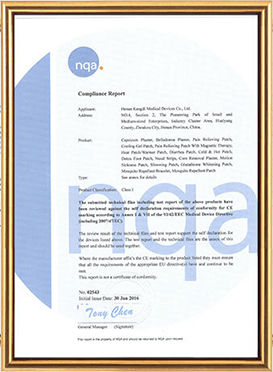
Henan Kongdy Medical Devices Co., LTD. (KONGDY) was founded in 1989 and has 37 years of production experience as of 2026 across pain relief patches, slimming patches, capsicum plasters, heat patches, cooling gel patches, detox foot patches, steam eye masks, mosquito repellent patches and nose strips. Headquartered in Henan, China, KONGDY operates a 100,000-class GMP workshop built in 2008 and obtained ISO 13485 medical device Quality Management System European Standard Certification in 2014. The company runs OEM and ODM services for international brands across multiple regulatory pathways.
For a 2026 procurement evaluation the qualification team can supply the ISO 13485 certificate, GMP workshop audit reports, stability programme documentation, and reference customer case studies upon request via our contact page.
Frequently asked questions
Why organise a checklist by substance family rather than by document?
Because the record shows that the substance is what the finding is about. Chemical risk accounted for 53 percent of all 2025 notifications and cosmetics for 36 percent of alerts, and almost eight in ten of the cosmetics alerts involved a single banned fragrance. A checklist organised by document would check the paperwork and leave the substance question open.
Does this checklist apply to a product sold as a medicine or a device?
No. This one is written for the cosmetic route, which is the route a patch takes when it is sold as a consumer product under the General Product Safety Regulation, Regulation (EU) 2023/988, and the cosmetic provisions of Regulation (EC) No 1223/2009. A product marketed as an external analgesic or as a device sits under different frameworks, and the substance rules that apply to it are different.
How often should the screen be repeated?
On a stated cycle and again after any change to the formula, a supplier, a label or a claim. The reason is specific: TPO was banned in 2025, and the reason the January 2026 cases turned on these substances is that a substance became prohibited while formulas written earlier were still in use.
Is a supplier certificate of analysis enough?
Not on its own, and point seven is written to make that explicit. A certificate is a statement by the supplier about a material. The screen has to be run against the substance families in the annex, and a substance can be restricted without appearing on any certificate the supplier provides.
What if the formula contains a botanical?
Point five covers it, and the January 2026 cases show why. A botanical that is lawful to sell as a substance can be prohibited in a cosmetic formulation, and the delta-9-THC and delta-9-THCA case in Lithuania is exactly that pattern. A plant name is not a clearance.
Does the checklist cover the online listing?
Points nineteen to twenty one do, and they exist because in 2025 the eSurveillance Webcrawler scanned more than 1.6 million websites and found more than 20,800 products already listed in Safety Gate that were still being sold. A listing is a version of the label, and it is the version that is found.
Who should own the screen?
The quality function, on a dated record, and the regulatory function should review the claim boundary that sits alongside it. The reason is not a division of administrative labour. It is that the substance screen and the claim screen answer different questions about the same product, and in the 2026 cases the second one has closed findings that the first one passed.
Is a 21 CFR Part 201.66 format used anywhere in this checklist?
Only as a reference for how a label format is organised, and only in the comparison in this series. Part 201.66 is the United States Drug Facts format for over-the-counter drug products. A cosmetic patch sold into the European Union is labelled under Article 19 of Regulation (EC) No 1223/2009, and describing it against the United States drug label format would be wrong.
Related Guides
Five further references from the KONGDY knowledge base:
- Slimming Patch OEM: reading the EU Safety Gate report as a rhythm
- Detox Foot Patch OEM: the EU Safety Gate enforcement matrix
- Frequently asked compliance questions
- KONGDY OEM and ODM manufacturing services
- Cooling Gel Patch OEM: regulatory categories and stability evidence


