-
 KONGDY
After the Alert Arrives: A 10-Step Timeline for a Slimming Patch OEM Named in the EU Safety Gate in 2026
After the Alert Arrives: A 10-Step Timeline for a Slimming Patch OEM Named in the EU Safety Gate in 2026
In 2025 the EU Safety Gate validated 4,671 alerts on dangerous non-food products and national authorities took 5,794 follow-up actions, and the second number is the one that describes what happens to a manufacturer. The system is running continuously, at close to 100 validated notifications a week, and for cosmetic products the category has been the most closely notified one for three consecutive years.
The alert text is short. What a manufacturer actually has to do with it is not, and the work does not start when the alert arrives. It starts when the formula was written, the file was assembled and the listing went live, because every one of those is a place where the alert could have been prevented.
This is a timeline of the ten steps that follow an alert, in the order they have to happen, for a cosmetic patch programme selling into the European Union. Each step says who owns it, which published text requires it, and what a buyer can ask to see.
One deliberate omission. There are no durations in this timeline, and that is not an oversight. Nothing in Regulation (EU) 2023/988, in Regulation (EC) No 1223/2009 or in the Safety Gate report itself states how long any of these steps takes. A schedule built from invented weeks would be signed by someone and then be wrong in the one place that matters, which is why the order here is given as a dependency order instead.
For a slimming patch OEM the ten steps are not the interesting part in themselves. The interesting part is which of them can be completed before the alert arrives, and the answer is eight of them.
A slimming patch OEM that has finished those eight in advance treats an alert as a verification exercise. One that has not treats it as a project, and the difference between those two is eight documents.
1. Step one: read the alert before touching anything
The first step is a reading step, and it is the one most often skipped because it feels like it produces nothing.
Four things have to be established, and the order they are established in decides everything that follows.
- Which product, which brand and which batch the alert concerns, because everything downstream depends on knowing whether the finding is about your product at all.
- Which member state notified it, because that state took the measure and will take the next one.
- Which measure was taken, since the 2025 report lists withdrawal, stop at the border, listing removal, recall, destruction and an unspecified measure, and each one leads to a different step three.
- Whether the product is a consumer product, a medicine or a device, because medicines and medical devices sit outside Safety Gate altogether.
The second point is the one that surprises people. A Safety Gate alert names a product and a risk. It is published, it is searchable, and the authority that notified it is acting on its own market. A manufacturer may learn of it by reading the weekly report, by receiving a message from a marketplace, or from a customer, and in none of those cases is there a letter sitting in a post box waiting to be opened.
That is why step one is a reading step and not a response step, and why a slimming patch OEM that monitors the weekly panel as a routine finds out on a Friday rather than on a Tuesday.
2. Step two: find the batches, not the product
The second step is a traceability step, and it is where most programmes discover they cannot answer the question.
| What has to be located | The record that answers it |
|---|---|
| Every batch of the affected product still in your control | The lot record from production, carried through packing |
| Every batch already shipped into the European Union | The shipment record and the delivery confirmation for each consignment |
| Every customer who bought it | The order record and the customer service complaint file |
| Every listing the product appears under | The listing inventory across platforms and marketplaces |
The first row is the one that is usually missing, and it is missing for a reason worth naming. A lot record is normally kept because a customer may complain about a patch that does not perform. It is rarely kept because an authority in another country may one day name a batch number, and that second reason is the only one that matters in step two.
A slimming patch OEM that can answer "which batches, which countries, which customers" in one sitting has a programme. A supplier that has to go and look has a filing system, and the difference shows up on the day it matters. The same question applies to the listings, and a slimming patch OEM that cannot list its own live pages has a distribution problem before it has a compliance one.
3. Step three: screen the formula against the annex in force now
The third step is the chemical screen, and it is the step the 2025 data says matters most.
| The 2025 evidence | The figure | What it tells step three to do |
|---|---|---|
| Chemical risk as a share of all notifications | 53 percent, more than half of the entire system | Screen the chemistry first, because that is where the finding is |
| BMHCA in cosmetics alerts | Almost eight in ten cosmetics alerts in 2025 | One fragrance substance accounts for most of the category, and it is a screening question, not a testing question |
| TPO | Banned in 2025, with nail polish alerts notified for the first time that year | A substance that was lawful until a recent date can still be inside a formula written against an older annex |
| The January 2026 weekly cases | Bulgaria withdrew two perfumes for BMHCA and HICC, Czechia destroyed or banned nail polishes for TPO, Slovakia ceased sales of two haircare products for formaldehyde | One product can carry two restricted substances, and a botanical that is lawful to sell can be prohibited in a cosmetic formulation |
The screen runs against Regulation (EC) No 1223/2009, Article 22 and its annex, and it has to be run against the annex version in force today rather than the one that was in force when the formula was written. That distinction is the whole content of the TPO case, and it is why the screen needs a date attached to it rather than a name.
There is also a piece of discipline here that costs nothing. A slimming patch OEM that screens one substance and then records "screened" has screened one substance. The January 2026 cases include a product withdrawn for two substances at once, which is the argument for screening against the annex as a list rather than against the substances that have been in the news. A slimming patch OEM that keeps the annex version and the screening date on one line of a file has answered the only question that step three produces.

4. Step four: work out which of the six measures this is
The fourth step is a decision step, and the 2025 annual report is unusually helpful here because it names the six measures directly.
| Measure | What it commits the company to next |
|---|---|
| Withdrawal from the market | The product leaves that national market, and steps five and six follow |
| Stop at the border | Consignments already in transit do not clear, so held stock has to be located before anything else |
| Removal of the online listing | The page disappears while the goods do not, and it can repeat across every listing |
| Recall | The company has to reach consumers and offer remedies, which pulls in steps five, seven and eight |
| Destruction or prohibition of sale | The goods cannot be sold or returned, which brings step two forward |
| Not specified | Nothing about the scope is public, so step two has to start from the widest assumption |
The last row is the one that changes how step two is done. When the measure is not stated, the only defensible assumption is the widest scope, and a programme that starts from a narrow assumption has to redo step two later.
The row that surprises exporters most is the second one. A border stop lands on consignments that have already been paid for, and it is the only measure that happens before the product is sold, so it is the one that converts a quality problem into a cash flow problem.

5. Step five: identify the responsible person and notify them
The fifth step is the one that most often reveals that a company did not know who it was in Europe, and it exists because of the structure of the rules rather than because of anything the Safety Gate does.
Four documents have to be in place, and each of them has a published source.
- The responsible person in the European Union, under Regulation (EC) No 1223/2009, Article 10, who is the one the authority will contact and the one who has to be able to answer for the file.
- The product information file under Article 11, which is the document that has to be produced at the moment a finding arrives and which only works if it describes the product that was shipped.
- The labelling under Article 19, which is the most visible thing in the alert and the first document anybody outside the company will read.
- The general product safety framework, Regulation (EU) 2023/988, which carries the recall powers and the obligation to offer remedies to consumers, which is what step seven turns on.
The second point is where a lot of programmes discover a gap. The product information file is the document that has to be produced at exactly the moment a finding arrives, and it is only useful if it describes the product as shipped. A file that describes the formula but not the pack, or the pack but not the claim set, cannot answer the question the authority is asking. A slimming patch OEM that discovers this in step five has discovered it cheaply.
The reason step five sits here and not earlier is a dependency rather than a preference. You cannot notify a responsible person about a product without knowing which batches and which markets are affected, and that is step two.

6. Step six: deal with the listings, which are the live part
The sixth step is the one that has changed most, because the enforcement surface moved online, and four developments from 2025 define it.
- The eSurveillance Webcrawler scanned more than 1.6 million websites in 2025 and found more than 20,800 products already listed in Safety Gate still being offered online, so a listing can be found long after the alert and this step is not a one-off cleanup.
- More than 1,200 online marketplaces had registered in the Safety Gate Portal by the end of 2025, so a removal instruction now goes to a party with a single point of contact, which makes it fast to carry out.
- Consumers can report safety issues directly through the Consumer Safety Gateway, so a complaint can open an alert without any inspection and the listing is a possible starting point rather than a consequence.
The 20,800 figure is the one that makes this step larger than it looks. Those are products that had already been notified and were still being offered, which means the volume of listings an authority can act on is not limited to what was found this year.
For a slimming patch OEM the practical form of step six is a listing inventory. Every platform, every language, every seller account, and a check of each one against the approved claim block. A product with a formulation that is sound and a listing that says something the file does not support is a product in the enforcement system and not in the quality system. A slimming patch OEM that reconciles its listings monthly has closed step six as a routine, which is the only way it can be closed at all.
7. Step seven: decide whether a recall is owed, and pay for it
The seventh step is the most expensive one, and it is the step that a company with a consumer remedy obligation cannot avoid by being careful.
Three questions decide it, and each of them has a published answer.
- Does the general product safety regulation require a remedy? It requires businesses to offer remedies to consumers for recalled products, so reading a recall as a withdrawal leaves the obligation unaddressed.
- Is a recall required even without a consumer complaint? The framework gives authorities stronger powers over recalls and the 2025 report records recalls among the measures taken, so waiting for a complaint treats the absence of complaints as evidence about product safety.
- What do the recent cases show about frequency? In the January 2026 weekly cases Slovakia withdrew and recalled several wash and care products for BMHCA while other cases in the same week recorded withdrawal without recall, so the measure is not the same in every case.
That second point is the trap that costs the most. A company that has heard no complaints has evidence about complaints and not about product safety, and the difference between those two statements is the difference between a programme and an accident.
What a slimming patch OEM can do about step seven is not to decide it cheaply but to decide it early. The remedy obligation attaches to the recall decision, so the work that decides whether a recall is owed has to happen while the file is still current, not after the authority has already instructed one. For a slimming patch OEM the cheapest preparation is a written recall procedure, because the decision itself is the part that takes the longest.
8. Step eight: test the stock, and test it against the right samples
The eighth step is the laboratory step, and it is the step where a great deal of guesswork happens.
| The issue | What the record shows |
|---|---|
| Which batches to test | In the United States case MARCS-CMS 724506 the company was asked for an action plan and timelines for testing retain samples of all batches within expiry as of the date of the letter, so the population is defined by the date of the finding |
| What to test | The same letter required chemical and microbial specifications with the test methods used for each batch before a batch disposition decision, because a test without a specification behind it produces a number that cannot be compared with anything |
| How the method is written | The same letter rejected reports that referenced modified pharmacopeial methods without describing the modifications, and asked for justification with validation data, because a modified method has to be explained and validated rather than quoted |
This is the clearest available statement of how a retention sample programme behaves when it is tested against a real enforcement question, and it comes from a United States letter rather than a European one. A European cosmetic patch programme has no equivalent statutory requirement for retrospective retain sample testing, and the three rows above are offered as a discipline that works rather than as a European obligation.
That distinction matters. A slimming patch OEM that describes retain sample testing to a European buyer as a legal requirement would be wrong, and a supplier that has a dated programme anyway is stronger than one that has neither. A slimming patch OEM that describes it honestly as a commercial strength is in a stronger position than one that overstates it.
9. Step nine: correct the file and close the cause
The ninth step is the corrective step, and it is the one that determines whether the same thing happens again.
| What has to be corrected | Which document it lands in | The evidence that it was done |
|---|---|---|
| The substance screen against the annex in force | The product information file under Article 11 of Regulation (EC) No 1223/2009 | A dated screening record naming the annex version it was run against |
| The claim set, including the listing copy | The labelling file under Article 19, and the approved claim block | A record that each live listing has been checked against that block |
| The change that caused the finding | The change log and the corrective action record | An entry naming the change, the date it was made, and the review that authorised it |
| The supply chain that supplied the material | The supplier qualification record | Evidence that the supplier of the substance was verified rather than relied on |
The third row is the one that separates a correction from a patch. Closing the finding means removing the cause, and the cause is usually a change that was made without being screened, a supplier that was trusted rather than verified, or a claim that was written without a record.
That is also why step nine is where a buyer gets its answer. A supplier who can show a dated corrective action record naming a change and a review has demonstrated something a supplier who has written a letter about a corrective action has not.
For a slimming patch OEM the corrective action record is also the document that makes the next batch defensible, because it is the only record that links the change to the review and the review to the product.

10. Step ten: sell again, and stay watchable
The tenth step is the one that decides whether the effort was worth it, and it is not a single event.
| What has to be true before selling again | How a buyer checks it |
|---|---|
| The cause is closed and the file reflects the correction | The corrective action record, dated, with the change log entry |
| The responsible person can answer for the product | The Article 10 record and a current product information file |
| Every live listing has been checked | A listing inventory reconciled against the approved claim block |
| The programme stays watchable | A routine that reads the weekly panel and checks the listing inventory |
The last row is the one that most programmes get wrong, because the reason for it is that the alert stops being visible. An alert that has been dealt with does not send a second notification, and a company that treats silence as closure assumes the listing has stopped being found. The crawler found more than 20,800 products that had already been notified and were still being offered in 2025, which is a measure of how long that silence can last.
A slimming patch OEM that treats step ten as a routine rather than an event has a programme, and one that treats it as the closing of a case has run a project. The weekly reading routine behind it is one person and one hour, the cheapest insurance in the whole timeline.
11. What this timeline is for
A timeline is worth writing when the sequence is fixed by dependency and the steps can be checked from outside, and both of those are true here. What it settles is the order of the ten steps, which document answers which question at each step, and which steps can be completed before an alert arrives. What it does not settle is how long anything takes, because no published text states a duration, or whether a particular product will be named.
The third point of the first paragraph is the one a reader should take away. Eight of the ten steps can be finished before an alert arrives, because they consist of work on documents and records that nobody asks for until they are needed. The two that cannot are the first step and the last one, and both of those are about watching rather than producing. That is the argument for treating step ten as a routine rather than a case. A slimming patch OEM that has a current file, a dated substance screen, a listing inventory and a weekly reading routine is a company for which an alert is a bad morning rather than a bad year. For a slimming patch OEM that is the whole promise of writing the ten steps down.
About KONGDY Medical

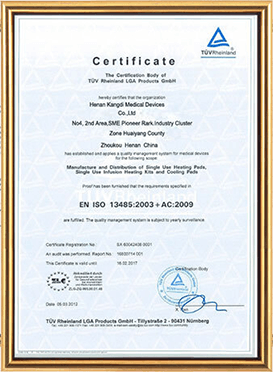
Henan Kongdy Medical Devices Co., LTD. (KONGDY) was founded in 1989 and has 37 years of production experience as of 2026 across pain relief patches, slimming patches, capsicum plasters, heat patches, cooling gel patches, detox foot patches, steam eye masks, mosquito repellent patches and nose strips. Headquartered in Henan, China, KONGDY operates a 100,000-class GMP workshop built in 2008 and obtained ISO 13485 medical device Quality Management System European Standard Certification in 2014. The company runs OEM and ODM services for international brands across multiple regulatory pathways.
For a 2026 procurement evaluation the qualification team can supply the ISO 13485 certificate, GMP workshop audit reports, stability programme documentation, and reference customer case studies upon request via our contact page.
Frequently asked questions
How long does this process take?
This timeline does not say, and that is deliberate. Regulation (EU) 2023/988, Regulation (EC) No 1223/2009 and the Safety Gate 2025 report do not state a duration for any of these steps. What is fixed is the order, because the order follows from dependencies: you cannot notify a responsible person before you know which batches are affected, and you cannot screen a formula before you have established which version of the annex applies.
Will the authority contact us?
Do not plan on it. An alert names a product and a risk, and it is published and searchable. The authority that notified it acts on its own market, and the manufacturer may learn about it from the weekly report, from a marketplace, or from a customer. In several of the 2026 weekly cases the action taken was a withdrawal or a removal of a listing, and neither of those depends on the manufacturer having been told.
Are retain sample tests required in Europe?
Not under the European cosmetic framework. The requirement for retrospective retain sample testing, with an action plan and timelines for batches within expiry, appears in United States warning letter MARCS-CMS 724506 under 21 CFR 211.165(a) and (b). For a cosmetic patch sold into the European Union, running the same discipline is a commercial strength rather than a legal obligation, and it should be described that way to a buyer.
Does a recall have to wait for a consumer complaint?
No. The General Product Safety Regulation requires businesses to offer remedies to consumers for recalled products, and the 2025 report records recalls among the measures authorities took. The absence of complaints is evidence about complaints and not about product safety.
What should we do first if we are named?
Read the alert and establish whether it concerns your product, then locate the batches and the listings, and only then decide anything. The most common expensive error is changing the copy before establishing the scope, because it destroys the evidence of what was sold.
What does a buyer ask for at each step?
One record per step rather than a description of one. The alert, the lot and shipment records, the dated substance screen, the measure determination, the Article 10 record, the listing inventory, the recall decision, the test plan with its specifications, the corrective action record, and the weekly reading log. Eleven records make a programme; eleven descriptions make a brochure.
How do we keep this from being a project rather than a routine?
By doing the eight steps that do not depend on an alert in advance, and by treating the weekly reading and the listing check as standing activities. The 20,800 products the eSurveillance Webcrawler found still being offered in 2025 are products whose companies had every reason to believe the matter was closed.
Is a slimming patch covered by the Safety Gate?
A cosmetic patch sold into the European Union is a consumer product under the General Product Safety Regulation. Medicines and medical devices sit outside Safety Gate, so the regulatory route a product takes determines which system it can appear in at all.
Related Guides
Five further references from the KONGDY knowledge base:
- Detox Foot Patch OEM: the EU Safety Gate enforcement matrix
- Capsicum Plaster OEM: pre-contract checklist
- Frequently asked compliance questions
- KONGDY OEM and ODM manufacturing services
- Cooling Gel Patch OEM: regulatory categories and stability evidence


