-
 KONGDY
Why Warning Letters Appear in Batches: Reading the Publication Lag for a Mosquito Repellent Patch OEM in 2026
Why Warning Letters Appear in Batches: Reading the Publication Lag for a Mosquito Repellent Patch OEM in 2026

Warning letters have two dates on them. One is the date the agency signed the letter, and the other is the date the letter appeared on the public list, and the two are rarely the same.
This library has measured that gap on a sample of 100 consecutive entries published between 29 September and 10 November 2026. The median gap was 14 days, 70 percent of the entries appeared within 8 days, and the longest gap was 239 days.
The median is the number everybody quotes and it is the least useful of the three. The interesting structure is in the other two figures, and the structure explains something about how letters are released that a buyer can use.
For a mosquito repellent patch OEM the payoff is a rule for reading the public list: how to tell one enforcement action from several, and why that matters before the letters arrive rather than after.
1. The dataset, and what it can carry
One hundred consecutive entries, measured, with the boundary stated.
| The measure | The value | The boundary |
|---|---|---|
| The sample | 100 consecutive entries | Published between 2026-09-29 and 2026-11-10, not a full year and not a random sample |
| The median gap | 14 days | Between the date on the letter and the date of publication |
| The concentration | 70 percent within 8 days | A tight cluster close to the start of the distribution |
| The longest gap | 239 days | The tail exists and it is long |
| The office split | CDER 50 percent, CDRH 7 percent | Within this sample only |
| The range of the dates on the letters | 2026-02-02 to 2026-11-03 | Nine months of signing dates inside a 43 day publication window |
The last row is the one that carries the second reading, and almost nobody looks at it, because it is recorded as a footnote in the sample description rather than as a headline.
A mosquito repellent patch OEM that only takes the median from this dataset will conclude that letters appear about two weeks after they are signed, and that conclusion is true and useless.
2. The first reading: fourteen days, and why it is the least useful number
The median describes the middle letter and nothing about the rest of them.
A median of 14 days sounds like a system with a fourteen day process. It is not, and the two other numbers in the same sample are what show that.
| The number | What it describes | What it does not describe |
|---|---|---|
| Median 14 days | The middle entry in the sample | How long any particular letter took, and how consistent the process is |
| 70 percent within 8 days | The shape of the bulk of the sample | The 30 percent that did not, which includes the longest gap |
| Longest gap 239 days | The extreme end of the sample | How often the extreme occurs, because a sample of 100 cannot say |
The second row is the one that matters. Seventy percent inside eight days is a spiky distribution rather than a spread one, and a spiky distribution is a process that runs in batches.
A mosquito repellent patch OEM that reads the median as a promise will be surprised by the tail, and a mosquito repellent patch OEM that reads the concentration correctly understands that letters are released in groups.

3. The second reading: the ninety day hole
The dates on the letters in the sample run nine months, and the publication dates run 43 days, and the gap between those two facts is the finding.
Letters signed in February 2026 and letters signed in November 2026 appeared on the same public list within the same 43 day window. Whatever is happening here, it is not a queue that empties at a steady rate.
| What the shape implies | What it means for the letters | What it means for a buyer |
|---|---|---|
| The signing dates are spread over nine months | Letters are produced continuously, one decision at a time | A letter that exists is not necessarily on the list yet |
| The publication dates are confined to 43 days | The list is refreshed in batches rather than continuously | A cluster on the list is one release event, not a coincidence |
| Both are true at once | Production is steady and release is batched | The delay is a publication schedule, not an agency backlog |
The third row of the first column is the mechanism, and it is worth stating plainly: the gap between signing and publication is a release schedule, not a backlog.
This library has a direct example of what a release event looks like. On 1 October 2026 three letters were issued on the same day by the same office and the same signer, about overlapping products, to a manufacturer and to two platforms.
A mosquito repellent patch OEM that watches the public list will see those three letters arrive together, and a mosquito repellent patch OEM that understands why will not read them as three separate problems.
4. The rule: one date, several letters, one action
A self-check rule, and it is the single most useful thing in this dataset.
| What you see on the list | What it means | What to do next |
|---|---|---|
| One letter | One action, or an action whose other letters are not yet public | Wait a further 30 days before treating it as finished |
| Several letters with the same date on them | One enforcement action applied along a product chain | Read them as one problem and find the product they share |
| Several letters, different dates, the same product | Separate actions on the same product, which is a repeat pattern | Treat the second one as evidence about the first |
The second row is the rule and the middle column is why it holds. When the same day appears on several letters, those letters are the same decision applied to several parties, and the product they share is the handle.
The example in this library is exact. On 1 October 2026 the agency issued three letters, and the products overlapped: Herstat GST appeared in the manufacturer letter and in both platform letters, and Terragen HG Formula appeared in the manufacturer letter and in both platform letters.
A mosquito repellent patch OEM that saw only one of the three letters would think it had one problem, and a mosquito repellent patch OEM that saw all three knows that the product is the subject and that the chain has three links.

5. What a batch of letters costs the party that was not named
The transmission happens after the letters, not before them, and it is faster than the letters.
A platform that receives a letter of this kind has an obligation to respond within fifteen working days, and the cheapest way for it to respond is to ask every seller of a similar product for evidence about theirs.
| The step | What happens | Who feels it |
|---|---|---|
| The platform receives the letter | It has a response obligation of its own, separate from the manufacturer | The platform |
| The platform asks its own sellers | Labelling, test summaries and supplier information are requested from every seller of a similar product | Every seller of a similar product, within days |
| Sellers respond, or cannot | Some produce the file, some do not have it, and some did not know the product was listed | The seller who did not know |
| The platform acts on what it holds | It requires evidence or removes the listing, on a commercial timetable | The seller whose file is incomplete |
The third row of the second column is the point. The spread runs from the named party to every seller of a similar product, and the spread happens in days rather than in the fourteen day median or the 239 day tail.
For a mosquito repellent patch OEM the consequence is that a clean search result on the public list on any given day says very little, because a letter can be signed and not yet published, and a platform can be acting on a letter that the list has not shown yet.

6. The forty-three percent that nobody has looked at
The office split in the sample leaves a gap, and the gap is bigger than either named share.
| The office | Share of the sample | What it tells a reader |
|---|---|---|
| CDER, the drug center | 50 percent | Half of the letters in this sample concern drugs, and this is where the patch and gel cases sit |
| CDRH, the devices and radiological health center | 7 percent | A small share, and a reminder that device rules are a separate regime |
| Everything else | 43 percent | The largest single block after the drug center, and it is not broken down in this library |
The third row is the one to be honest about. Forty-three percent of the sample is not attributed, and this library has not broken it down.
That matters more than it sounds, because the unlabelled block is the part of the record a reader is least equipped to interpret. A letter from a centre that does not regulate drugs is not about a monograph, and reading it as though it were would be a mistake.
A mosquito repellent patch OEM that reads the public list should check the office before reading the finding, and this library cannot yet tell it what the unlabelled forty-three percent contains.

7. What the timing does not tell you
Four limits, stated because the numbers invite over-reading.
| The dataset does not support | Why |
|---|---|
| Any statement about a full year | The sample covers 43 days of publication, not a year |
| Any probability attached to the 239 day case | One maximum in a sample of 100 cannot say how often the maximum occurs |
| Any conclusion that letters are delayed by the agency | The shape is consistent with a publication schedule, and this library cannot see the schedule itself |
| Any inference about the unreviewed part of the record | The cases in this library are the ones that were collected, and a clause or an office that was not collected cannot appear in a count |
The fourth row is the one that applies to every frequency claim in this library, including the clause ranking published alongside this article.
A mosquito repellent patch OEM that treats a sample of 100 as a census will draw conclusions the data cannot carry, and a mosquito repellent patch OEM that treats it as a screening signal will use it correctly.

8. Three actions this dataset supports
Three, and none of them needs a subscription to anything.
| The action | How to do it | What it produces |
|---|---|---|
| Group the letters by the date on them | Read the date on each letter, not the date it appeared, and put the same dates together | One action instead of several, and the product they share |
| Search back far enough | Search a window of at least 240 days, because the longest measured gap was 239 days | Letters that a thirty day search would have missed |
| Filter by office first | Check the issuing office before reading the finding, because the drug centre and the device centre are separate regimes | A finding read in the right framework instead of the wrong one |
The second row of the third column is the one that catches people. A search that covers thirty days will miss a letter that is still inside the longest measured delay, and a letter that is missed is a letter that is not acted on.
For a mosquito repellent patch OEM the practical routine is a monthly search over a two hundred and forty day window, and a mosquito repellent patch OEM that runs it will see the same letters as their dates rather than as their arrival dates.

9. The three datasets put together, as one timeline
The publication lag is the last piece of a timeline this library can now draw from end to end, and the three parts are measured separately.
| The route | From | To the letter | Then to the public list |
|---|---|---|---|
| Site inspection | The end of the inspection | A median of 175 days, with the seven cases running from 139 to 197 days | A median of 14 days more |
| Label, website or storefront review | The review itself, which needs no appointment and no company cooperation | About two and a half to three months in the three cases that were measured together | A median of 14 days more |
| Records and information request | The request, under section 704(a)(4) | About eleven months in the one case that was measured | A median of 14 days more |
| Platform letter | The purchase, at retail price, by the agency | About two and a half to three months to the letter, then 15 working days for the response | A median of 14 days more |
The third column is the part of the timeline that is measured from the case files, and the fourth column is the part that is measured from the publication sample.
The fourth row is the one that surprises a buyer, because the fastest route to a public letter runs through a purchase and the fastest route to a response runs through a platform obligation rather than through the manufacturer.
For a mosquito repellent patch OEM the timeline says that the earliest a letter can become visible is roughly three and a half months after somebody buys the product, and a mosquito repellent patch OEM that wants to be ahead of it has to be ahead of it on the label rather than on the timetable.
10. What the timeline says about a distributor relationship
A third party in the chain changes the clock, and it changes who is counting it.
The agency found the products in this case by buying them from a platform, and the platform then had fifteen working days to respond, and it is the platform rather than the manufacturer that the buyer experiences first.
| The party | What they can trigger | How fast |
|---|---|---|
| A platform listing | A request for labelling, test summaries and supplier information from every seller of a similar product | Days, and it reaches further along the chain than any agency timetable |
| A distributor who also lists the product | The same request, coming from a commercial party rather than a regulator | Days, and it arrives before any deadline in any letter |
| The manufacturer | The response to the agency itself, within fifteen working days | Fifteen working days, once the letter has been received |
| A buyer who checks the public list | Nothing, but it does tell the buyer how many letters share a date | A median of 14 days after the letter, with a tail to 239 days |
The first two rows are the ones a supplier is usually not watching, and they are the fastest.
For a mosquito repellent patch OEM the practical answer is to keep one file that a distributor can be answered from in a day, because a mosquito repellent patch OEM that has to assemble that file on request has already lost the week it was supposed to be given.
About KONGDY Medical

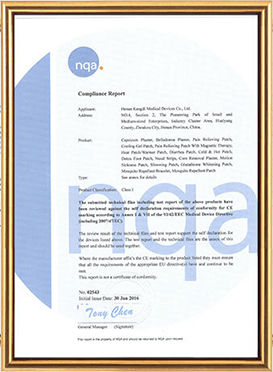
Henan Kongdy Medical Devices Co., LTD. (KONGDY) was founded in 1989 and has 37 years of production experience as of 2026 across pain relief patches, slimming patches, capsicum plasters, heat patches, cooling gel patches, detox foot patches, steam eye masks, mosquito repellent patches and nose strips. Headquartered in Henan, China, KONGDY operates a 100,000-class GMP workshop built in 2008 and obtained ISO 13485 medical device Quality Management System European Standard Certification in 2014. The company runs OEM and ODM services for international brands across multiple regulatory pathways.
For a 2026 procurement evaluation the qualification team can supply the ISO 13485 certificate, GMP workshop audit reports, stability programme documentation, and reference customer case studies upon request via our contact page.
Frequently asked questions
What is the publication lag in the measured sample?
A median of 14 days between the date on the letter and the date of publication, with 70 percent of the 100 consecutive entries published within 8 days and the longest gap at 239 days. The sample covers entries published between 2026-09-29 and 2026-11-10.
Why is the median the least useful of the three numbers?
Because the distribution is spiky rather than spread. Seventy percent inside eight days is a batch release pattern, and a median taken from a spiky distribution describes the middle of the spike rather than the process.
What does it mean that the letters in the sample span nine months of signing dates?
That the letters are produced continuously and published in batches. The signing dates inside the sample run from 2026-02-02 to 2026-11-03 while the publication window covers only 43 days, so the gap is a release schedule rather than an agency backlog.
How can I tell one enforcement action from several?
By the dates. Several letters carrying the same date on them are one action applied along a product chain, and the product they share is the handle. On 2026-10-01 three letters were issued by the same office and the same signer about overlapping products, to a manufacturer and to two platforms.
What happens to sellers who are not named in those letters?
A platform that has received a letter has a response obligation of its own and will typically ask every seller of a similar product for labelling, test summaries and supplier information, which reaches far beyond the named party and does so in days rather than in the fourteen day median.
What is the 43 percent of the sample that this library has not broken down?
CDER accounts for 50 percent and CDRH for 7 percent, so 43 percent is attributed to other offices that this library has not analysed. It is the second largest block in the sample and it should not be read as though it concerned drug rules.
Does a clean search result mean there is no letter?
No, and there are two reasons. A letter can be signed and not yet published, and the median gap is 14 days with a tail that reaches 239 days. And a platform can already be acting on a letter that the public list has not shown.
How should I use this dataset?
As a screening signal and as a reading rule. Use the 14 day median and the 8 day concentration to know that a public list is refreshed in batches rather than continuously, use the same-date rule to group letters into actions, and do not attach a probability to any of it, because a sample of 100 from a 43 day window cannot carry one.
Related Guides
Five further references from the KONGDY knowledge base:
- Mosquito Repellent Patch OEM services and manufacturing
- Cooling Gel Patch OEM: which clauses actually appear in warning letters
- Pain Relief Patch OEM: what an FDA site inspection looks like
- Frequently asked compliance questions
- KONGDY OEM and ODM manufacturing services


