
-
 KONGDY
The Letter That Named Glycerin: What FDA Warning Letter 704166 Shows a Detox Foot Patch OEM in 2026
The Letter That Named Glycerin: What FDA Warning Letter 704166 Shows a Detox Foot Patch OEM in 2026
On 29 May 2025 the Center for Drug Evaluation and Research issued warning letter MARCS-CMS 704166 to Amish Origins Management, LLC, of Worland. The firm had been inspected from 7 to 10 January 2025 and had answered the Form FDA 483 on 1 February 2025.
The letter is remembered in this library for one paragraph, and that paragraph is about glycerin.
It records that the firm failed to test each shipment of each lot of glycerin for identity, that glycerin is a component at higher risk for diethylene glycol and ethylene glycol contamination, that identity testing for glycerin and certain other high-risk components includes a limit test in the United States Pharmacopeia to ensure the component meets the relevant safety limits for those levels, and that the use of ingredients contaminated with the two has resulted in various lethal poisoning incidents in humans worldwide.
For a detox foot patch OEM this is the most directly actionable letter in the whole library, because a gel matrix commonly holds glycerin or propylene glycol and the requirement in this letter is written in terms a manufacturer can act on: every shipment, every lot, three named parts of the monograph, and a thirty calendar day clock.
1. The facts, exactly as the letter states them
The identification facts come first, and two of them matter more than the others for the argument this article makes.
| Item | What the letter states |
|---|---|
| Letter | MARCS-CMS 704166, dated 29 May 2025 |
| Firm | Amish Origins Management, LLC |
| Facility identifier | FEI 3013538760 |
| Address | 1214 South Flat Road, Worland |
| Recipient | Mr. Hansen |
| Inspection | 7 to 10 January 2025, four days |
| Form FDA 483 response | 1 February 2025, 22 days after the inspection ended |
| Products | Four DEEP PENETRATING pain relief lines, and AMISH ORIGINS AUTHENTIC LIP DOC SPF 15 MEDICATED |
| CGMP findings | 21 CFR 211.165(a) and (b); 211.84(d)(1) and (d)(2); 211.188 |
The sixth row is worth a second look. Twenty-two days from the end of the inspection to the response is the fastest interval in this library, and it did not help: the letter found the response inadequate on four separate grounds.
That is the first lesson of the case, and it is the one that is easiest to get wrong. Speed of response is not quality of response, and a firm that answers quickly without the documentation underneath has not bought anything.
2. Finding one: the release test that was never done
The first finding is 21 CFR 211.165(a) and (b), and the letter states the failure in the plainest terms available.
The firm failed to have, for each batch of drug product, appropriate laboratory determination of satisfactory conformance to final specifications including the identity and strength of each active ingredient prior to release. The letter then names what was not tested.
| The attribute named in the letter | What its absence means |
|---|---|
| Identity | The batch has not been shown to contain what it is supposed to contain |
| Assay | The amount of active in the batch is unknown |
| Impurities | The degradation profile of the batch is unknown |
| Microbiological attributes | Where the product requires it, the microbial status is unknown |
The third row is the one most programmes think about last, because a release test is usually imagined as an assay. The letter lists four, and the fourth is conditional while the first three are not.
The response is quoted as inadequate for a specific reason, and the reason is a model answer for every supplier in the world: the firm stated that it was now performing release testing, but failed to adequately detail the tests, methods and specifications. A commitment is not a specification, and the letter says so in those words.
A detox foot patch OEM that has told a customer it performs release testing should be able to produce the tests, the methods and the specifications in the same conversation, and that is the standard the letter sets.
3. Finding two: the substance, and why it is the important one
The second finding is 21 CFR 211.84(d)(1) and (d)(2), and it contains the paragraph that makes this letter worth reading in full.
The firm failed to perform adequate identity testing of each component lot used in the manufacture of its over-the-counter drug products, including for its active ingredient menthol and glycerin, and relied on suppliers certificates of analysis without establishing the reliability of those analyses at appropriate intervals.
| The element in the letter | What it says | Why it matters |
|---|---|---|
| Glycerin as a component at higher risk | It is named as a component whose contamination risk is higher than others | A component can be entirely ordinary and still carry a specific hazard |
| Every shipment of every lot | Not every lot, and not every year | A lot can be split, and one passing shipment establishes nothing about another |
| The USP identification test that detects these hazardous impurities | A named method exists and it is the one the letter expects | The screen is specified rather than improvised |
| The lethal poisoning record | The agency cites incidents worldwide in the letter itself | This is not a theoretical contaminant |
| The agency guidance at fda.gov/media/167974 | A published document covering glycerin, propylene glycol, maltitol solution, hydrogenated starch hydrolysate, sorbitol solution and other high-risk components | The list is longer than two substances and a firm needs to know it |
The second row is the operational one and the third row is the technical one, and together they define what a compliant screen for this component looks like.
For a detox foot patch OEM the four-letter finding is a finding about the identity of the materials, but the substance it names is the one that can kill, and that is why the letter gives it a paragraph of its own.

4. What the letter asks for, and the thirty day clock
The requirements in this letter are unusually specific, and the specificity is what makes them usable.
| What is required | The period or the condition |
|---|---|
| DEG and EG test results from testing retains for all lots of high-risk drug components used | No later than 30 calendar days from the date of the letter |
| If a component retain is unavailable | Retain sample testing of all implicated finished drug product lots for DEG and EG |
| A full risk assessment for products within expiry containing any ingredient at risk for DEG or EG contamination, including propylene glycol | In the response, with prompt and appropriate actions |
| Determining the safety of all lots of the component and any related drug product | Including customer notifications and product recalls for any contaminated lots |
| Additional corrective and preventive actions securing the supply chain | Ensuring all incoming raw material lots come from fully qualified manufacturers and are free from unsafe impurities |
| For glycerin, propylene glycol and certain additional high-risk components | The performance of parts A, B and C of the USP monograph |
| Where a supplier certificate is relied on instead of testing | Robust establishment of reliability through initial validation and periodic revalidation, plus at least one specific identity test for each incoming component lot |
The first row is a deadline and it runs from the date of the letter, and the last row is the alternative to testing every lot, which is conditional on a reliability programme that the firm in this case did not have.
The sixth row is the one that a supplier reads twice. It says three parts, not the monograph, which means a screen that runs one of the three is not a screen that failed but a screen that was never complete.

5. Finding three: the batch records
The third finding is 21 CFR 211.188, on batch production and control records, and it is the least specific of the three but it completes a pattern.
The three findings together describe a single system rather than three unrelated problems, and the sequence is the same one that appears throughout the letters in this library.
| The finding | The system layer it belongs to | What was missing |
|---|---|---|
| 211.165(a) and (b) | The decision to release a batch | No determination against final specifications |
| 211.84(d)(1) and (d)(2) | The decision to accept a material | No identity test on the component lot, and no verification of the supplier |
| 211.188 | The record of what was done | Incomplete batch production and control records |
The third row is the layer that connects the other two. A firm that does not test and does not qualify a supplier is not having three bad weeks, it has a records problem that sits underneath both.
The sixth row is the one to look for first when reviewing a supplier, because it is the cheapest to check and it predicts the other two. A detox foot patch OEM that produces complete batch records for two lots is telling a buyer something about the other two findings before either has been asked about.
6. The label finding, and a category that is not the unapproved new drug finding
Five products are named, and four of them were found to be unapproved new drugs. The fifth is the interesting one.
| Product | The findings cited against it |
|---|---|
| DEEP PENETRATING Pain Relief Spray | Unapproved new drug under 21 U.S.C. 355(a); misbranded under 352(ee) |
| DEEP PENETRATING Pain Relief Ointment | Unapproved new drug under 355(a); misbranded under 352(ee) |
| DEEP PENETRATING Greaseless Pain Relief Cream | Unapproved new drug under 355(a); misbranded under 352(ee) |
| DEEP PENETRATING Pain Relief Aloe | Unapproved new drug under 355(a); misbranded under 352(ee) |
| AMISH ORIGINS AUTHENTIC LIP DOC SPF 15 MEDICATED | Misbranded under 352(f)(2) and further misbranded under 352(ee) |
The fifth row is a product that was not found to be an unapproved new drug and was found to be misbranded under a provision this library has not recorded before. A medicated SPF 15 lip balm sits in the over-the-counter sunscreen monograph rather than in the general cosmetic route, and its labelling obligations differ from those of an ordinary cosmetic lip balm.
The point for a manufacturer is not the lip balm. It is that a product can be a legitimate over-the-counter drug, sold lawfully, and still be misbranded for carrying the wrong labelling. A detox foot patch OEM that offers a sunscreen or an antimicrobial variant of a gel patch is in a labelling framework that differs from the cosmetic one, and the difference is invisible until somebody checks it.

7. What this letter does to the interval figures in this library
One consequence reaches beyond this article, and it has to be stated plainly because it corrects figures already published.
Two articles in this library set out the interval between the event that starts an enforcement process and the letter that ends it, across the letters then held. This letter adds a sixth site inspection case, and the inspection group changes.
| The figure | As published on 16 November | With this letter included |
|---|---|---|
| Number of inspection cases | 5 | 6 |
| Shortest interval | 163 days | **139 days** |
| Median interval | 189 days | **182 days** |
| Longest interval | 197 days | 197 days |
| Spread | 34 days | **58 days** |
The first row of the third column is the one that changes the argument, and the direction of the argument survives. The published claim was that the inspection route is far more predictable than the review route, and at 58 days against 119 the claim holds with roughly half the margin it had.
The second row is a fair correction rather than a reversal. A detox foot patch OEM that has read the earlier figures should treat the published numbers as superseded, and a supplier that has been quoting the 34 day spread should quote 58 days instead.
What did not change is the more useful conclusion, which is about the route rather than the number. A firm with a dated inspection horizon is planning against a calendar, and a firm facing a review or a records request is not. The case that produced this correction is itself an argument for the second route, because it is the one that required no visit and produced the shortest interval in the group.

8. Six questions a buyer can ask
Each question corresponds to a finding, and each one is answerable from a document.
- Show me the release specification and one recent batch report for the product, with the method named. Four attributes are expected: identity, assay, impurities and microbiological where applicable.
- Show me the incoming test record for the most recent shipment of every lot of glycerin and propylene glycol. Every shipment, not every year.
- Show me parts A, B and C of the USP monograph for those components. Three named parts, and a gap in any one of them is a gap.
- Show me the component retain store record. Whether a component lot can be located for every lot used in the last two years.
- Show me the supplier qualification file, including the initial validation and the periodic revalidation. A supplier list is not a qualification programme.
- Show me the completed risk assessment, if one has been done. The letter asked for a full risk assessment across product within expiry, and a template that has never been filled in is not one.
The second and third questions are the ones that separate this letter from the others in the library, because they concern a material that arrives without anyone choosing it.
A detox foot patch OEM that can answer all six from the folder has a position on the substance that most firms in its category do not have a position on at all, and the thirty calendar day period in the letter shows how quickly the absence of one becomes visible. A detox foot patch OEM that has no position on it is not in breach of anything yet, and that is precisely the point. The detox foot patch OEM that would be in breach is the one that discovers the absence after a shipment has already been used.
The fourth row of the third column is a finding that is easy to overlook and hard to recover from. A batch record that is incomplete cannot be completed after the event, and the letter requires the correction to be made in the record rather than in a separate document.
A detox foot patch OEM that treats its batch records as a set of documents to be assembled at the end of a batch rather than as a record made during it has built the third finding into its own process, and a detox foot patch OEM that completes them as it goes has removed it. A detox foot patch OEM should check which of the two it is before it answers the first two findings, because the answer to the first two depends on it.
The third row is the one that makes the requirement in this letter different from a general quality expectation. The limit test for DEG and EG is not a test a laboratory invents; it is a named part of a monograph, and a firm that runs the right test in the wrong way still has a gap.
A detox foot patch OEM that has identified which of the three parts it runs for each high-risk component has already done the hard part of the analysis, and a detox foot patch OEM that has not should treat that as the first piece of work rather than as a detail inside a larger programme. A detox foot patch OEM that names the parts in its specification can answer the question in a sentence, and a detox foot patch OEM that cannot will have to run the whole exercise before it can say anything at all.
A detox foot patch OEM that has done this has a position, and a detox foot patch OEM that has not has a question that the next shipment will answer.

About KONGDY Medical

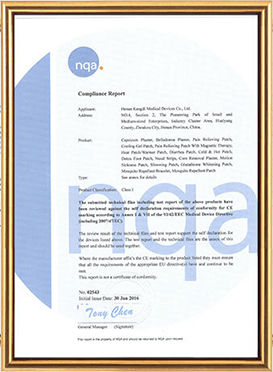
Henan Kongdy Medical Devices Co., LTD. (KONGDY) was founded in 1989 and has 37 years of production experience as of 2026 across pain relief patches, slimming patches, capsicum plasters, heat patches, cooling gel patches, detox foot patches, steam eye masks, mosquito repellent patches and nose strips. Headquartered in Henan, China, KONGDY operates a 100,000-class GMP workshop built in 2008 and obtained ISO 13485 medical device Quality Management System European Standard Certification in 2014. The company runs OEM and ODM services for international brands across multiple regulatory pathways.
For a 2026 procurement evaluation the qualification team can supply the ISO 13485 certificate, GMP workshop audit reports, stability programme documentation, and reference customer case studies upon request via our contact page.
Frequently asked questions
What is warning letter MARCS-CMS 704166?
A warning letter dated 29 May 2025 from the Center for Drug Evaluation and Research to Amish Origins Management, LLC, facility identifier FEI 3013538760 at 1214 South Flat Road, Worland, following an inspection from 7 to 10 January 2025 and a Form FDA 483 response dated 1 February 2025. It contains three CGMP findings and names five products.
What did the letter say about glycerin?
That the firm failed to test each shipment of each lot of glycerin for identity, that glycerin is a component at higher risk for diethylene glycol and ethylene glycol contamination, that identity testing for glycerin and certain other high-risk components includes a limit test in the United States Pharmacopeia, and that the use of ingredients contaminated with DEG or EG has resulted in various lethal poisoning incidents in humans worldwide.
Which ingredients are covered by the agency guidance?
Glycerin, propylene glycol, maltitol solution, hydrogenated starch hydrolysate, sorbitol solution and other high-risk drug components, in the guidance Testing of Glycerin, Propylene Glycol, Maltitol Solution, Hydrogenated Starch Hydrolysate, Sorbitol Solution, and Other High-Risk Drug Components for Diethylene Glycol and Ethylene Glycol, published at fda.gov/media/167974.
How much time did the firm have?
Thirty calendar days from the date of the letter for DEG and EG test results from component retains, or retain sample testing of all implicated finished product lots where a component retain is unavailable. The risk assessment across product within expiry was a deliverable in the response, not a process.
Why was the response inadequate if it was only 22 days?
Because the letter found the response failed to detail the tests, methods and specifications for release testing, failed to give a detailed plan for how components would be tested including methods and a review of compendial requirements, gave no timeline for the corrective actions, and did not consider a retrospective review of previously distributed products or detail how suppliers would be qualified.
What is new in the misbranding analysis?
One product, a medicated SPF 15 lip balm, was found misbranded under 21 U.S.C. 352(f)(2) and further misbranded under 352(ee), and was not cited as an unapproved new drug. That is a separate category from the four pain relief lines, and it concerns a product in the over-the-counter sunscreen monograph rather than in the general cosmetic route.
What is the practical difference between this letter and the others in the library?
Every other letter in this library concerns something a firm chose: a claim it wrote, a record it kept, a procedure it designed. This one concerns a substance that arrives in a container from a supplier, in a quantity that looks exactly like the last one. That makes it the least visible of the findings and the one with the shortest deadline, because the thirty calendar day period in the letter has nothing to do with how quickly a firm can write a plan and everything to do with whether the retains exist.
Does this letter change the interval figures published on 16 November?
Yes. It adds a sixth site inspection case at 139 days from the end of the inspection, which changes the group from five cases between 163 and 197 days with a spread of 34, to six cases between 139 and 197 days with a median of 182 and a spread of 58. The conclusion that the inspection route is more predictable than the review route holds, with a narrower margin.
Related Guides
Five further references from the KONGDY knowledge base:
- Cooling Gel Patch OEM: the glycerin and DEG questions
- Nose Strip OEM: three enforcement routes compared
- Frequently asked compliance questions
- KONGDY OEM and ODM manufacturing services
- Pain Relief Patch OEM: six warning letters compared


