-
 KONGDY
Six Warning Letters Side by Side: A Failure Type Matrix for a Pain Relief Patch OEM in 2026
Six Warning Letters Side by Side: A Failure Type Matrix for a Pain Relief Patch OEM in 2026

Six warning letters from the public record are compared below, and the point of putting them side by side is that they are usually read one at a time. Read one at a time they look like six versions of the same event. Read together they are five different kinds of failure, reached by two different routes, answering to three different parts of the statute.
The six are Aidance Scientific 735346, Medical Products Laboratories 721916, Macau-Union 724506, Amazon 736006, International Medication Systems 320-26-99 and Dabur India 320-26-105. All six are dated in 2026, and all six are in this knowledge base with their clauses recorded.
The reason this matters to a manufacturer is arithmetic. FDA issued 303 warning letters in fiscal year 2025 against 190 in fiscal year 2024, which is a 59 percent increase. A supplier that has been asked "have you had a letter" has been asked one question about six different things.
For a pain relief patch OEM the useful output of the matrix is not a ranking of severity. It is a mapping from the kind of finding to the one document that would have answered it, because that mapping is what turns a public record into a diligence request.
One result is stated up front because it changes how the rest should be read. Three of the six record a site inspection. Two record a review of a website or a purchase of the product. One records neither. The route is not a detail; it determines how long the process took and what evidence existed. A pain relief patch OEM that reads only the subject line of each letter will miss the route entirely.
1. The six on one page
The first grid is the identification grid, and it is deliberately mechanical. Everything in it is taken from the published letters.
| Letter | Firm | Issued | How the finding arose |
|---|---|---|---|
| 735346 | Aidance Scientific, Inc. | 2026-10-01 | FDA reviewed the firm website and storefront in July 2026 |
| 721916 | Medical Products Laboratories, Inc. | 2026-04-09 | The letter concerns unapproved new drug violations and stability evidence |
| 724506 | Macau-Union Pharmaceutical Limited | 2026-05-29 | Site inspection 15 to 17 December 2025; Form FDA 483 response 2 February 2026 |
| 736006 | Amazon.com, Inc. | 2026-10-01 | FDA purchased products on the website in July 2026 |
| 320-26-99 | International Medication Systems Limited | 2026-07-02 | Site inspection 9 to 19 December 2025; facility FEI 2016148 |
| 320-26-105 | Dabur India Limited | 2026-07-24 | Site inspection 12 to 16 January 2026 |
The fourth column is the one the other grids are built on. Three rows name an inspection window with exact dates. Two rows name a review rather than a visit. One row names neither, which is itself information rather than an omission in this summary. A pain relief patch OEM should read the fourth column before reading the subject.
2. The route determines the clock
The second grid compares the interval from the event that produced the finding to the date of the letter, and the difference between the two route types is large enough to plan around.
| Route | Cases | Interval to the letter |
|---|---|---|
| Site inspection | 320-26-99, inspection ended 19 December 2025 | About 6.4 months |
| Site inspection | 320-26-105, inspection ended 16 January 2026 | About 6.2 months |
| Site inspection | 724506, inspection ended 17 December 2025 | About 5.4 months |
| Website and storefront review | 735346, reviewed July 2026 | About 2.5 to 3 months |
| Purchase of the product | 736006, purchased July 2026 | About 2.5 to 3 months |
| Not recorded in the published text | 721916, letter dated 2026-04-09 | Cannot be computed from this library |
The last row is included rather than dropped, because a comparison that quietly omits the inconvenient row is not a comparison. The interval for that letter cannot be computed from the dates this library records, so it is not computed.
The practical reading is that an inspection-based finding takes roughly five and a half to six and a half months to become public, and a review-based finding takes roughly three. A pain relief patch OEM that has never received a letter is therefore reporting something about a register that lags the underlying event by months rather than weeks. That asymmetry is the first thing a pain relief patch OEM should take from the second grid.

3. Five kinds of failure, not one
The third grid is the one the article is named for. Sorting the six by what actually went wrong produces five categories and one case that carries three at once.
| Failure type | Which case | The leading clause | What it is about |
|---|---|---|---|
| Claim | 735346 | 21 U.S.C. 355(a) and 331(d), section 301(d) | The product was an unapproved new drug because of what the labelling said it would do |
| Claim | 736006 | 21 U.S.C. 355(a), 21 CFR 201.128, section 505G | Nine products were unapproved new drugs, and one also fell outside the external analgesic monograph |
| Record and release | 724506 | 21 CFR 211.165(a) and (b) | No laboratory determination of identity and strength before release, with appearance and weight the only evidence available |
| Component and supplier | 724506 | 21 CFR 211.84(d)(1) and (d)(2) | No incoming component testing, and supplier certificates relied on without verification |
| Process and system | 320-26-105 | 21 CFR 211.22(a), 211.194(a), 211.67(b), 211.100(a) | The quality unit functions across four separate requirements at once |
| Whole system | 320-26-99 | 21 CFR parts 210 and 211 | A site-level finding recorded against the parts rather than against individual clauses |
| Stability evidence | 721916 | 21 U.S.C. 331(d) and 355(a) | Without appropriate stability studies there is no adequate scientific evidence that the product retains its quality attributes throughout the labelled expiry period |
Two observations follow from that grid and neither is obvious from reading the letters individually.
The first is that the two claim cases are the ones with no inspection at all. Both were found by reading or buying, and both are about what the product said. A pain relief patch OEM that thinks of compliance as a factory activity has its two cheapest exposures entirely outside the factory.
The second is that 724506 appears twice in the grid under different headings, which is the accurate representation of a letter that carries four findings and two separate statutory routes in one document. A pain relief patch OEM should count findings rather than letters, because the two numbers differ.

4. The one document that would have answered each
The fourth grid converts each failure type into a diligence request, which is the only form in which a public record is usable in a procurement decision.
| Failure type | The document that answers it | Where the requirement comes from |
|---|---|---|
| Claim, monograph boundary | A dated claim determination naming the framework and the permitted indications | 21 CFR 201.128 for intended use; the monograph conditions for the permitted indications |
| Claim, market route | A written statement of which route the product is marketed under, and not a labelling tradition | The statute applies to homeopathic drugs as it does to others |
| Record and release | The release specification and one recent batch assay report | 21 CFR 211.165(a) and (b) |
| Component and supplier | At least one identity test per incoming batch, plus a validated programme for any supplier result relied on | 21 CFR 211.84(d)(1) and (d)(2) |
| Process and system | Process performance qualification records and a cleaning validation addressing worst case | 21 CFR 211.100(a) |
| Whole system | A six-part quality system outline mapped against the subparts of Part 211 | 21 CFR parts 210 and 211 |
| Stability evidence | A stability protocol with timepoints, methods and the container-closure system named | The stability finding in 721916 and ICH Q1A |
The fifth row is the one worth reading twice, because the letter that carries it also lists six worst-case factors the agency wanted addressed. A cleaning validation that does not name the worst case is a cleaning validation that has not been scoped. A pain relief patch OEM that receives a cleaning procedure without a worst case has received half of one.

5. What the comparison cannot rank
A matrix invites a ranking, and this one deliberately does not produce one. What it cannot rank is worth stating as plainly as what it can.
| The matrix settles | The matrix does not settle |
|---|---|
| Which failure type each letter concerns | Which failure type is most likely for your own product |
| How long each route takes to produce a letter | Why a particular firm took the time it did |
| Which document answers each failure type | Whether the agency would accept that document as adequate |
| That two of the six involved no inspection | How many letters in the whole population involve no inspection |
| That the failure types are distributed across letters | Whether the distribution in these six reflects the distribution of all letters |
The last row of the second column is the honest limit. Six letters taken from a set of public documents are not a sample, and nothing in this matrix should be read as a frequency. What the six do establish is that the categories exist and that each has been used in 2026.
For a pain relief patch OEM the safe use of the matrix is as a checklist of seven document requests, not as a forecast of which one will be asked for. A pain relief patch OEM that treats it as a forecast will prepare for the wrong one.
6. Where the patch-specific answer sits
One letter in the matrix, 736006, carries a footnote that is more specific to a patch than anything else in the six, and it deserves its own row.
The footnote concerns the over-the-counter monograph M017, External Analgesic Drug Products for Over-the-Counter Human Use. It lists the permitted indications as the treatment of pain, itching and minor skin irritation generally, and the prevention of premature ejaculation, and then finds that a product intended for genital sores went beyond them.
| What the footnote establishes | Why it lands on a patch |
|---|---|
| The permitted indications are listed as a set | A patch with a permitted active ingredient can still sit outside the permitted indication |
| One of the permitted indications is not a pain indication | The list is a list of intended uses rather than a list of symptoms a manufacturer would guess |
| Failing the list means the monograph route is unavailable | The consequence is the approved-application route, not a warning |
| The finding was made from labelling | The label is the evidence, and it was read without any site visit |
The fourth row is why the footnote belongs to a claim case and not to a factory case. The entire finding was made from text.
A pain relief patch OEM selling into the United States should read the permitted indications once, then read its own label as though it were the person deciding whether to open a letter. That exercise costs an hour and it is the cheapest one a pain relief patch OEM can run on itself.

7. Using the matrix before a new supplier is signed
Three passes, in this order, and the order matters because each pass narrows the next.
- Pass one, the route. Ask whether the supplier has had any site inspection, any Form FDA 483, or any review of its listings in the last three years. This is a question about exposure rather than about outcome, and it surfaces the stage before publication.
- Pass two, the failure type. For each letter or 483 the supplier discloses, identify which of the five types it falls into and ask for the document in the fourth grid that corresponds to that type. A single letter can produce several document requests; 724506 alone produces at least four.
- Pass three, the claim. Read the label and the live listings against the permitted indications for the market in question. This pass requires no cooperation from the supplier and catches the two cheapest exposures in the matrix.
The third pass is last because it needs the first two to be worth doing. A supplier whose claim set is already clean does not need a long conversation about the other two, and a supplier whose claim set is not clean makes the other two academic.
A pain relief patch OEM that has run these three passes on its own file before a buyer does knows the answers in advance, which is a commercial position rather than a compliance one. A pain relief patch OEM that has run them knows where it stands before the question arrives.

8. What the letters actually asked the firms to produce
The most useful feature of a warning letter, and the one least often used, is that it specifies the records the agency wanted. The list below is consolidated from the letters in the matrix and is organised by the failure type it answers.
| Failure type | What the letters asked for | What a buyer can ask for instead |
|---|---|---|
| Claim and labelling | A statement of the specific steps taken to correct the labelling, an explanation of how recurrence will be prevented, and copies of the related documentation | The approved claim block, dated, and the record showing each live listing was checked against it |
| Record and release | Chemical and microbial specifications with the test methods used for each batch before a batch disposition decision | The release specification, one recent batch assay report, and the disposition record for a failed batch |
| Component and supplier | An independent material system review, a supplier qualification assessment, a CAPA plan, and evidence that each component batch was tested for identity | The incoming identity test record, and the programme that validates any supplier result relied on |
| Process and system | Process performance qualification records, ongoing monitoring of intra-batch and inter-batch variation, and a cleaning validation with the worst case identified | The PPQ summary and a cleaning validation naming the worst case and the sampling locations |
| Stability evidence | Stability-indicating methods, studies in the marketed container-closure system before distribution, an ongoing programme with new batches added annually, and the attributes tested at each timepoint | The stability protocol naming the pack, the timepoints, the methods and the attributes |
| Whole system | A six-part quality system outline with the associated procedures, plus a retrospective risk assessment for product already distributed | A system outline mapped to the subparts of Part 211, and the change log |
The third column is the translation this article is arguing for. Every item in the second column is something the agency had to ask for after a finding. Every item in the third column is the same thing asked for before one, and a pain relief patch OEM that already holds it can answer in days.
Two rows in that grid carry a detail that only appears in the original text. The component row asks for an independent review rather than a corrective action, because the agency wanted the vendor qualification programme examined rather than patching. The stability row asks for an ongoing programme with new batches added annually, which is a requirement about the future rather than about the batches already on the market.
Neither of those distinctions survives a summary, and both change what a supplier should be able to show. A pain relief patch OEM that offers a corrective action record where an independent review was asked for has answered a different question. A pain relief patch OEM should read the request in the second column rather than the summary in a consultant deck.

About KONGDY Medical

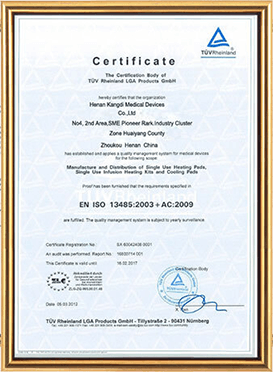
Henan Kongdy Medical Devices Co., LTD. (KONGDY) was founded in 1989 and has 37 years of production experience as of 2026 across pain relief patches, slimming patches, capsicum plasters, heat patches, cooling gel patches, detox foot patches, steam eye masks, mosquito repellent patches and nose strips. Headquartered in Henan, China, KONGDY operates a 100,000-class GMP workshop built in 2008 and obtained ISO 13485 medical device Quality Management System European Standard Certification in 2014. The company runs OEM and ODM services for international brands across multiple regulatory pathways.
For a 2026 procurement evaluation the qualification team can supply the ISO 13485 certificate, GMP workshop audit reports, stability programme documentation, and reference customer case studies upon request via our contact page.

Frequently asked questions
What are the six letters compared here?
Aidance Scientific 735346 of 1 October 2026, Medical Products Laboratories 721916 of 9 April 2026, Macau-Union 724506 of 29 May 2026, Amazon 736006 of 1 October 2026, International Medication Systems 320-26-99 of 2 July 2026, and Dabur India 320-26-105 of 24 July 2026. All six are in the public database.
Why do the intervals differ so much?
Because the route differs. The three inspection-based letters in this set run from about five and a half to about six and a half months between the end of the inspection and the letter. The two review-based letters run about two and a half to three months between the review or purchase and the letter. The sixth letter records neither, so no interval is computed for it.
What are the five failure types?
A claim failure, where the labelling makes the product an unapproved new drug. A record and release failure, where no laboratory determination was made before release. A component and supplier failure, where incoming material was not tested and certificates were relied on. A process and system failure, where the quality unit did not function across several requirements. And a stability evidence failure, where the expiry period was not supported.
Which of the six is most relevant to a patch?
Two are directly relevant and for different reasons. 736006 carries the footnote on the external analgesic monograph M017, which lists the permitted indications for the category a pain relief patch sits in. 721916 carries the stability finding, which is the requirement behind any labelled expiry period on a patch.
Does a letter always follow an inspection?
No. Two of the six letters involved no inspection at all. One arose from a review of a firm website and storefront, and the other from products purchased on a website in July 2026. Both were decided on the labelling rather than on any manufacturing observation.
How many warning letters did FDA issue in fiscal 2025?
303, against 190 in fiscal year 2024, an increase of 59 percent. The agency also shortened its issuance cycle by roughly a third, which is why a public register that looks quiet is not the same as a quiet underlying position.
Can these six be used as a frequency estimate?
No. They are six documents selected because they are in this library, not a sample of the population. What they establish is that each category exists and was used in 2026. A buyer should treat the matrix as a list of document requests rather than as a forecast.
What is the single most useful question to ask a supplier?
Whether it has received any Form FDA 483, any site inspection, or any review of its listings in the last three years, and whether it can produce the response it filed. The public register answers a narrower question than that one, and the wider question is where the earliest signal sits.
Related Guides
Five further references from the KONGDY knowledge base:
- Cooling Gel Patch OEM: warning letter 736006 and marketplace responsibility
- Capsicum Plaster OEM: substance family screen
- Frequently asked compliance questions
- KONGDY OEM and ODM manufacturing services
- Heat Patch OEM: heat output and classification


